ElectroluxRepair Miami

55 jobs · 12 appliances

What we actually do, job by job rather than by the hour.

Every page says what the work involves, what moves the figure, and what the visit is like on an Electrolux that is usually fitted into the kitchen around it. The starting figures are on the page for the job, not behind a form.

  • 55 jobs written up
  • 12 kinds of machine
  • from $95 diagnostic, credited to the repair
  • Every one is a from, never a final price

Every job we list

All 55 of them

Sorted by the appliance they belong to. Each page carries its own starting figure.

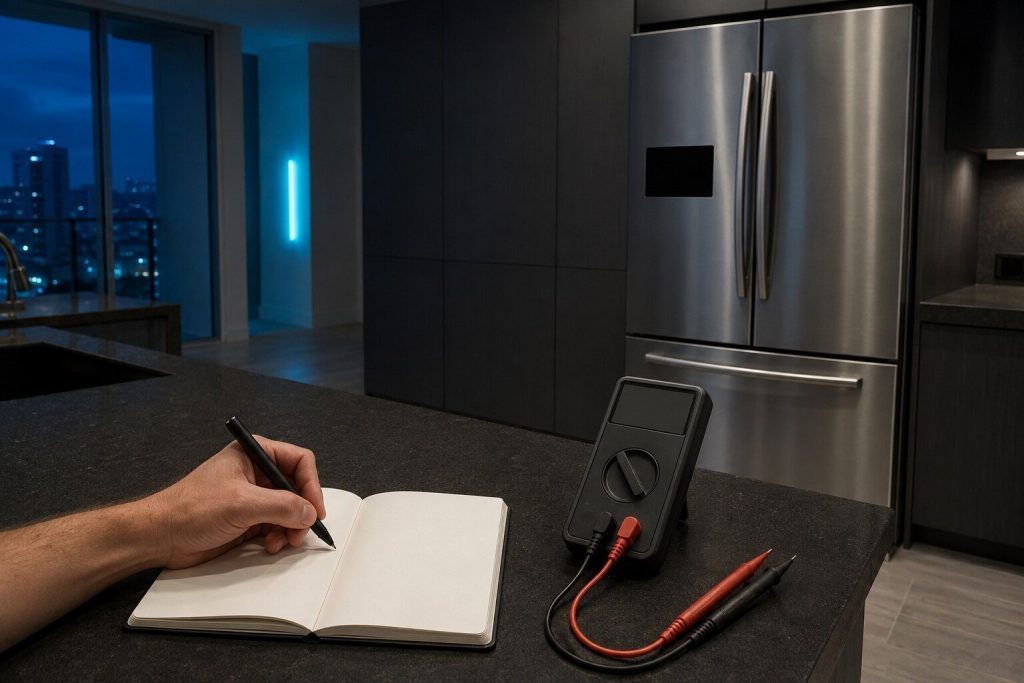
  • A multimeter and an open notebook with a pen on a counter beside an appliance whose panel is dark
    from $95

    Diagnostic visit

    Finding out what has actually gone wrong, before any part is named or priced. On this badge the opening question is usually about access rather than age: a counter-depth cabinet scribed into an opening, a column captured behind a trim kit, a wall oven sitting in a tall unit — each has to be brought far enough forward to be reached, and establishing that in advance is what separates one appointment from two. The charge is credited against the repair if you go ahead. Where our honest recommendation turns out to be that the machine is not worth mending, you still get that recommendation, and the charge does not change.

    • Access comes first — built-in equipment is most of what this badge sells
    • A written figure ahead of the work, credited against the repair
    • If mending it is the wrong call we tell you, rather than selling a part
    What this involves
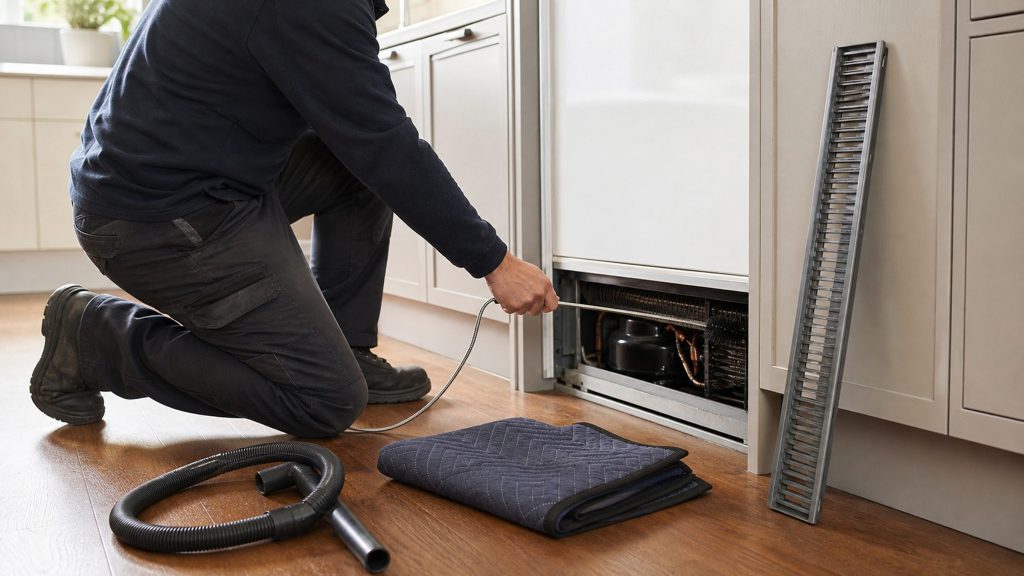
  • A long coil brush worked into a condenser behind a removed base grille
    from $149

    Appliance maintenance

    Scheduled work on the parts that fail from accumulation rather than from age: condenser coils in salt air, a dryer duct that has been narrowing for four years, a dishwasher sump, the fold in a washer door seal that never dries out in this climate. On a kitchen where the appliances were specified together it is worth doing them together — the visit costs less than the sum of its parts and it catches the one that was about to fail.

    • Coils, ducts, sumps and seals — the parts that fail from accumulation
    • Worth doing as a suite when the kitchen was specified as one
    • Finds the failure that was three months away, which is the actual value
    What this involves
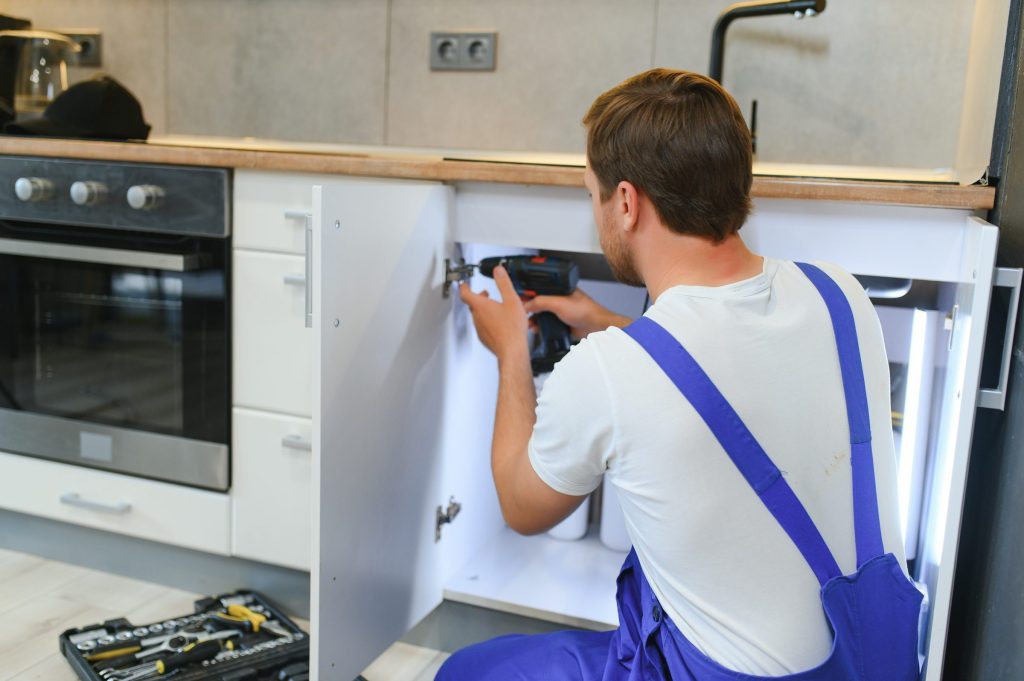
  • A technician kneeling to fit a built-in appliance into its cabinet opening, tools laid out on the floor
    from $175

    Appliance installation

    Fitting an appliance properly, which on this badge usually means fitting it into something. Columns go behind trim kits, counter-depth cabinets go into openings that were drawn for them, wall ovens and built-in microwaves go into tall units, and every one of those has a clearance and an air path that the appliance depends on. This maker sends three of its own washer codes and two of its dryer codes back to whoever installed the machine — which is a fair measure of how much installation decides here.

    • Built-in work: trim kits, openings, clearances and air paths
    • Five of this maker's published codes are installation problems, not failures
    • Supply, drain and vent checked and documented rather than assumed
    What this involves
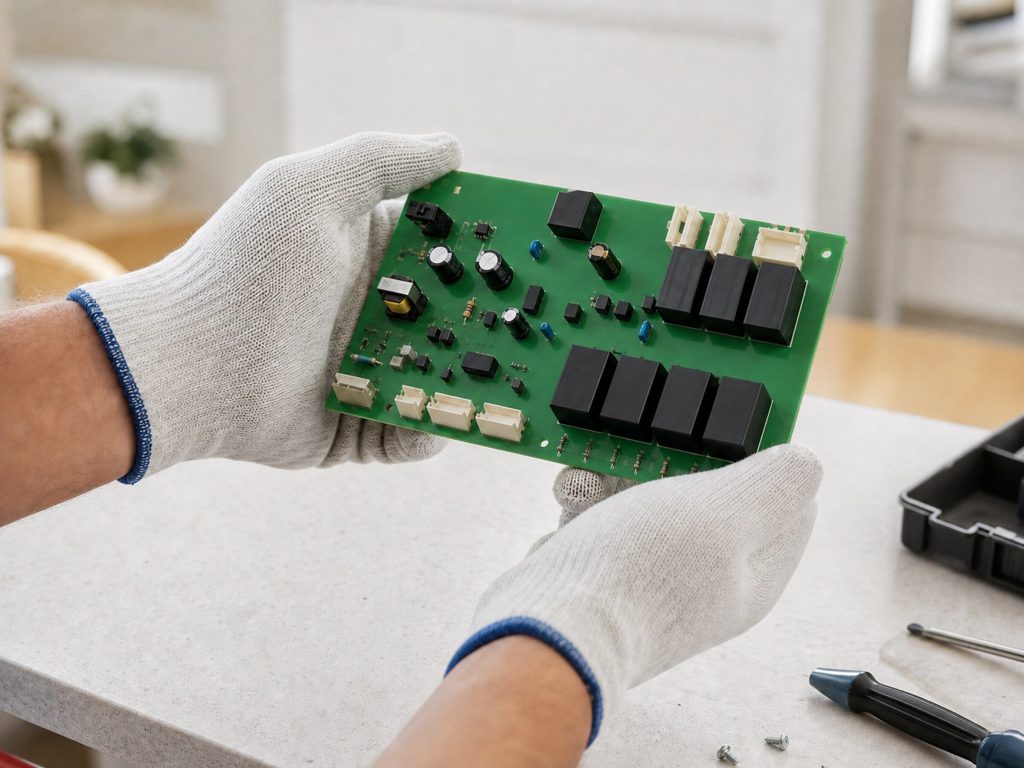
  • An appliance control board held in two gloved hands over a workbench, its relays and capacitor visible
    from $245

    Control board repair

    When the board is genuinely the answer — and it is worth saying that it often is not. A great many appliances condemned as "a board problem" have a sensor lying to a board that is working perfectly. This maker helps here more than most: F12, F13 and the F3/F20/F26 family are published as board-level conditions by name, so when one of them is on the display the diagnosis has a document behind it rather than an assumption.

    • Named board conditions — F12, F13 and the communication family
    • Most "board problems" are a sensor telling a healthy board something false
    • Connectors and harnesses checked before anything is ordered
    What this involves
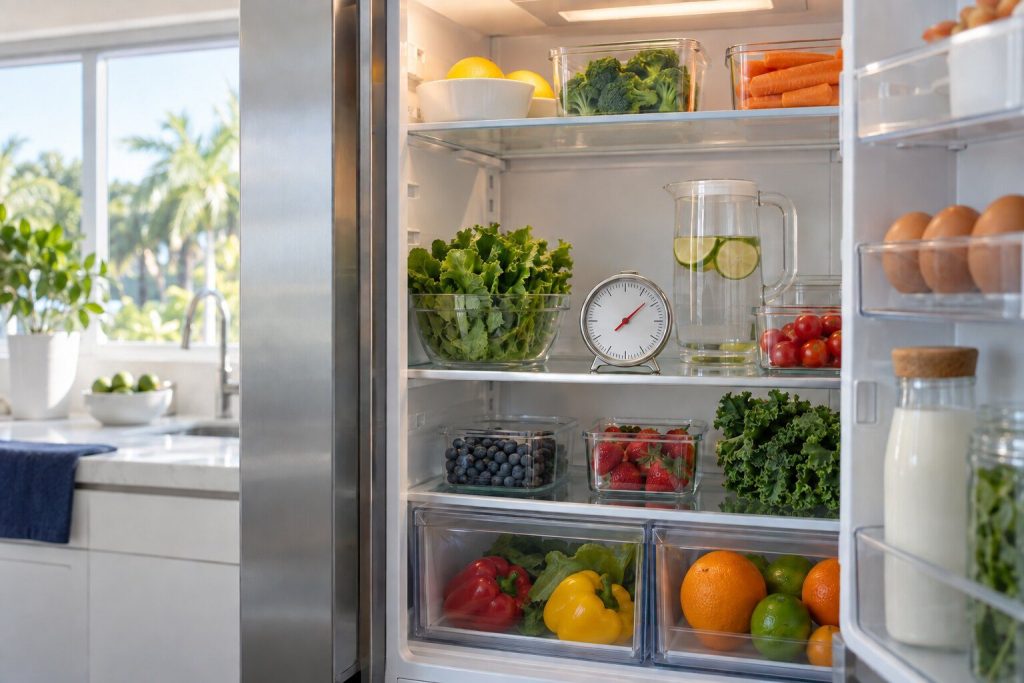
  • A dial thermometer standing on a shelf inside the open fresh-food compartment of a stainless counter-depth refrigerator, ordinary food around it, the interior light on.
    from $175

    Refrigerator not cooling repair

    The call that matters most and the one where the description decides everything. One warm compartment and one cold one points at air — defrosting, a duct, a damper, the evaporator fan. Both compartments drifting together points at the sealed system or the condenser. On a counter-depth cabinet the difference is worth establishing on the phone, because the expensive half of this visit is getting the unit out of its opening and we would rather do that once with the right part already on the van.

    • Which compartment is wrong decides where we start
    • Counter-depth cabinets cost access before they cost parts
    • Condenser and air path checked before anything is condemned
    What this involves
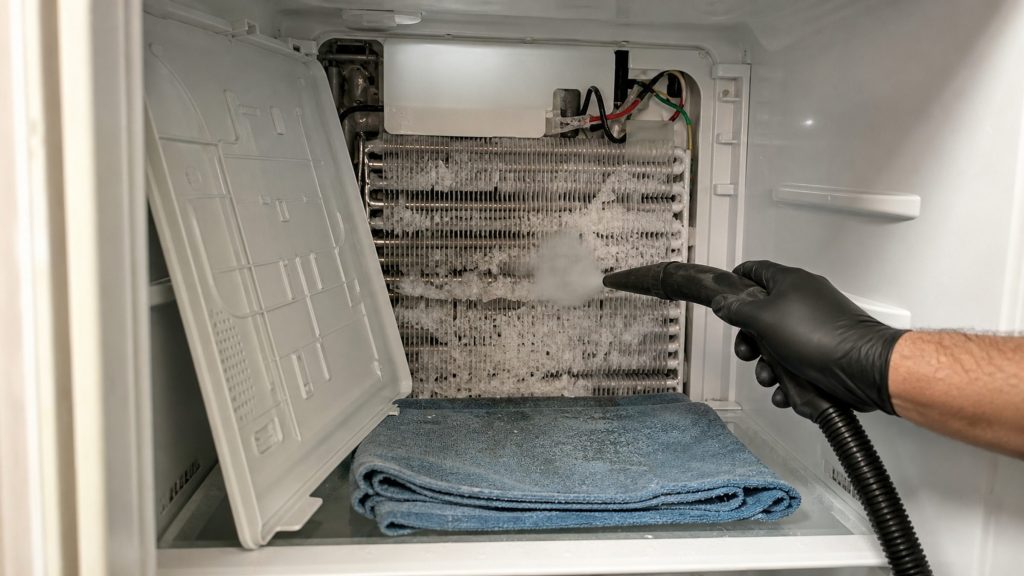
  • A freezer compartment with the rear panel off, evaporator fins packed with frost, the defrost heater exposed
    from $165

    Defrost system repair

    Frost on the shelves, an evaporator sealed into a block of ice, or a cabinet that behaves for a week after every visit and then slides again. Three parts do this job — something that heats, something that decides when, and a route for the water to leave — and on a full-height column the geometry makes it worse than on a small box. The evaporator is tall, the ice climbs from the floor of it upward, and by the time anything is noticeable on the top shelf there is a great deal of ice underneath.

    • Heater, the control deciding when to run it, and the drain out
    • On a tall column the ice climbs from below and surfaces late
    • The drain is the same system and is done in the same visit
    What this involves
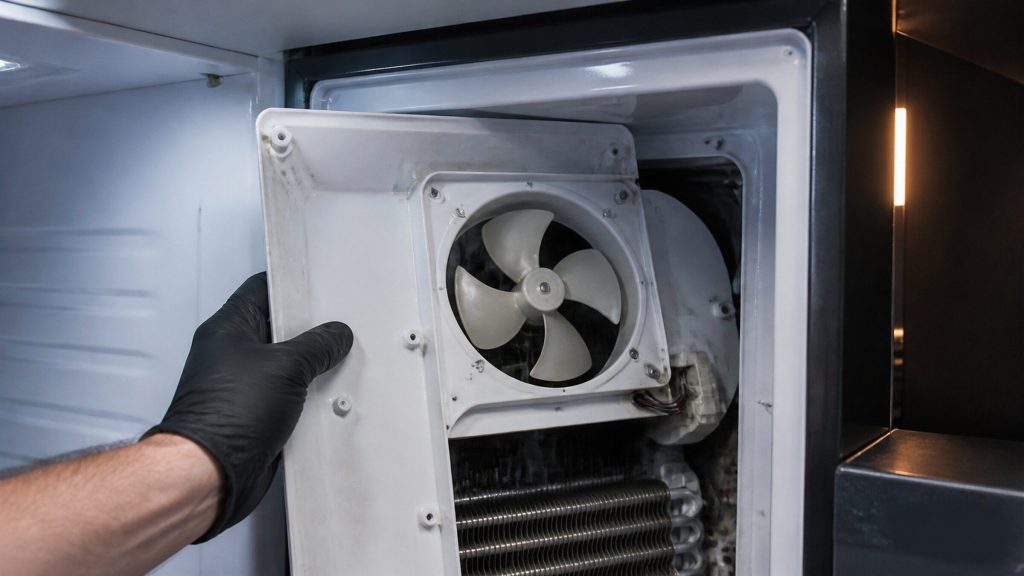
  • The rear interior panel of a freezer compartment removed to expose the evaporator fan and its housing
    from $149

    Evaporator fan repair

    Cold is manufactured in one compartment and has to be carried to the other. Let the fan doing the carrying slow, seize or stop, and the freezer stays perfectly cold while the fresh-food side climbs — which is why this single part explains most of what people report as "the freezer is fine and the fridge is not". It is also among the cheaper things that can be wrong with a cabinet of this price, which makes it worth confirming before anyone starts talking about compressors.

    • Explains most warm-fridge, cold-freezer complaints on these cabinets
    • The part is inexpensive; the cabinet it sits in is not
    • Confirm it before any conversation about a sealed system
    What this involves
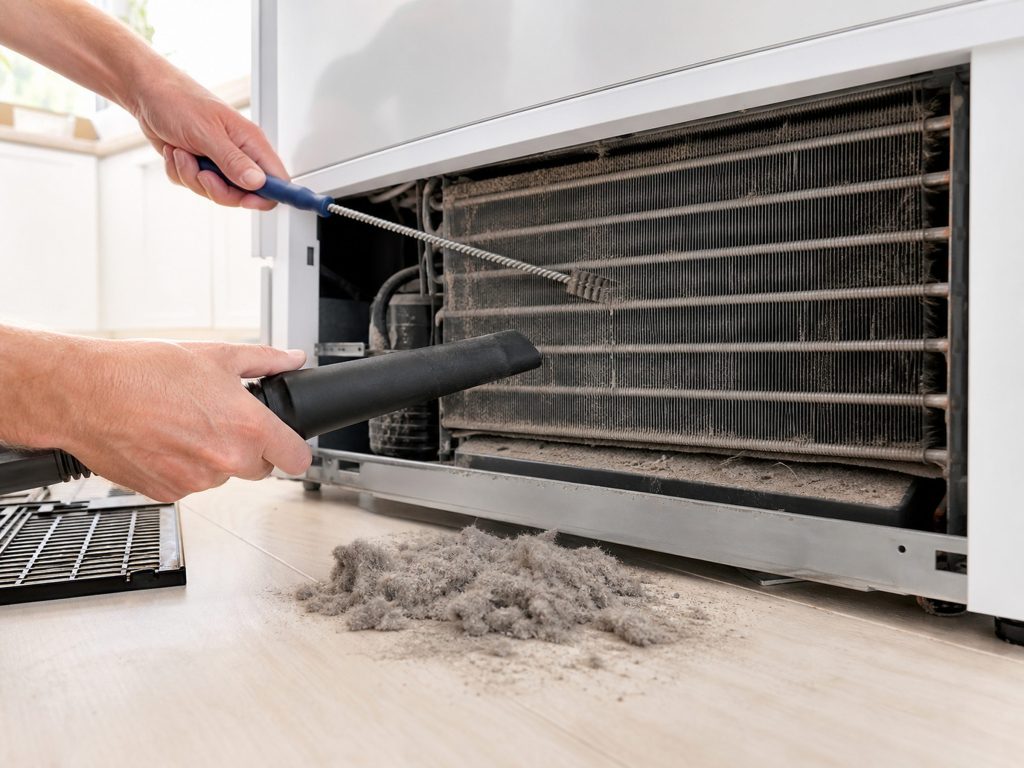
  • A vacuum nozzle and a coil brush at a dusty condenser coil behind a removed refrigerator base grille
    from $119

    Condenser cleaning

    The highest-value hour anybody spends on refrigeration in this region, and the one most reliably skipped. A condenser sheds the heat the cabinet removes, and in salt air within a few miles of the coast it silts up with a mixture nobody planned for. On a built-in column or a cabinet in a trim kit it is worse, because the air reaches the coil through a defined route that also collects. A choked condenser runs the compressor continuously and shortens the life of the most expensive part in the appliance.

    • Coastal air loads a condenser faster than any specification allows for
    • Built-in cabinets breathe through one route, and that route collects too
    • The compressor is what this protects, and it is the part worth protecting
    What this involves
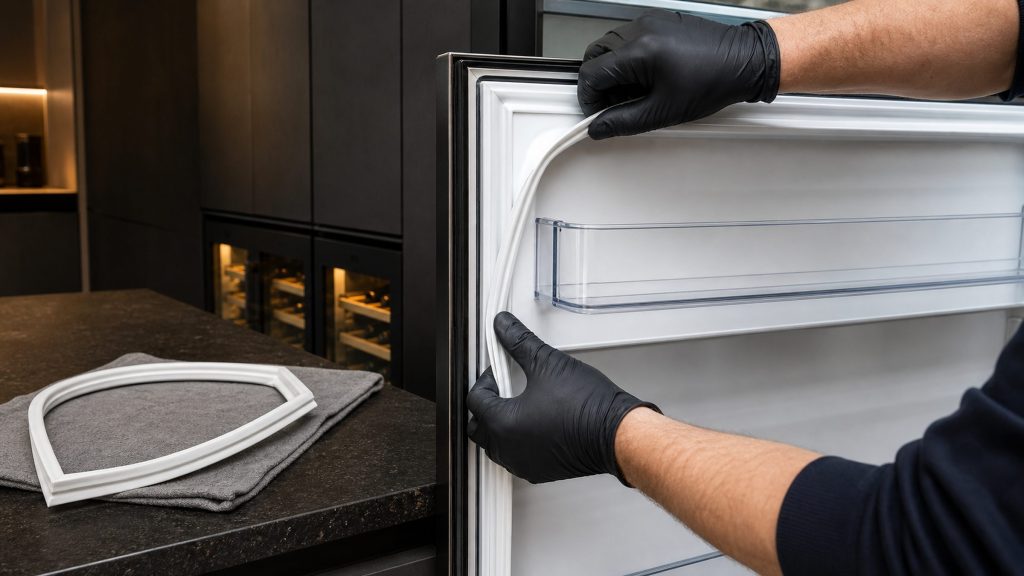
  • Hands in nitrile gloves fitting a new magnetic door gasket into the channel around a refrigerator door
    from $155

    Door seal replacement

    A seal that no longer pulls is a cabinet running continuously and losing anyway, and in this humidity it also means condensation, frost and eventually a door that is wet more often than it is dry. On this badge the doors are heavy — a 33-inch column door, often carrying a panel or a trim kit — and years of that weight take the door slightly out of square before the gasket itself is worn out. Which of the two it is decides whether this is a part or an adjustment.

    • A heavy column door goes out of square before the gasket wears out
    • Condensation and frost follow a seal that has lost its pull
    • Hinge adjustment first — it is free and it is often the answer
    What this involves
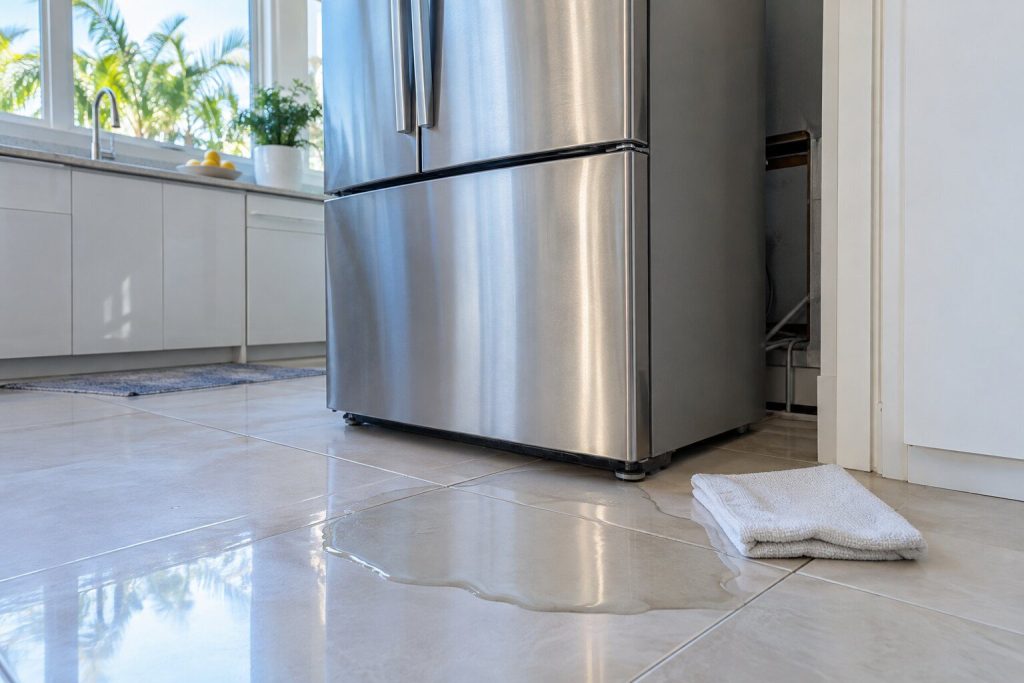
  • A shallow pool of water on a tiled floor at the foot of a stainless refrigerator that has been eased forward from its opening, a folded cloth laid beside it.
    from $145

    Refrigerator leak repair

    Water on the floor from a refrigerator has three ordinary sources and they are easy to tell apart once you know: the defrost drain, the water line to the dispenser and ice maker, or condensation from a seal that is not sealing. On a built-in cabinet the order of urgency is different from a freestanding one, because the water reaches joinery and flooring before anybody sees a puddle — which is why a slow leak in a fitted kitchen costs more than a fast one in a rental.

    • Three ordinary sources, and they are distinguishable before anybody arrives
    • In a fitted kitchen the water finds the cabinetry before it finds the floor
    • A slow leak in joinery is more expensive than a fast leak on tile
    What this involves
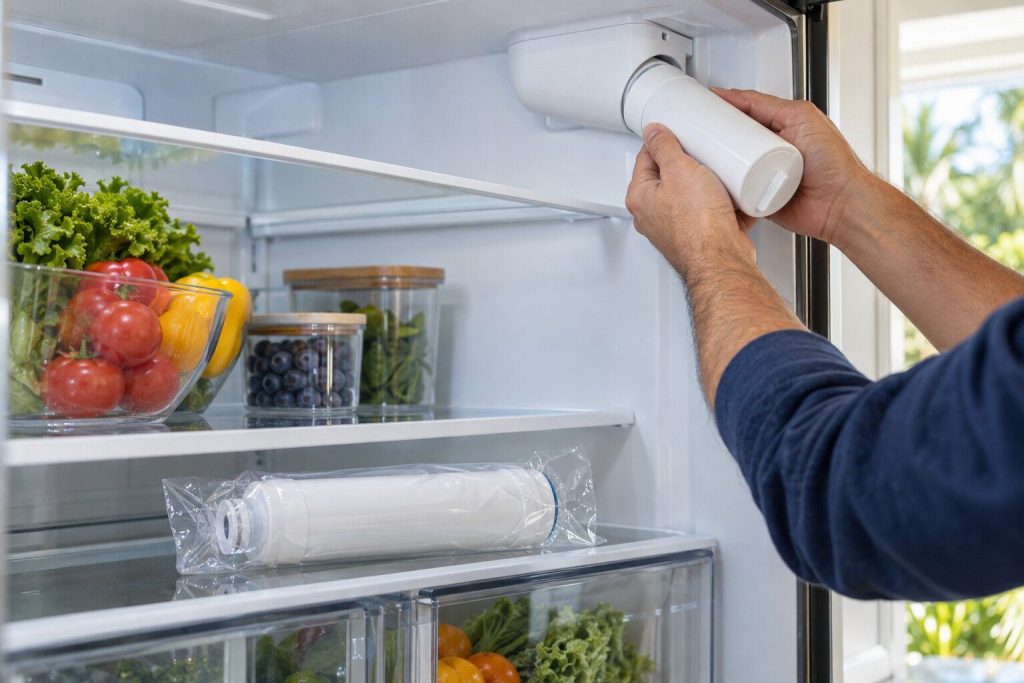
  • A cylindrical water filter cartridge being turned into its housing in the upper right of an open refrigerator compartment, a new cartridge still in its wrapper on the shelf below.
    from $129

    Water dispenser and filter service

    Slow water, no water, water that tastes of nothing good, or a filter that will not seat. Most of this is the filter and the line rather than the dispenser, and the tell is usually how the ice is behaving at the same time: hollow or undersized cubes alongside slow water means restriction upstream of both. On a built-in cabinet the shutoff is often behind the unit or under the floor, which is a reason to have somebody who can reach it do the work.

    • Slow water and hollow ice together means restriction, not two problems
    • The filter, its housing and the line before the dispenser itself
    • On a built-in cabinet the shutoff is not where a homeowner can reach it
    What this involves
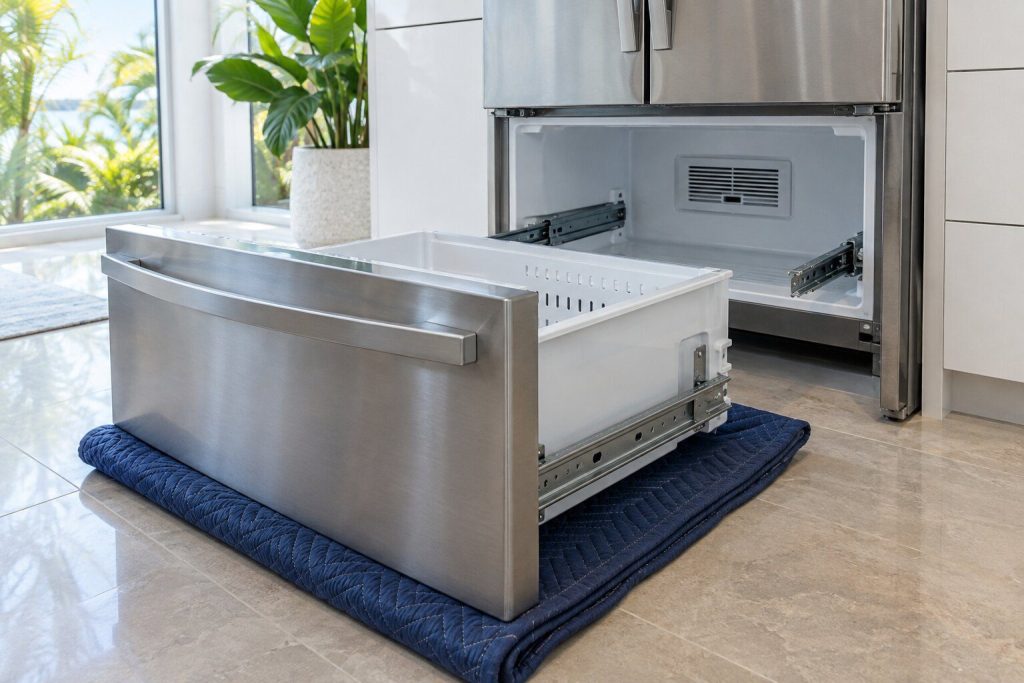
  • A convertible refrigerator drawer drawn fully out on its runners and resting on a folded blanket on the floor, the empty bay above it showing the damper vent at the back.
    from $165

    Convertible drawer repair

    The drawer this maker calls TempAdapt runs from −6 °F to 45 °F, which is a span no ordinary compartment attempts, and it does it with its own air path, its own damper and its own sensor. That independence is the useful part of the diagnosis: the drawer can fail while the rest of the cabinet is faultless, and that is an ordinary outcome rather than a contradiction. It is also one of the features people specified the cabinet for, so it is worth repairing rather than working around.

    • A −6 °F to 45 °F span on its own damper and its own sensor
    • It fails independently of the cabinet, and that is normal rather than odd
    • One of the reasons the cabinet was chosen — worth fixing properly
    What this involves
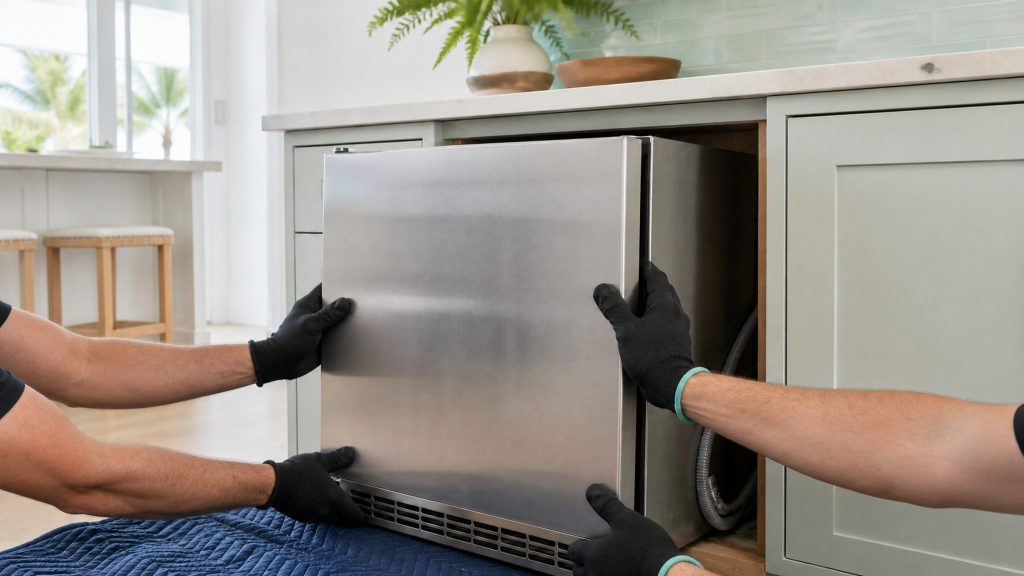
  • Two pairs of gloved hands easing a built-under cabinet forward out of its opening under a stone counter
    from $185

    Built-in and column access

    Not a repair in itself — the work that has to happen before one. Columns sit behind trim kits, counter-depth cabinets are scribed into openings, and under-counter units are captured by the countertop above them. Getting any of those out far enough to reach the back is genuine work, sometimes two people, and occasionally it means removing trim that was fitted by a joiner. We price it separately so you can see it rather than finding it inside a repair bill.

    • Trim kits, scribed openings and captured under-counter units
    • Priced separately so the access is visible rather than buried in a part
    • Sometimes a two-person job, and we say so when we book it
    What this involves
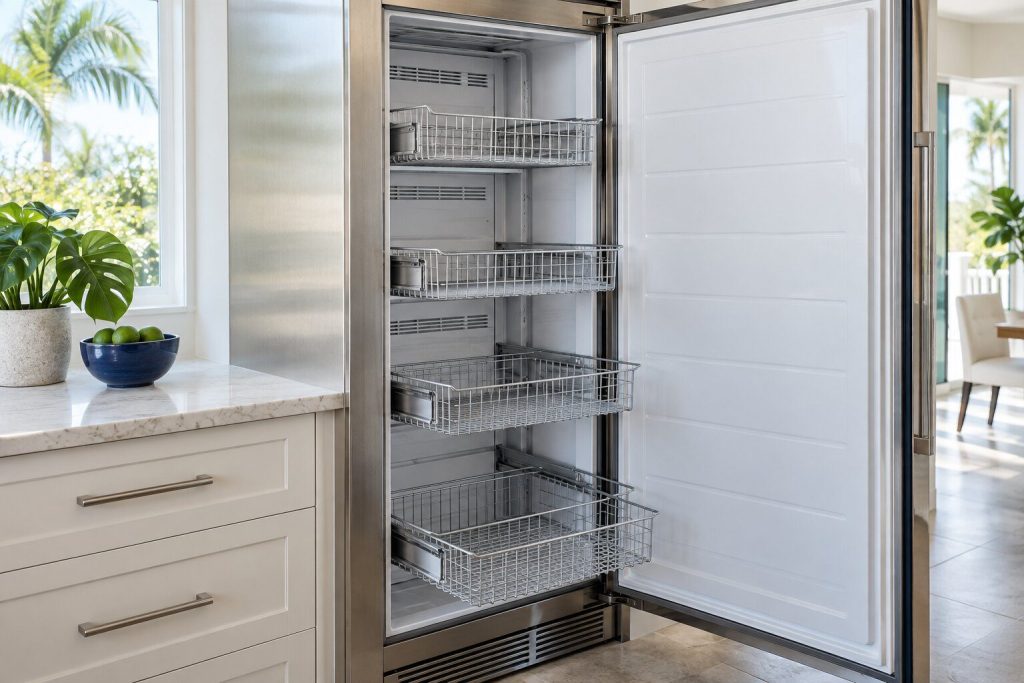
  • The inside of a tall all-freezer column with its door open and its wire baskets drawn out, the rear panel visible behind them, no frost.
    from $175

    Freezer column repair

    The only freezer this badge builds is a 19 cubic foot, 33-inch column made to stand beside its refrigerator twin behind matching trim. Everything written about freezer repair for a chest in a garage is the wrong advice here. The failures are a tall evaporator icing from the bottom, a heavy door losing its seal, and — because the cabinet is captured in joinery — an air path that silted up years ago and has been quietly shortening the compressor's life.

    • A 19 cu. ft. column, not a chest and not a garage upright
    • A tall evaporator ices from the bottom, so symptoms arrive late
    • The air path through the trim is part of the diagnosis
    What this involves
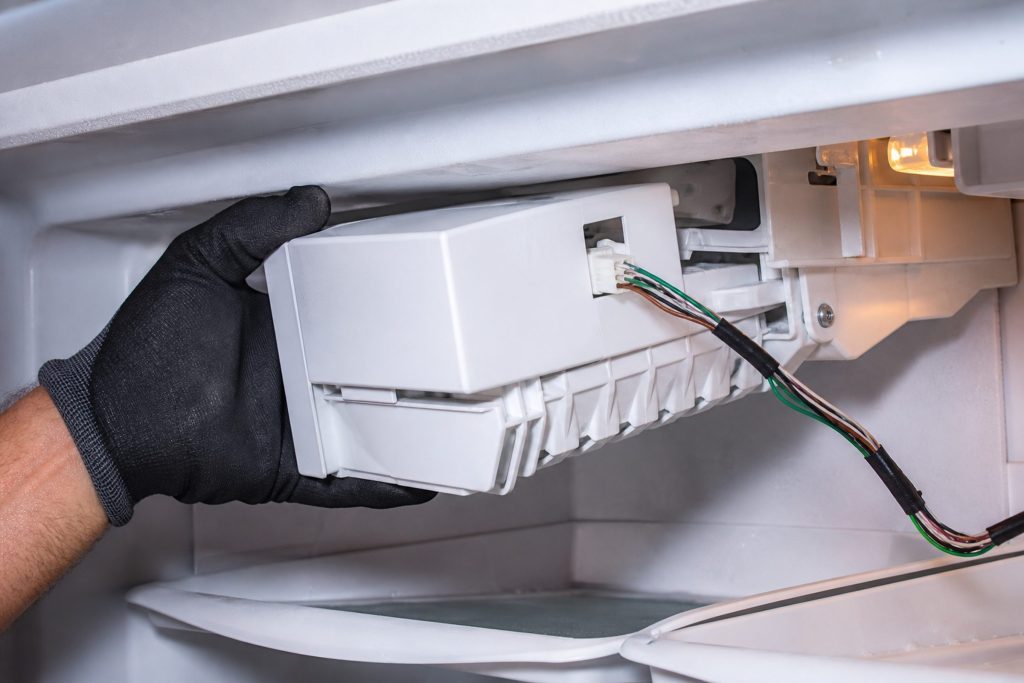
  • Gloved hands drawing an ice maker module out of a freezer compartment with its wiring loom still attached
    from $155

    Ice maker repair

    This maker sells no standalone ice maker today, so what we repair is the module inside the French-door cabinets and the 15-inch under-counter unit from the built-in range that preceded the current line. Both are proper appliances with parts behind them. The commonest calls are no ice at all, ice that arrives hollow or small, and a bin that has bonded into one mass after a week away — which in a region with summer outages is a seasonal rather than an occasional problem.

    • The in-cabinet module and the older 15-inch under-counter unit
    • Hollow or undersized cubes are water supply, not the ice maker
    • A bin that stood still through an outage is the region's own failure
    What this involves
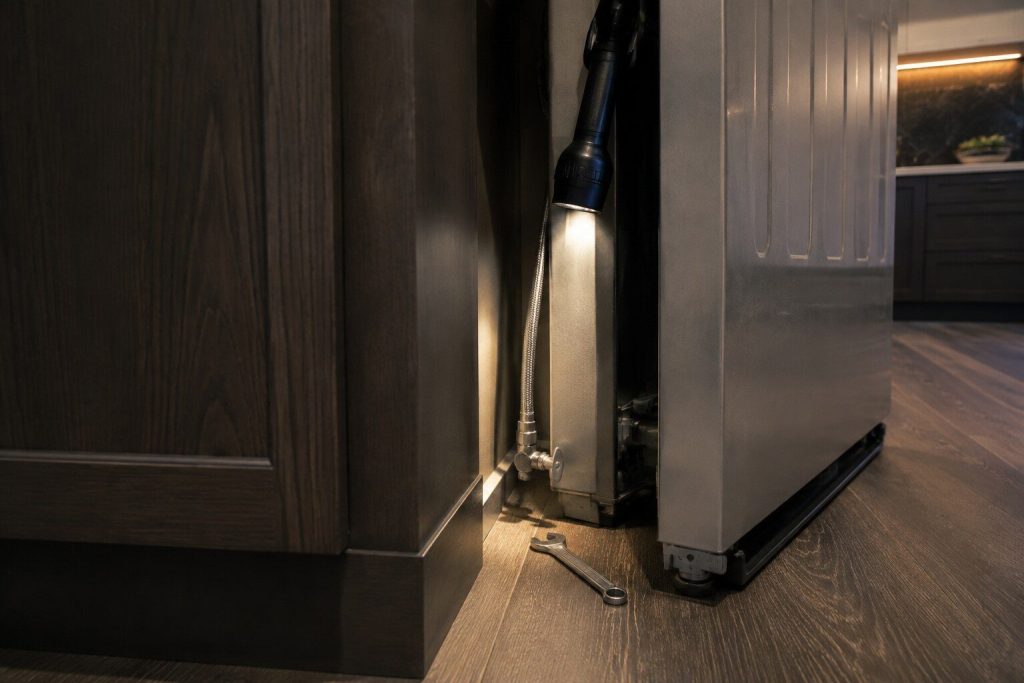
  • The braided water line and its small shut-off valve in the narrow gap behind a built-in refrigerator
    from $135

    Ice maker water line and valve

    Most ice complaints are water complaints. The line from the wall, the shutoff somebody installed behind a cabinet fifteen years ago, the filter, and the fill valve on the appliance are one chain, and a restriction anywhere in it produces the same symptoms. On a built-in cabinet the awkward part is that half of that chain is behind joinery, which is why this is priced as its own job rather than as an add-on to an ice maker repair.

    • Line, shutoff, filter and fill valve are one chain
    • Half the chain is behind joinery on a built-in cabinet
    • A restriction anywhere in it produces identical symptoms
    What this involves
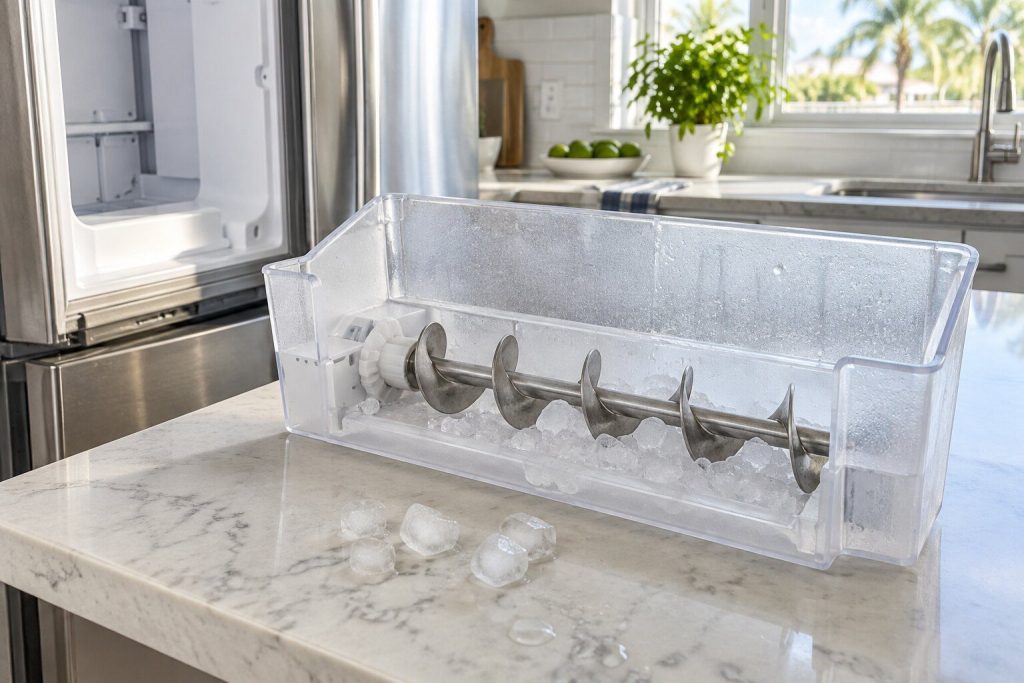
  • An ice bin lifted out of a freezer door and set on a counter, the spiral auger visible along its floor and a few loose cubes beside it.
    from $145

    Ice dispenser and auger repair

    Ice in the bin and nothing at the door. The mechanism is a motor, an auger, a chute and a flap that has to close so the cabinet does not lose cold air through it, and this maker has an error code of its own — DI SP — for a cube jammed in that chute. The useful distinction is audible: an auger that will not turn is silent or grinding, while a flap that will not open lets you hear the motor run with nothing arriving.

    • DI SP is this maker's own code for a jam in the chute
    • A silent auger and a running motor are two different repairs
    • A flap that will not close costs cold air continuously
    What this involves
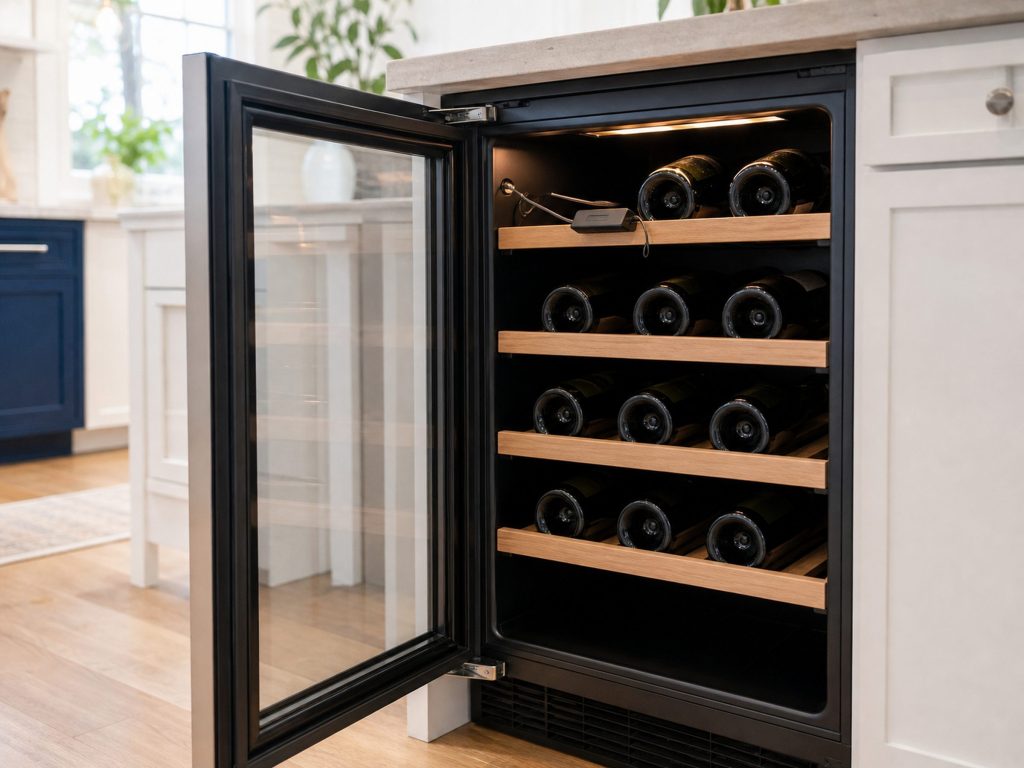
  • A glass-fronted under-counter wine cabinet with the door open and a thermometer among the bottles
    from $175

    Wine cooler not cooling

    Two cabinets carry this badge — a 24-inch wine cooler and a 24-inch beverage center — and each is a modest compressor working behind glass in a room that never really cools. Drifting through the hot part of the day and catching up again overnight points at how the unit was fitted far more often than at the unit itself: set flush with nothing behind it and no grille in front, a cabinet simply re-breathes its own warm exhaust. That gets examined before any component is condemned.

    • Two under-counter cabinets, both glass-doored and both small-compressor
    • Afternoon drift with overnight recovery usually means the installation
    • The condenser and clearance are checked before any part is quoted
    What this involves
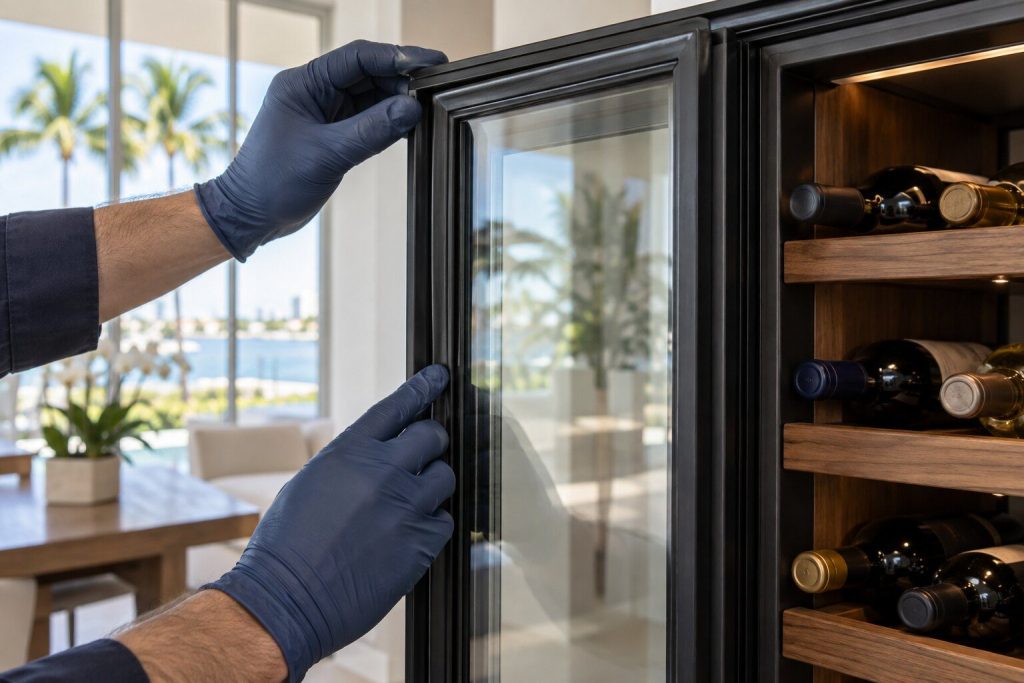
  • Gloved fingers running along the black perimeter gasket of an open glass wine-cabinet door, bottles on walnut shelves behind.
    from $139

    Wine cooler door and seal

    Glass doors are the whole thermal problem of these cabinets in one part, and they are also where the ordinary complaints come from: misting on the inside, a door that no longer pulls shut, a hinge that has taken the weight of a glass panel for eight years. Constant condensation is rarely the glass — it is a seal that has lost its pull, a rack loaded so full the door never quite closes, or a setpoint below anything the wine asks for.

    • Misting is usually the seal or the loading, not the glass
    • A glass door is heavy and its hinges take that weight continuously
    • Setpoint is worth checking before any part is ordered
    What this involves
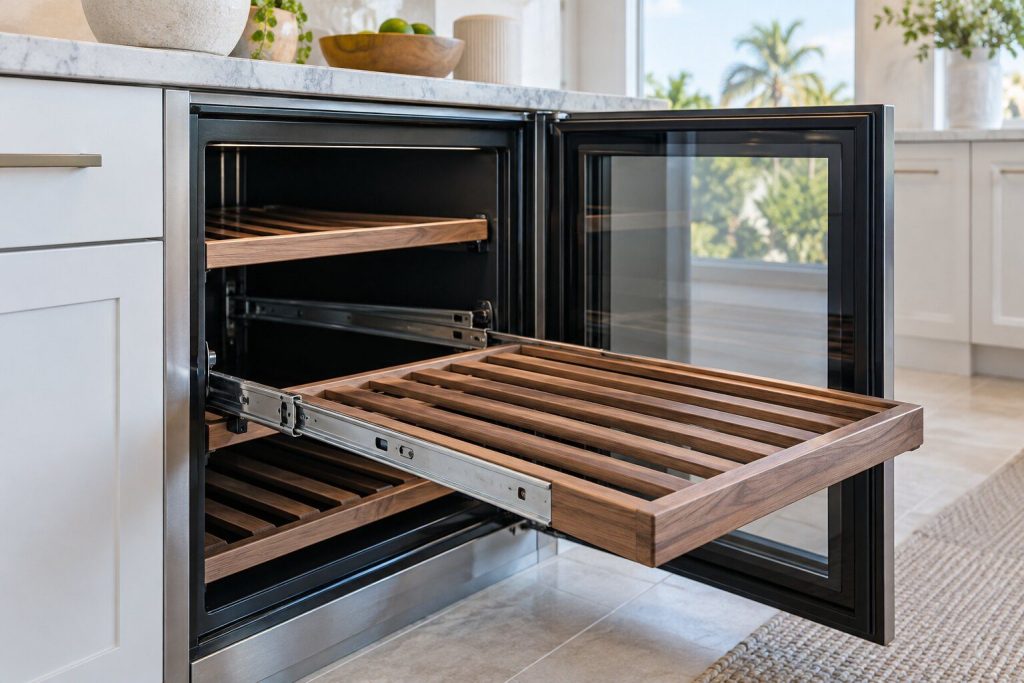
  • A wide walnut-slat shelf drawn fully out of an under-counter wine cabinet and the empty metal runners behind it.
    from $109

    Wine cooler shelving service

    The wide walnut-slat shelving is the reason people chose this cabinet over a cheaper one, and it is a serviceable part rather than something to live with. Shelves that bind, runners that have gone out of square under years of front-loading, a slat that has split — all of them are fixable, and none of them is worth a separate call-out on their own. Mention it when you book something else and it is usually done in the same visit.

    • Walnut-slat shelving is a serviceable part, not a fixed fitting
    • Binding is normally the runner rather than the shelf
    • Worth adding to another visit rather than calling out separately
    What this involves
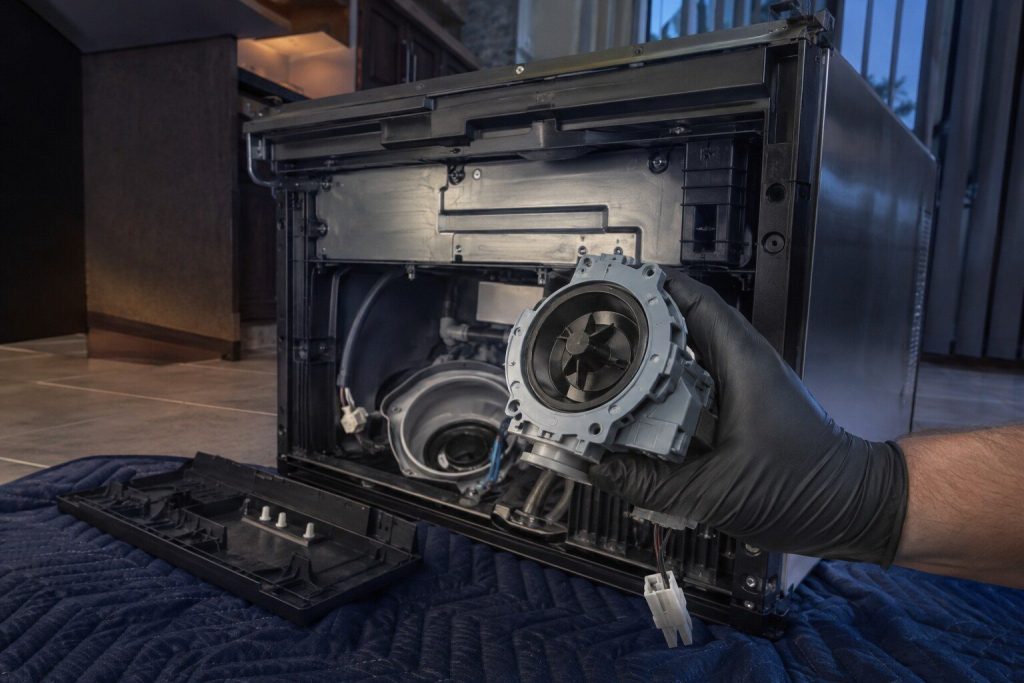
  • A dishwasher on its back with the base cover off and the drain pump lifted clear of the sump
    from $155

    Dishwasher drain and pump repair

    Standing water in the bottom, or a cycle that ends with the load still wet and dirty. This maker publishes one code for it — i40, a clogged filter or sump — and the honest thing to say is that a real share of these calls end at the filter and the glass trap, both of which lift out by hand. When water still stands with the filter removed, the problem is past the filter: the pump, the impeller, the drain hose or the air gap.

    • i40 is the maker's own code and it points at the filter first
    • Water standing with the filter out is what makes this a repair
    • One platform behind both models, so the parts are predictable
    What this involves
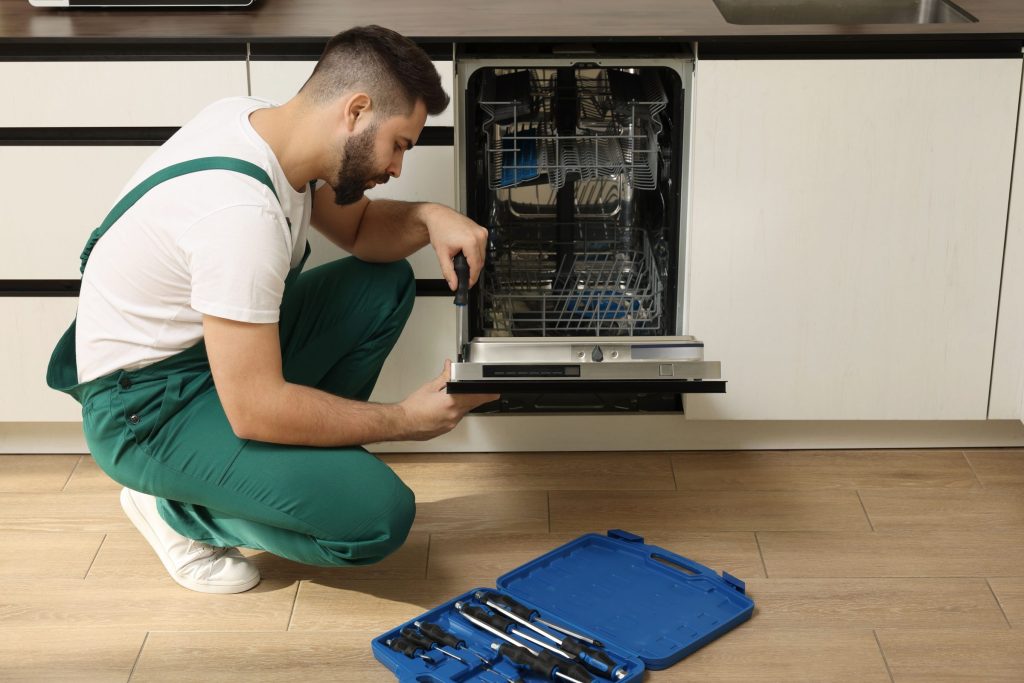
  • A technician kneeling at an open built-in dishwasher with a tool case on the kitchen floor
    from $149

    Dishwasher leak repair

    Water at the front of the machine, under the cabinet, or showing up as a swollen kick board some weeks after it started. A dishwasher is built into a run and leaks travel where the floor slopes, so what you see is rarely where the water is coming from. The ordinary sources are the door gasket, the sump seal, a hose connection and — more often than people expect — detergent foaming over from the wrong product or an overloaded lower rack.

    • What you see is rarely where the water starts in a fitted run
    • Door seal, sump seal, hose connections, and foam over the door
    • A swollen kick board means it has been running for a while
    What this involves
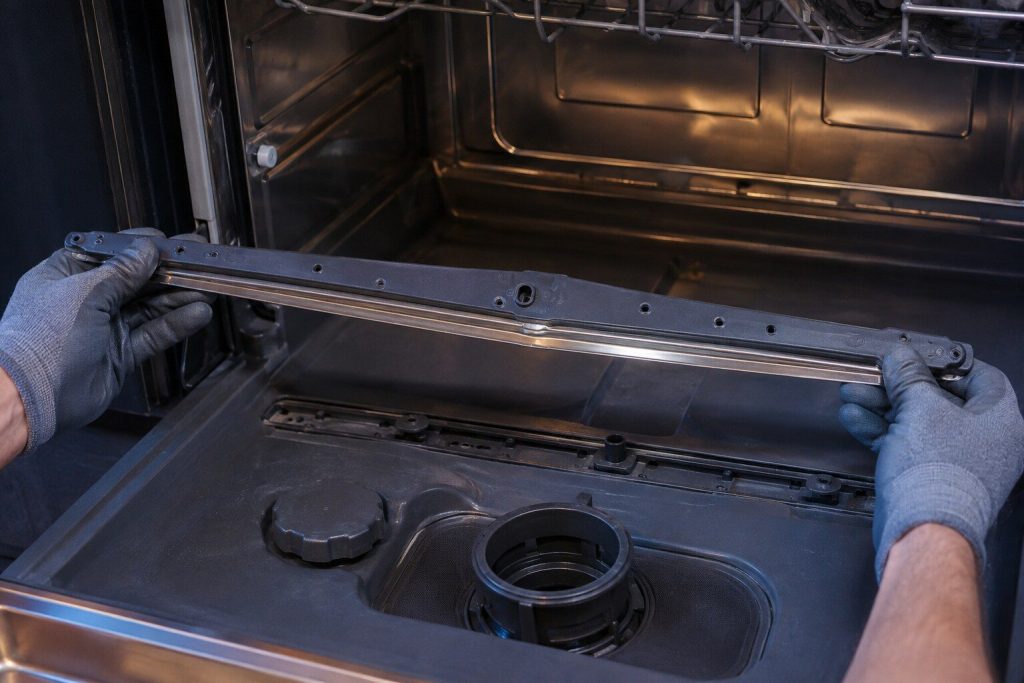
  • A flat wash bar lifted out of the floor of a dishwasher tub on two gloved hands
    from $129

    Dishwasher wash performance

    Dishes coming out gritty, filmed or still wearing what went in. On these machines the feature that does most of the work is SmartBoost — it premixes detergent with water before the first spray — and when it stops, what people notice is not an error but poor results on the short cycles, which they blame on the detergent for months. Beyond that it is spray arms, the filter, water temperature and, in this county, scale.

    • SmartBoost failing shows up as poor short cycles, not as an error
    • Spray arms, filter, inlet temperature and hard-water scale
    • Most of this is serviceable rather than a part
    What this involves
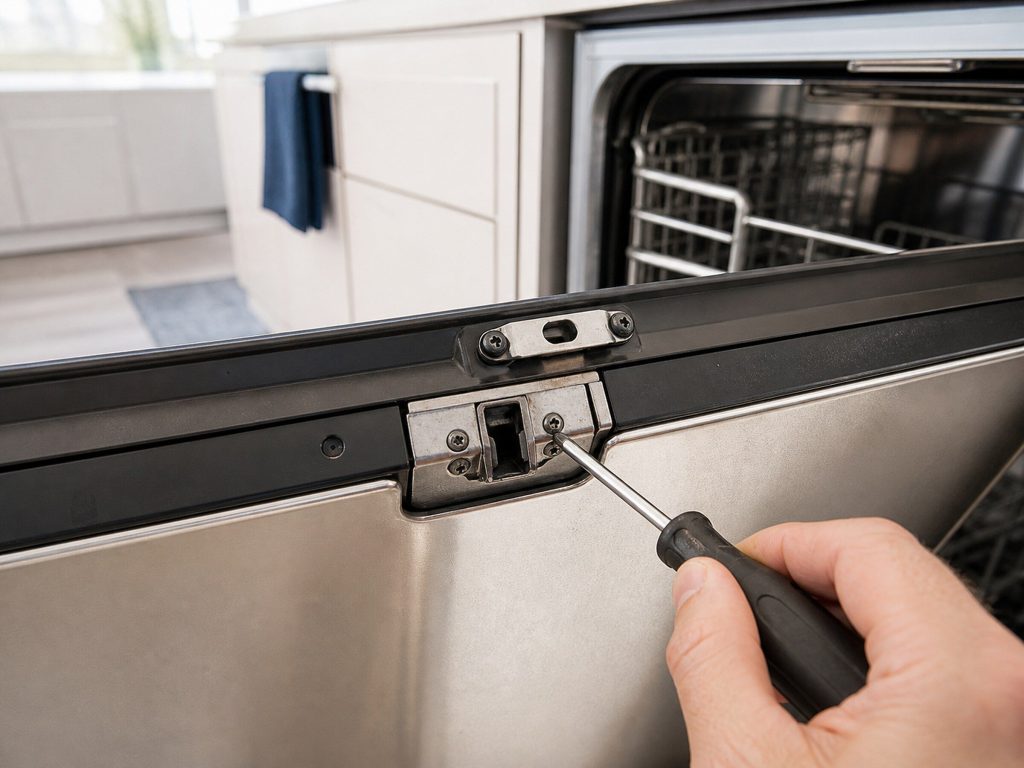
  • The latch and strike at the top of an open dishwasher door with a screwdriver resting against it
    from $125

    Dishwasher door and latch repair

    A machine that will not start, or one that starts and stops part-way. The latch has to close a switch before the control will run anything, so a door that feels shut and is not is a no-start with no other symptom. The other half of this job is the springs and cables that carry the door — when one breaks the door drops open under its own weight, which is both a nuisance and, in a kitchen with a tiled floor, a way to break the door.

    • The latch closes a switch, and no switch means no cycle
    • Door springs and cables carry the weight and they break singly
    • A dropping door is worth fixing before it damages itself
    What this involves
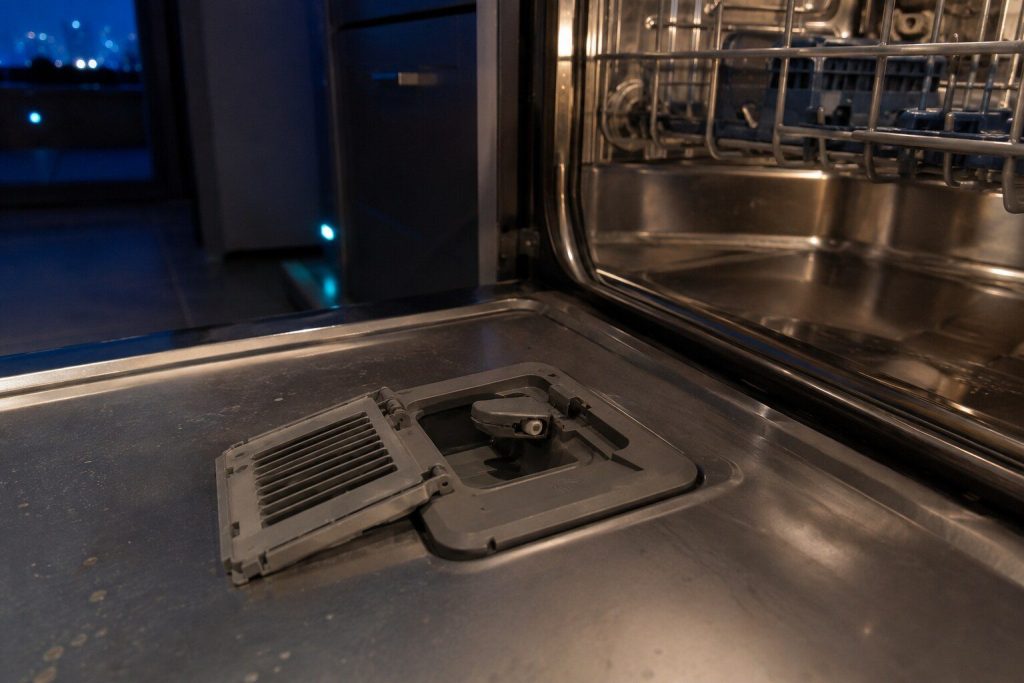
  • The drying vent in the inner face of an open dishwasher door with its cover unclipped and lifted aside
    from $145

    Dishwasher drying and heat repair

    Plastics coming out wet is normal on these machines and worth saying plainly — they dry with residual heat rather than a blast of hot air, so glass and china dry and plastic does not. What is not normal is everything coming out wet, or the machine sitting on Hd for half an hour and then washing cold. The maker publishes the arithmetic for that delay: one to two minutes for each single degree the water has to rise.

    • Wet plastics are the design, not a failure — we will say so
    • Everything wet, or a permanent Hd, is the heater or its control
    • Running the tap hot first removes most of the delay
    What this involves
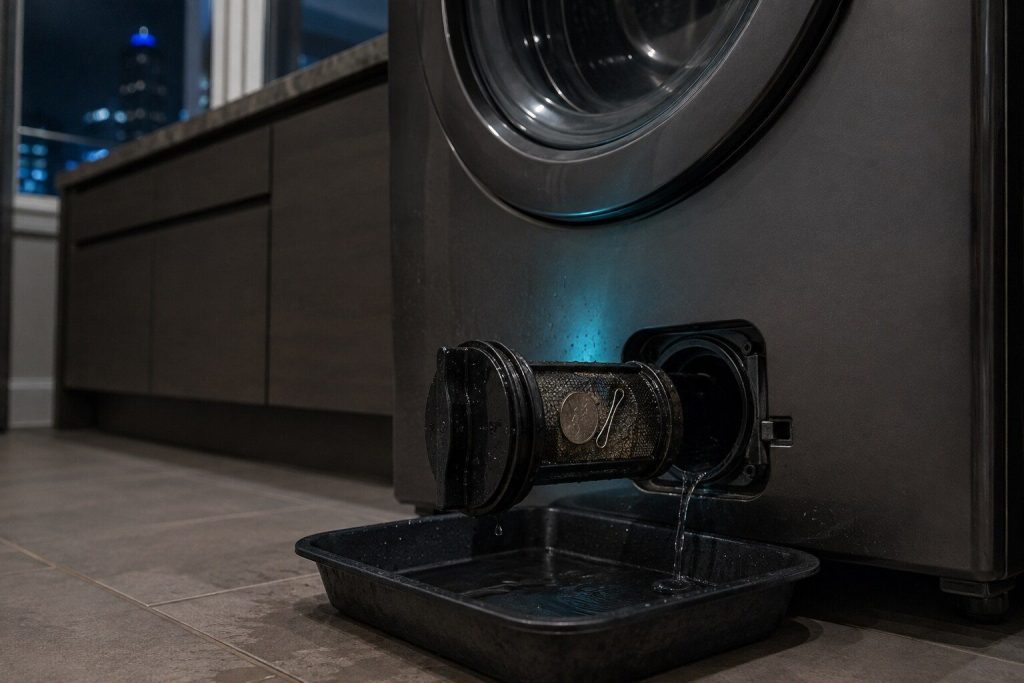
  • A drain pump filter unscrewed out of the bottom front of a washer over a shallow tray, a coin caught in it
    from $155

    Washer drain pump replacement

    The machine fills, washes and then stops with water in the drum, or shows E21 for a pump-out taking too long. This maker's own first answer is not a part: a kinked drain hose, and in a laundry closet where the machine has been pushed back to let the door close, the machine has folded its own hose. After that it is the pump filter — which on a household washing beach towels collects sand as reliably as lint — and only then the pump itself.

    • E21 is the maker's code, and its first answer is a kinked hose
    • The pump filter collects sand here, not only lint
    • A silent pump and a straining one are different parts
    What this involves
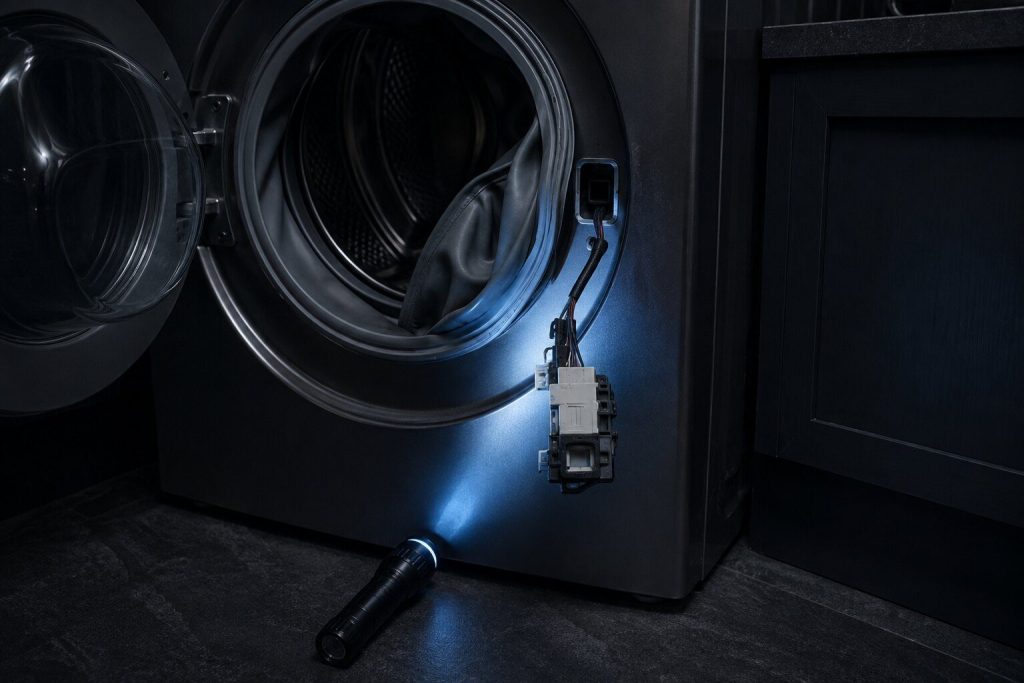
  • The door lock unit of a front-load washer drawn out of its cutout and hanging on its wiring loom
    from $139

    Washer door lock repair

    Two codes on this maker cover a door that the machine will not accept: E41, where the control thinks the switch is open, and E42, where the lock will not confirm it engaged. They look identical from outside and they are different parts. On a front loader the lock is not a convenience — it is what stands between a turning drum and the room — so the machine will not proceed without it, and it should not.

    • E41 is the switch; E42 is the lock. Same symptom, different parts
    • A towel corner in the seal is the most common cause of both
    • This is not a lock to defeat, and we will not defeat it
    What this involves
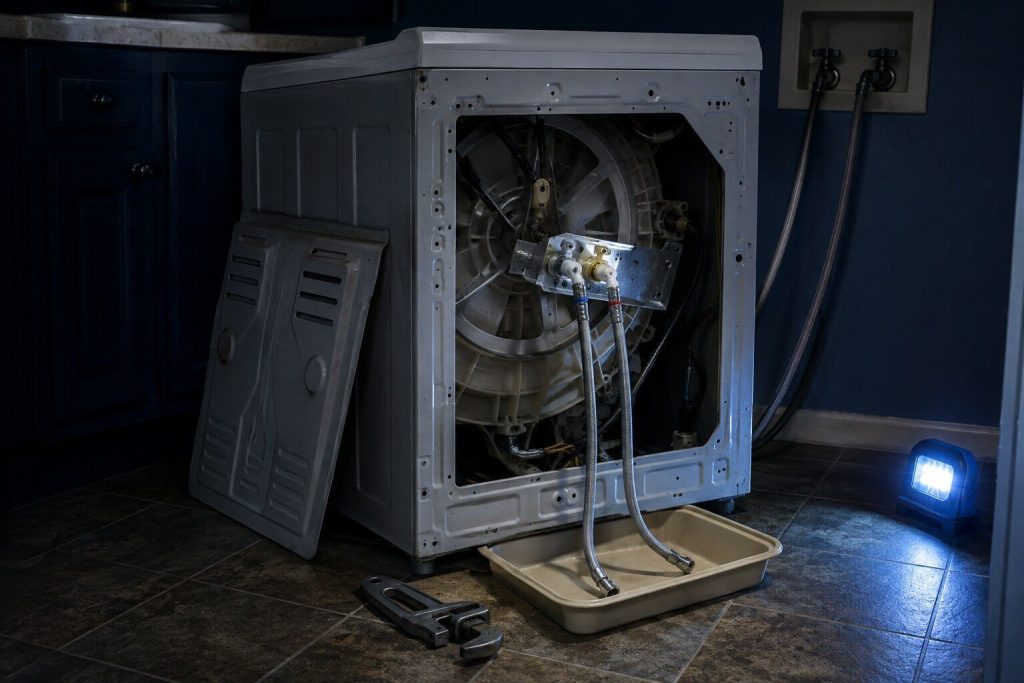
  • A washer pulled out with its upper rear panel off, the inlet valve on its bracket with both braided hoses
    from $139

    Washer inlet valve repair

    A washer that will not fill, fills slowly, or keeps filling when nothing asked it to. This maker publishes three codes across that ground — E11 for a long fill, E35 for the pressure sensor reporting overfill, and HO SE where the machine has worked out for itself that the hoses are crossed. Two of the three are installation problems, and if the machine was fitted or moved in the last month the fix is very likely free and not ours to charge for.

    • E11, E35 and HO SE — and two of the three are installation problems
    • Crossed supply hoses fill the machine badly for years without failing
    • Water arriving with the machine off is a shut-the-tap-now situation
    What this involves
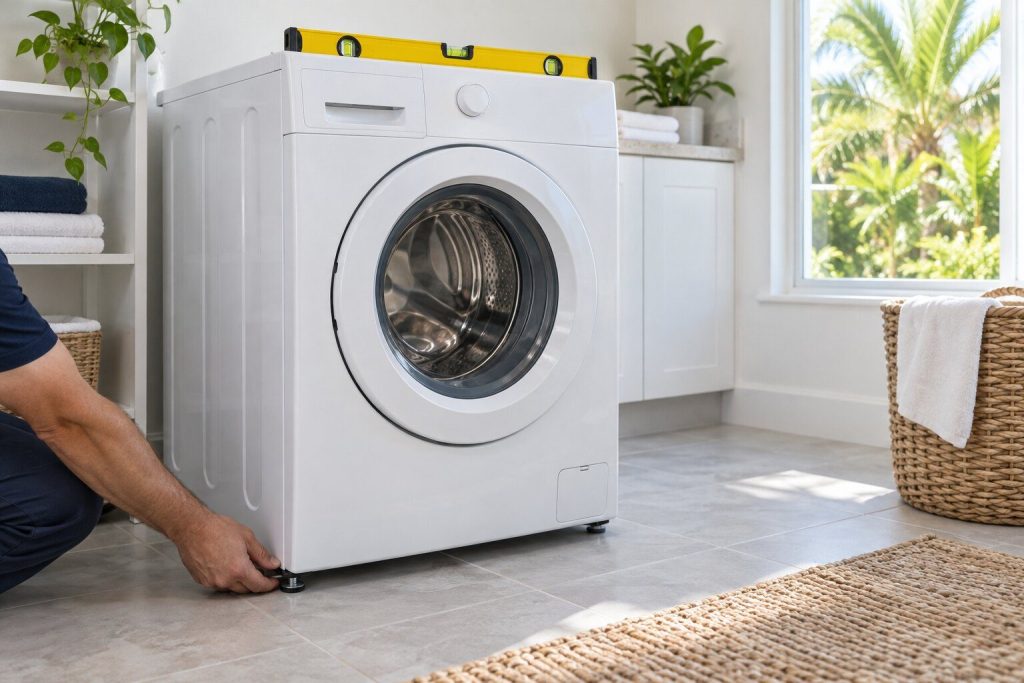
  • A spirit level laid across the top of a front-load washing machine and a hand adjusting one of its leveling feet at floor height.
    from $165

    Washer spin and balance repair

    Clothes coming out soaked, a machine that walks across the floor, or a spin that starts and aborts. On a front loader the machine will refuse to spin an unbalanced load rather than wreck itself, so a machine that spins small loads and not large ones is behaving correctly and telling you something about its suspension. In a second-floor condominium this is also the complaint the neighbors make first.

    • Refusing to spin an unbalanced load is correct behaviour, not a failure
    • Spins small loads but not large ones points at the suspension
    • On an upper floor the neighbors notice this before the owner does
    What this involves
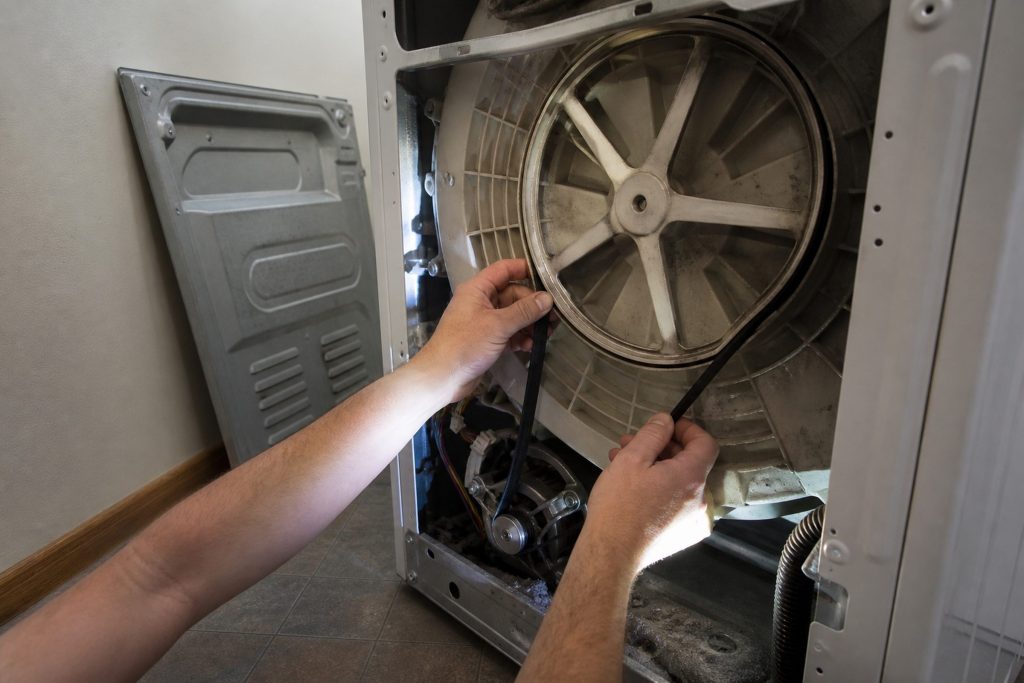
  • The rear panel of a washing machine removed and the drive belt looped around the motor pulley
    from $245

    Washer motor and drive repair

    A drum that crawls, turns one way only, refuses to turn, or makes a noise that tracks its speed. A belt around the drum takes the drive from the motor here, and the two failures separate neatly: once a belt stretches or jumps off you hear the motor working while nothing moves, whereas a motor or control problem leaves total silence. Worth settling before a figure is quoted, because those two answers sit a long way apart on price.

    • Motor working while the drum stands still means the belt, not the motor
    • Noise that changes with speed is mechanical, not electronic
    • The cost range here is wide and worth establishing before the work
    What this involves
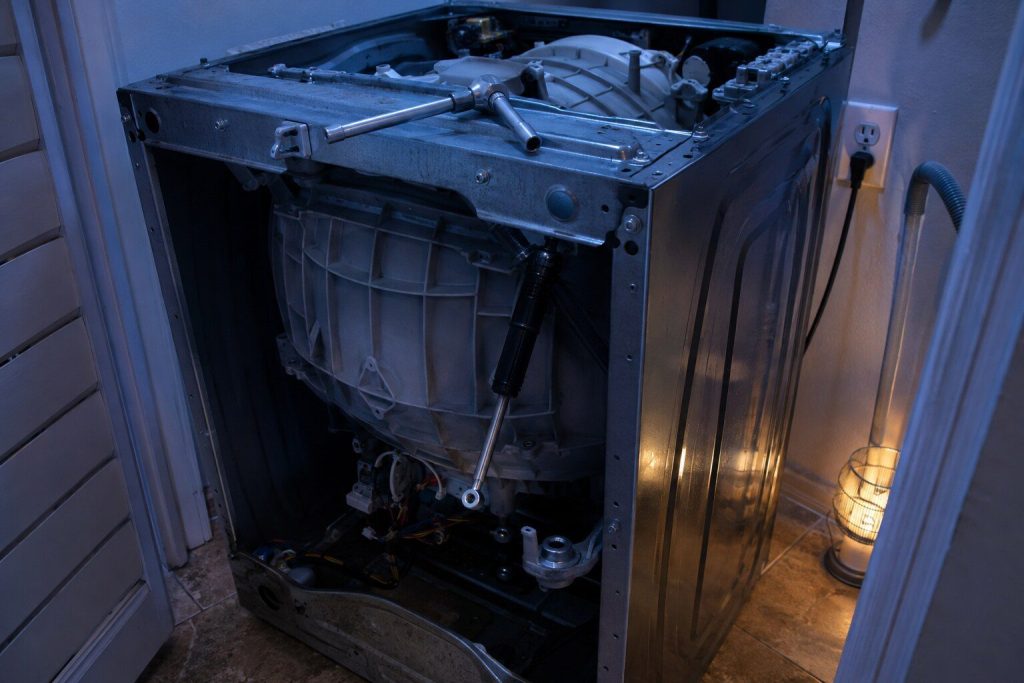
  • A washer with its top and front off and one suspension rod unbolted at the lower mount and swung clear
    from $275

    Washer suspension and bearing repair

    A roar on spin that rises with speed, a drum that moves more than it should when you push it, or rust-colored water appearing where there was none. Bearings are the repair on a front loader where we are most likely to advise against it, and we would rather say that before the work than halfway through. On a 700 Series machine in a building laundry it is usually worth doing; on an eight-year-old compact it usually is not.

    • The repair we most often advise against, and we say so before starting
    • A roar that rises with spin speed is the diagnostic, not the noise itself
    • Worth it on a large machine, rarely worth it on an aged compact
    What this involves
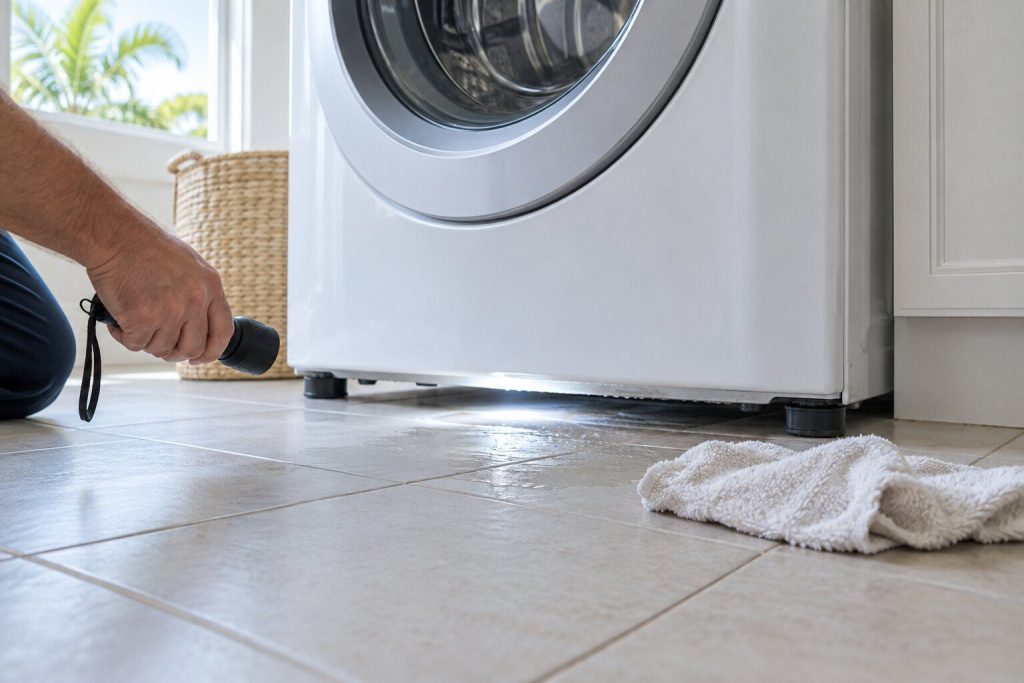
  • A torch beam on a wet patch under the front edge of a front-load washing machine pulled forward onto a tiled floor, a cloth beside it.
    from $149

    Washer leak repair

    Water under a front loader is usually one of four things and they are distinguishable by where and when: the door seal during the wash, the drain hose during pump-out, the inlet connections all the time, or the sump and pump underneath. In a laundry closet, on a second floor, none of these stays small for long — which is the one reason we will ask you to stop using the machine rather than book you for next week.

    • Where and when the water appears identifies the source
    • Door seal during wash, drain hose during pump-out, connections always
    • On an upper floor this is the call we ask you not to postpone
    What this involves
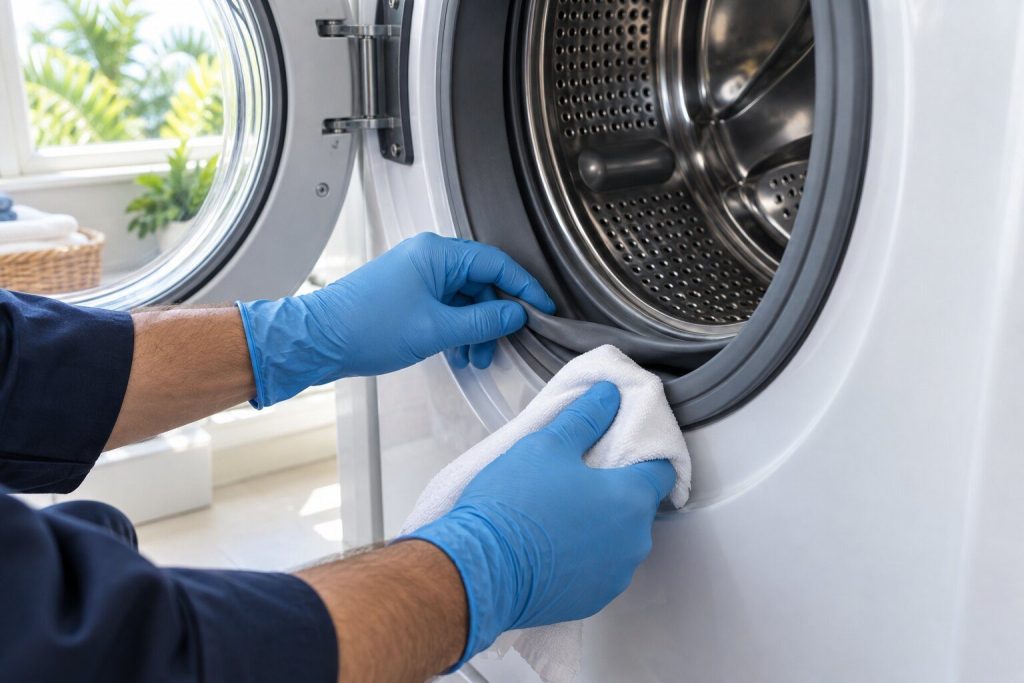
  • Gloved fingers pulling open the fold at the bottom of a front-load washer door gasket, a cloth in the other hand.
    from $145

    Washer seal and odor service

    The complaint everybody has and nobody mentions until something else needs fixing. A front loader seals tight, which is what lets it wash with so little water and also what traps the water it used. The gasket has a fold at the bottom that holds water, lint and detergent, and in this climate it does not dry between loads on its own. Most of this is maintenance rather than repair, and we would rather tell you that than sell you a part.

    • The fold in the gasket holds water, and here it never dries
    • Mostly maintenance — we will say so rather than sell a part
    • Where it is not, the sump or the drain hose is holding residue
    What this involves
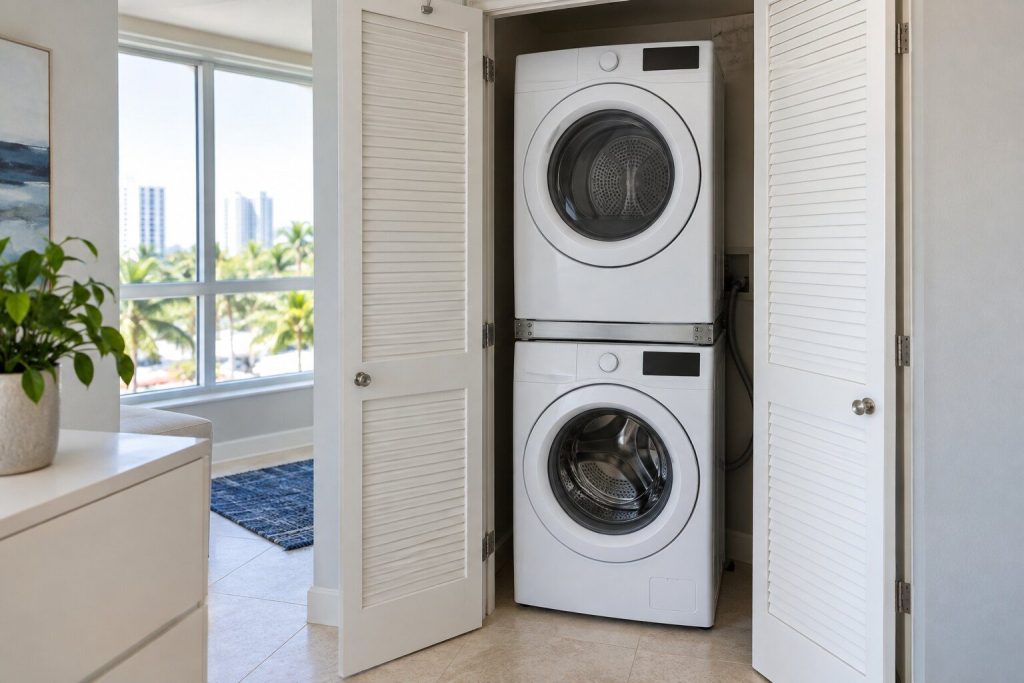
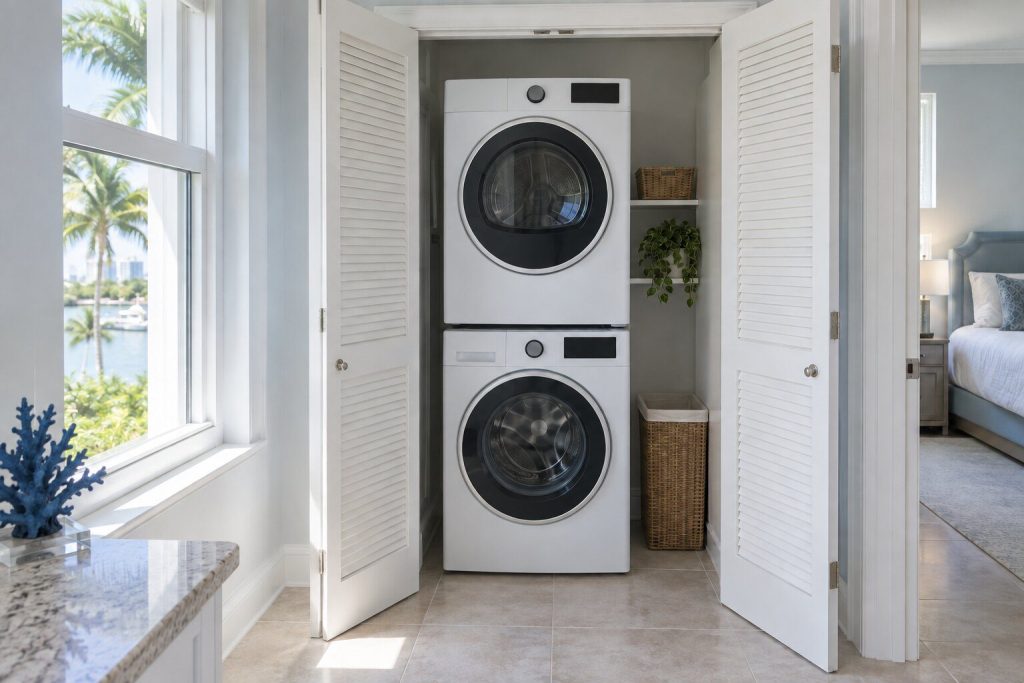
  • A narrow 24-inch washer and dryer stacked in a condominium closet with the louvered doors open, a stacking kit bracket visible between them.
    from $159

    Compact laundry service

    The 24-inch pair — a 2.4 cubic foot washer and a 4.0 cubic foot dryer — is its own design rather than a shrunk version of the full-size machines, and its parts are not interchangeable with them. It lives in condominium closets and in-law units across this region, usually stacked, usually with a vent run that was an afterthought. Telling us on the phone that it is the compact pair saves a visit that arrives with the wrong parts.

    • A separate design, not a small version — parts do not interchange
    • Usually stacked in a closet with an improvised vent run
    • Say it is the compact pair when you book and we arrive correctly equipped
    What this involves
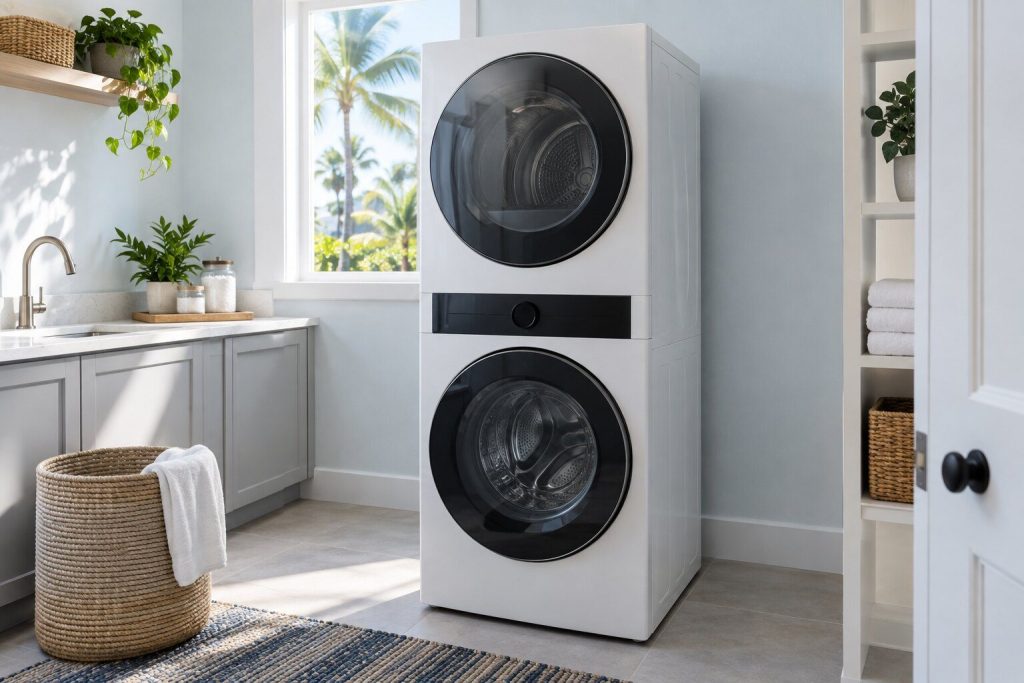
  • A single tall laundry unit with a washer drum below and a dryer drum above behind one continuous front and one control panel between them, standing in a bright laundry room.
    from $185

    Laundry tower service

    A laundry tower is a washer and a dryer built as one unit behind one control panel, not two machines stacked. That changes access more than mechanism — both halves are reached through the single cabinet — and it changes the replacement conversation completely, because you cannot replace half of it. Four of this maker's laundry machines are towers, and they are increasingly what goes into a renovated condominium laundry.

    • One cabinet, one control, two machines — you cannot replace half
    • Access is through the single cabinet, which changes the visit
    • Four of this maker's laundry models are towers
    What this involves
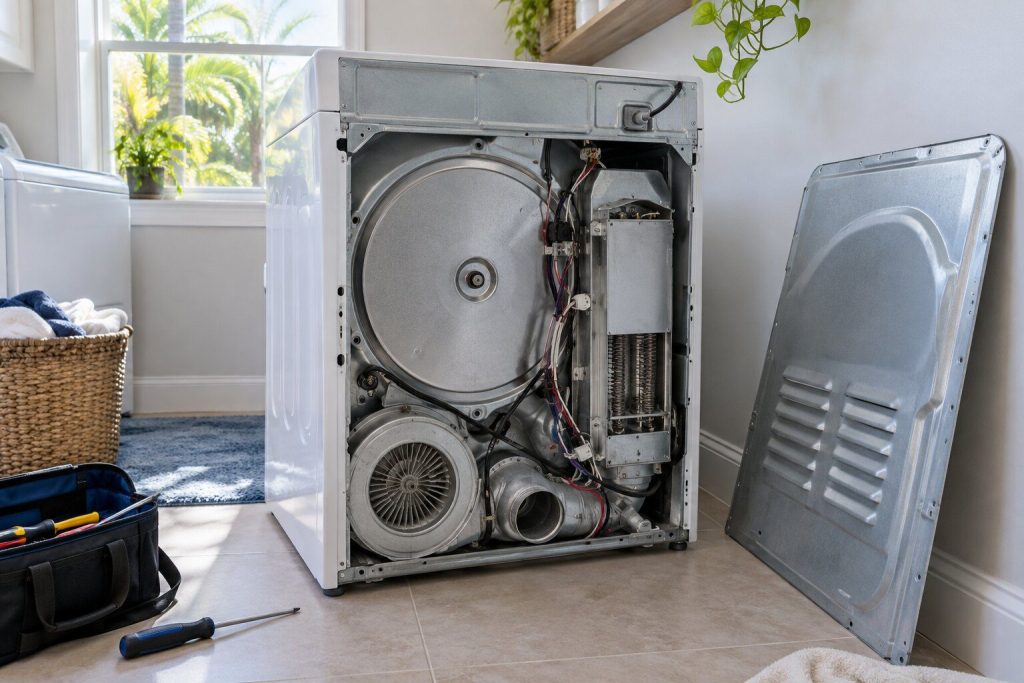
  • The rear panel of a dryer removed and leaning against a wall, the heater housing and its wiring visible inside, the machine pulled forward.
    from $149

    Dryer not heating repair

    The drum turns, the cycle runs, and nothing gets dry. On an electric dryer that pattern says something specific before anybody opens the machine: the motor runs on 120 volts and the element needs both legs of 240, so a dryer that tumbles without heating is very often a supply problem rather than an appliance one. This maker publishes two codes that say exactly that — H2/B2 for the supply and H4/B4 for wiring — and both send you outside the appliance.

    • Tumbling without heat points at the supply as often as at the element
    • H2/B2 and H4/B4 are this maker's codes and both point outside the machine
    • If it is the circuit we will say so rather than fitting a part
    What this involves
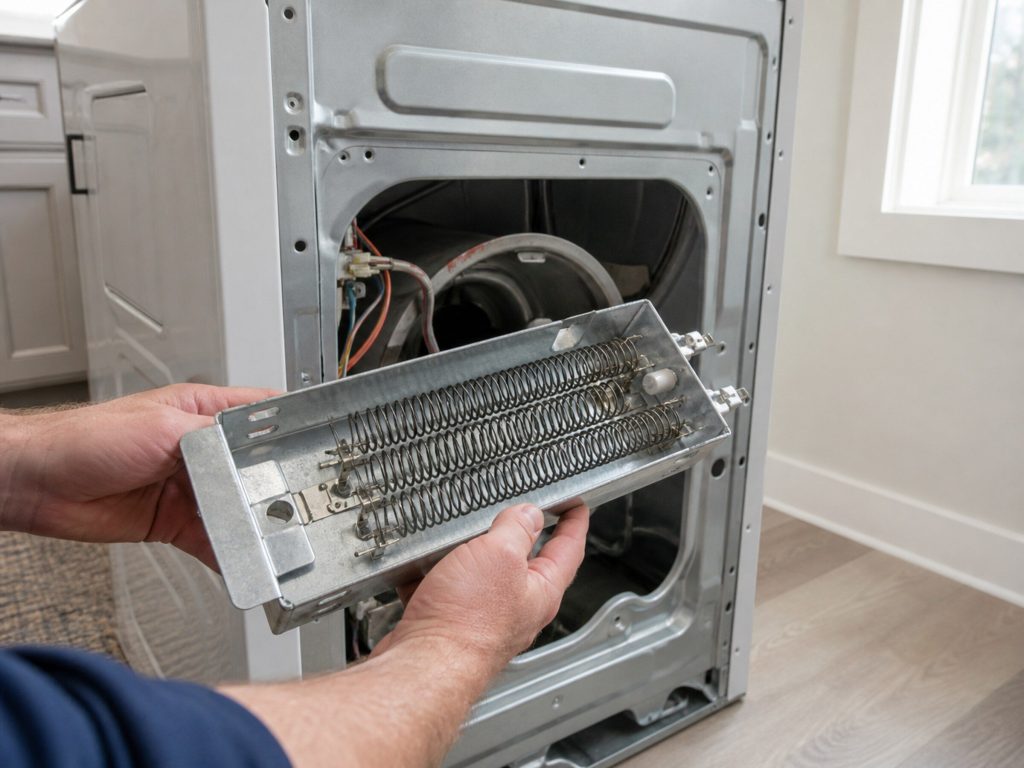
  • A dryer heating element coil in its metal housing held in two hands over an open dryer back panel
    from $165

    Dryer heating element replacement

    When the element is genuinely open, replacing it is straightforward work — and the part of this job that matters is what is done alongside it. An element rarely fails for no reason: restricted airflow makes it cycle hot, and a thermal fuse or a thermostat that went at the same time is the machine's record of that. Fitting the element and leaving the duct blocked is how the same repair comes back inside a year.

    • An open element usually has a restricted duct behind it
    • Thermostats and the thermal fuse are checked in the same visit
    • Fitting the part without clearing the cause guarantees a repeat
    What this involves
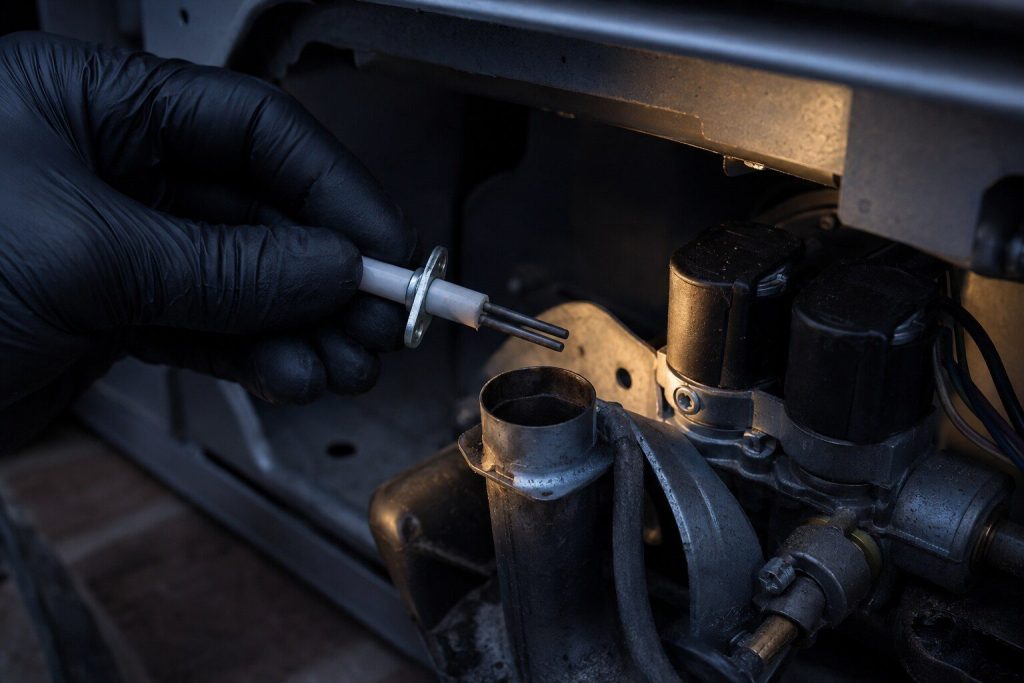
  • A small forked ceramic igniter held in gloved fingers above the open burner tube of a gas dryer
    from $175

    Gas dryer igniter and valve repair

    Six of this maker's eleven dryers are gas, and a gas dryer that tumbles without heat is a different machine from an electric one with the same symptom. The sequence is igniter, flame sensor, then the two coils on the gas valve, and it fails in a way you can hear: an igniter that glows and goes out without a flame is a coil or a sensor, while an igniter that never glows is upstream of that.

    • Six of eleven dryers on this badge are gas
    • Igniter, flame sensor, then the valve coils — in that order
    • Whether the igniter glows at all splits the diagnosis in half
    What this involves
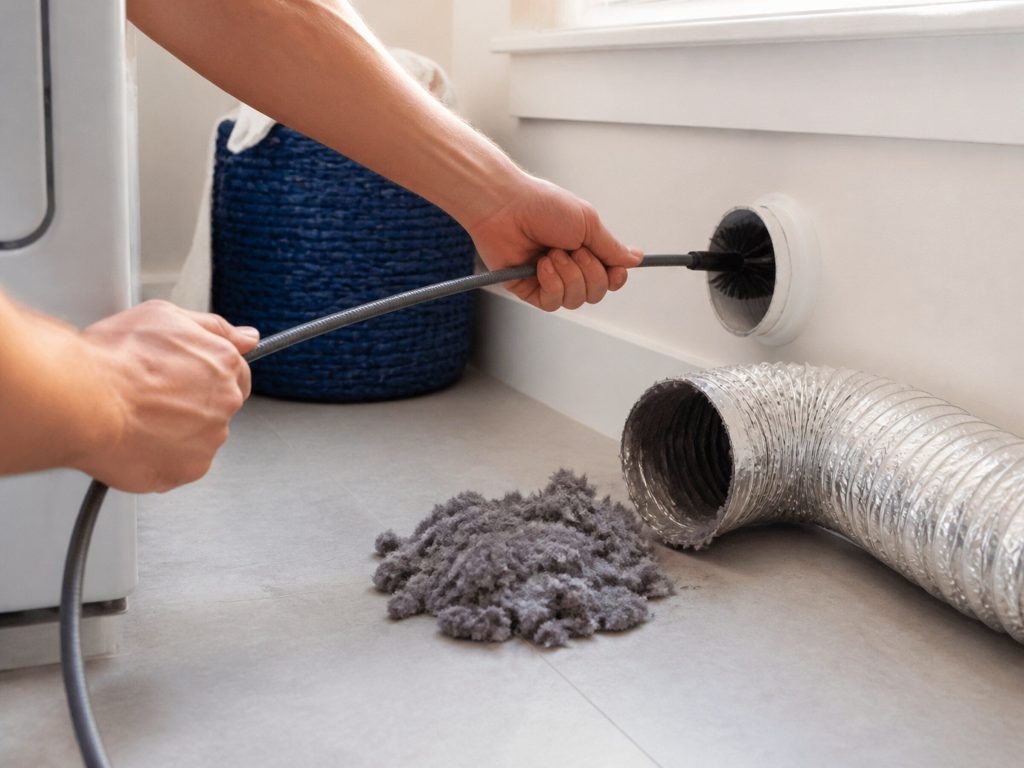
  • A long flexible brush fed into a disconnected dryer duct at a wall outlet, grey lint heaped on the floor
    from $119

    Dryer vent cleaning

    The item on this site where doing nothing is genuinely unsafe. This maker publishes a code for it — EF1, ventilation blockage — and sends it back to the installer rather than to service, which in a South Florida building is fairer than it sounds: the run goes up through a wall to a roof or a soffit, it is long, it has elbows, and the part that blocks is the end nobody can see. A dryer needing two runs for one load has been telling you this for months.

    • EF1 is the maker's own code, and the whole solution is the duct
    • In a condominium the run is vertical, long, and invisible to the owner
    • A fire risk before it is a repair — this is not one to defer
    What this involves
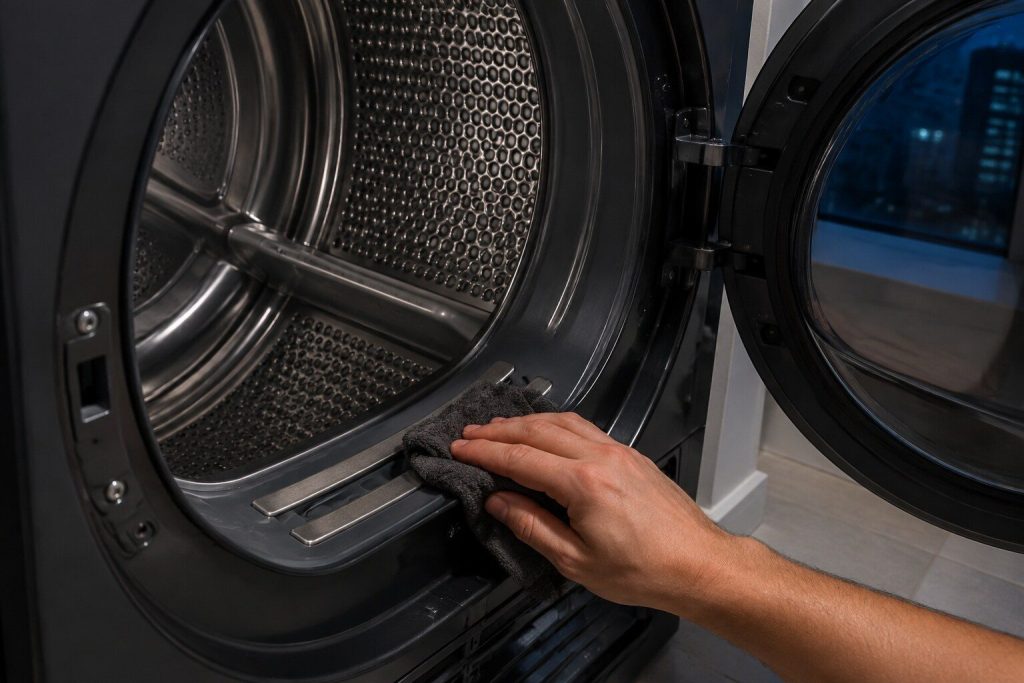
  • A cloth wiping along two metal sensor strips set into the inside of a dryer drum near the lint opening
    from $129

    Dryer moisture sensor service

    Automatic cycles that stop too early, run too long, or will not stop at all, while timed cycles work perfectly. That combination is the moisture sensor, and this maker publishes it as E 4 with unusually generous wording: the dryer keeps working, and what you lose is the automatic programs. The sensor is a pair of metal strips inside the drum opening reading the resistance across damp fabric, and the commonest reason they stop reading is a film of fabric softener rather than a failed part.

    • Automatic cycles wrong while timed cycles are right — that is the sensor
    • E 4, and the maker's own note says the machine keeps working
    • Softener film across the strips is the ordinary cause and it is free to fix
    What this involves
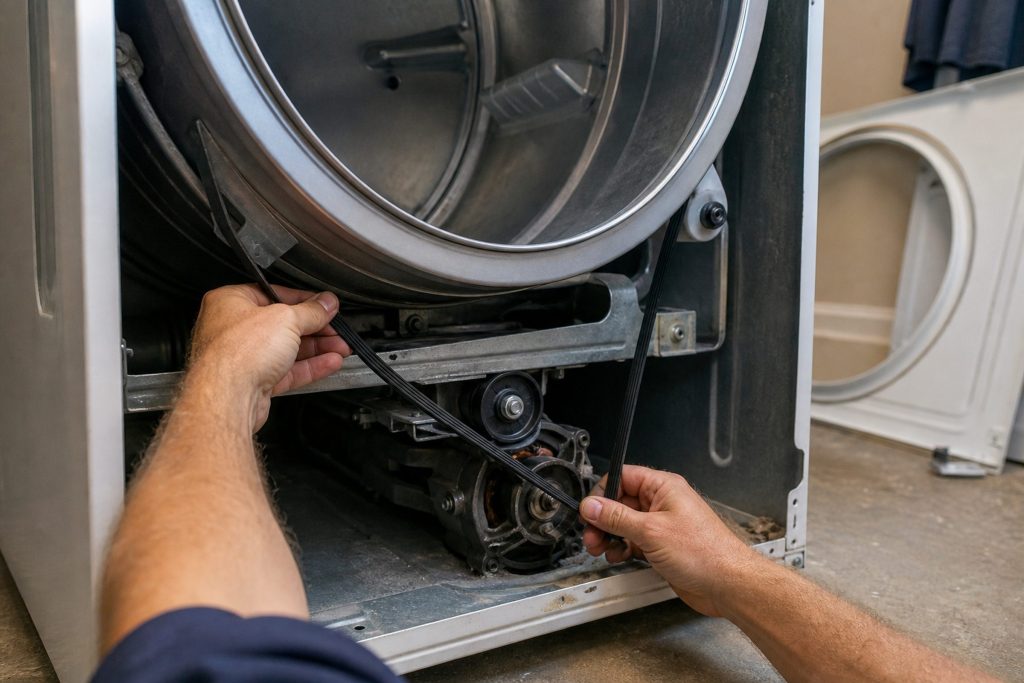
  • Drum rollers and the belt lying off a dryer on a bench
    from $165

    Dryer drum, belt and roller repair

    A dryer that hums without turning, or one that turns with a rumble, a squeal or a thump once per revolution. The drum rides on rollers and is turned by a belt around its circumference, and each of those parts announces itself differently: a snapped belt gives a motor running and a still drum, worn rollers give a rumble that rises with load, and a glazed idler gives a squeal. On a stacked or tower installation the access is most of the job.

    • The noise identifies the part before anything is opened
    • Belt, rollers and idler are replaced together on a high-hour machine
    • On a stacked pair or a tower, access is most of the work
    What this involves
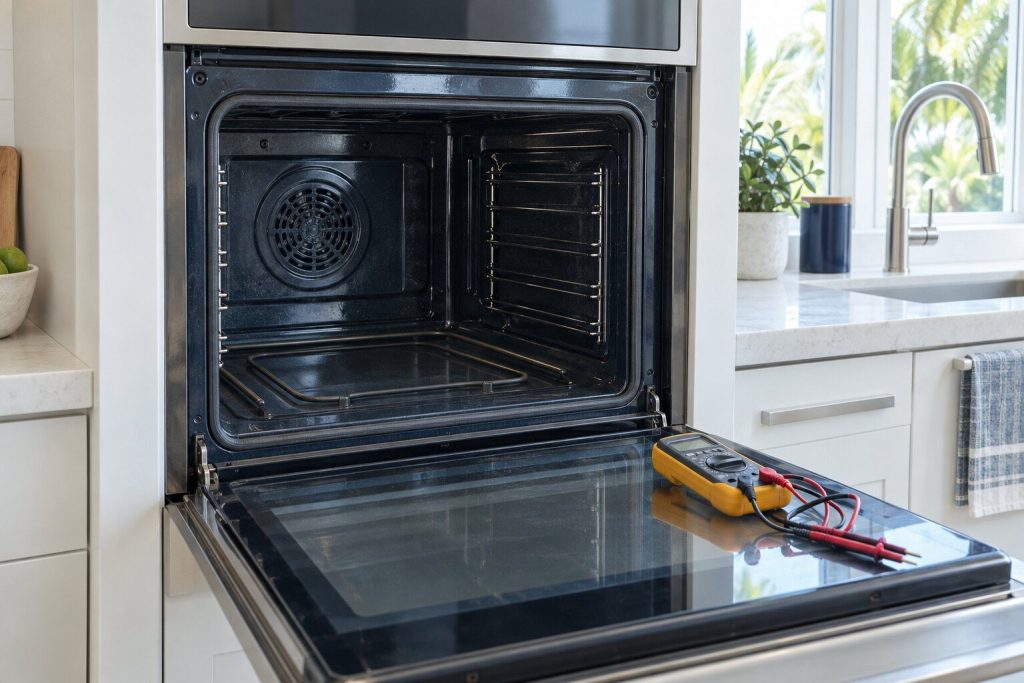
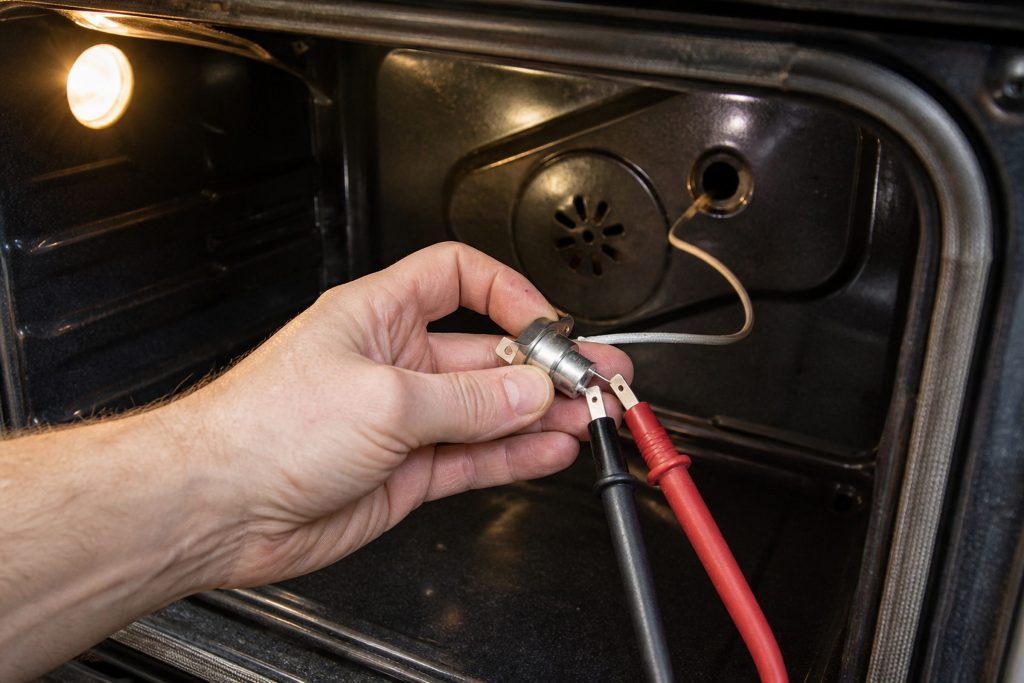
  • An empty wall-oven cavity with the door open and the bake element along the floor of it dark, a meter lying on the open door.
    from $165

    Oven not heating repair

    An oven that stays cold, heats slowly, or heats and then quits part-way. Before any of the expensive answers there are two free ones on this badge worth ruling out: demo mode, which accepts every setting and counts down a preheat without heating at all, and F10, which on the stone-baked pizza ovens is frequently the Pizza Shield in the wrong rack. Both are published by the maker and both cost somebody a call-out every year.

    • Demo mode and the Pizza Shield are free to rule out and often the answer
    • Element, sensor, relay, control — in that order and not the other way
    • A wall oven in a tall cabinet costs access before it costs parts
    What this involves
  • The oven temperature sensor unscrewed from the rear wall of an empty cavity and drawn forward
    from $139

    Oven temperature and calibration

    Everything comes out consistently wrong by about the same amount, or a recipe that worked for years has stopped working. That is calibration, and it has two ordinary causes: the sensor drifting, or the control losing what it was calibrated to — which is precisely what F13 reports on this maker. Worth knowing on a double oven that the two cavities have separate sensors, so one being right tells you nothing about the other.

    • Consistently wrong by a fixed amount is calibration, not a failure
    • F13 is the maker's code for the control losing its calibration
    • On a double oven the two cavities are measured separately
    What this involves
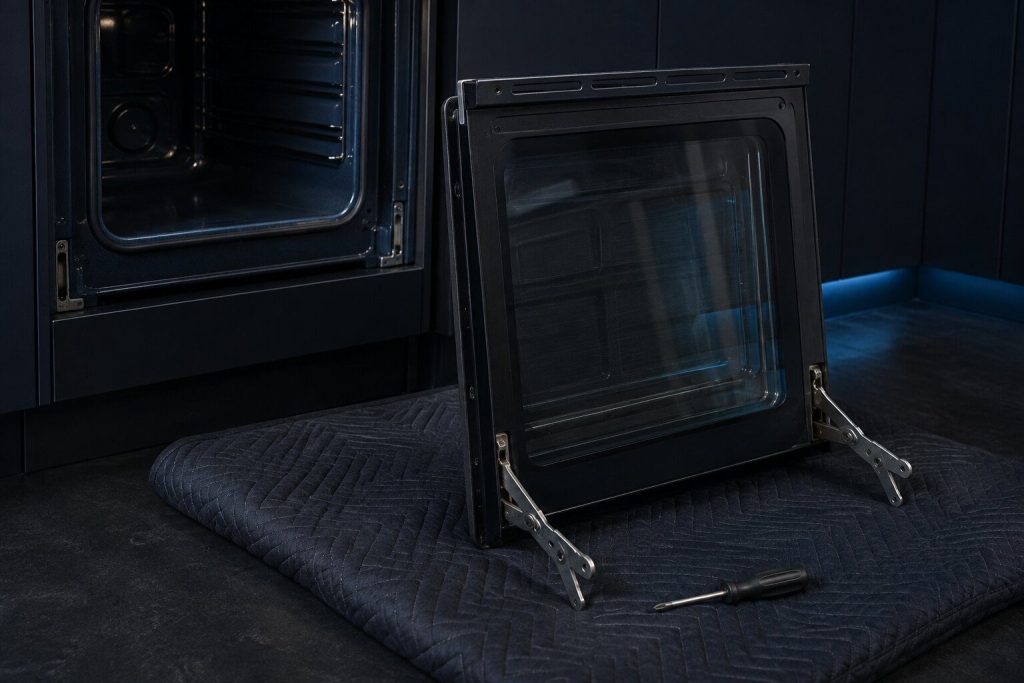
  • An oven door lifted off and stood against a padded blanket, both hinge arms locked open
    from $159

    Oven door and hinge repair

    A door that will not close flush, one that drops open, or a glass panel that has misted between its layers. All of it is heat management: a door that does not seal lets the cavity lose heat unevenly, which shows up as food browning on one side long before anybody thinks about the door. The hinges carry real weight on a 30-inch double oven, and they are replaced in pairs because one new hinge against one aged one puts the door out of true.

    • Uneven browning is a door problem more often than an element problem
    • Hinges are replaced in pairs, always
    • Misting between the glass panels is a seal, and it is serviceable
    What this involves
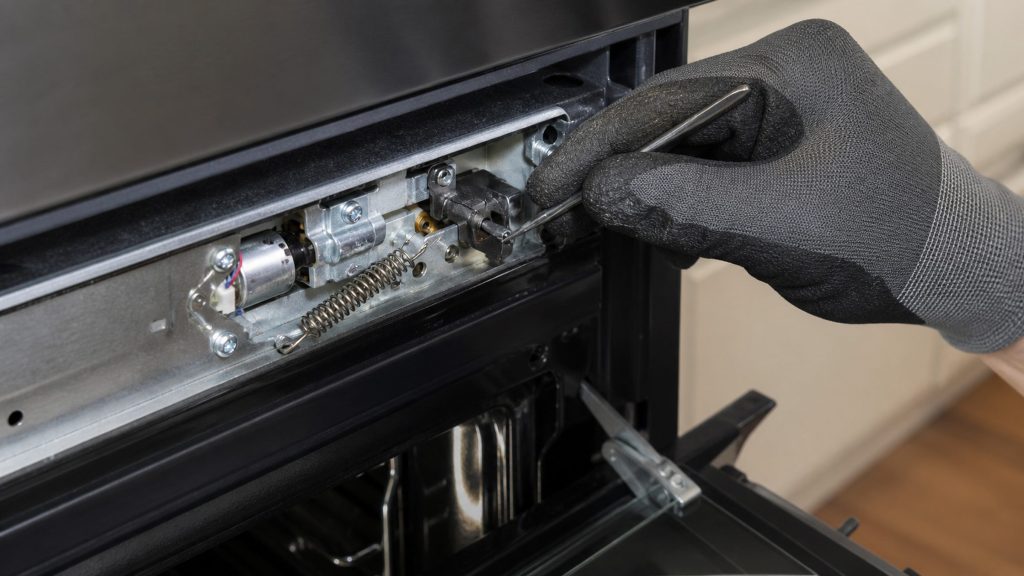
  • The latch assembly along the top of an oven frame with the trim off — motor, spring and catch
    from $165

    Self-clean and door lock repair

    Five of this maker's codes — F90 through F94 — describe one mechanism: the motorized latch that bolts the oven shut for a clean cycle. Nearly every one of them arrives the morning after a self-clean, because that is the only occasion the latch is asked for everything it has. The maker's own route out is the UNLOCK key, and on these ovens the screen hands you a code to enter back. What it is not is a door to lever.

    • F90 to F94 are five numbers for one latch mechanism
    • They nearly all appear the day after a self-clean cycle
    • Levering the door turns one part into a door, a hinge and a liner
    What this involves
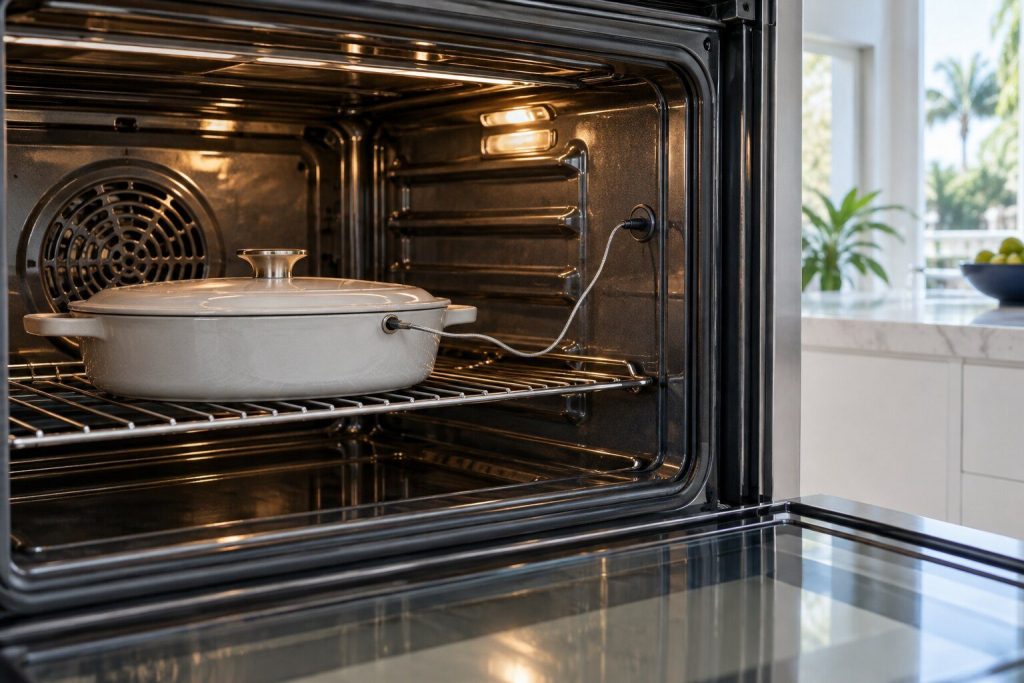
  • A shallow covered dish on a wire rack in a wall-oven cavity with a slim probe lead running from it to a socket in the cavity wall.
    from $155

    Air Sous Vide service

    The low-temperature mode on this maker's single and double wall ovens, and one of the specific reasons people chose them. It holds a controlled low temperature with its own sensing, which means it can stop working while conventional baking is completely unaffected — not a contradiction and not a whole-oven failure. It is also the kind of feature people live without for a year before mentioning it, and it is worth repairing if it is why the oven was bought.

    • It fails independently of conventional baking, which is normal
    • A named feature on the single and double wall ovens
    • Worth repairing if it is the reason the oven was specified
    What this involves
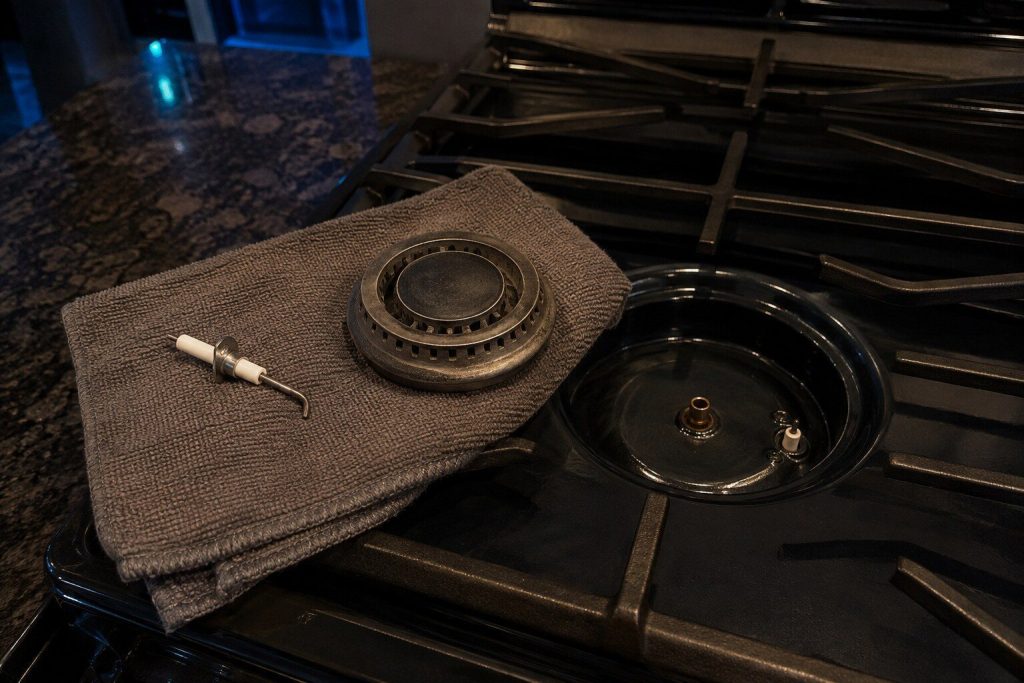
  • A spark igniter and a burner head lying apart on a folded towel beside the empty burner base
    from $145

    Gas burner and igniter repair

    Clicking that never lights, a burner that lights and goes out, or a flame that is yellow and lazy where its neighbors are blue. On a sealed burner the ordinary pair is a clogged port or a cap that went back very slightly out of true after a clean, and both are ordinary work. The gas rangetop and the drop-in cooktops on this badge share burner design, so the diagnosis carries across — the access does not.

    • A clicking burner and a silent one are different parts
    • Cap seating after a clean is a real and frequent cause
    • Yellow flame is air or ports, and it is worth attending to
    What this involves
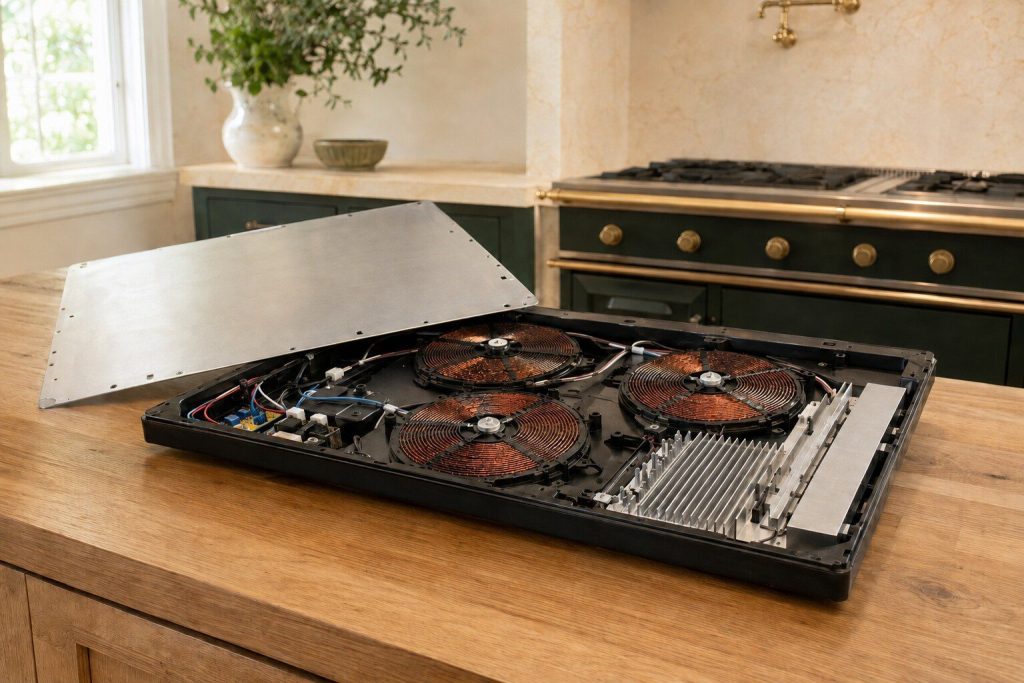
  • The underside of an induction cooking panel face down on a bench, its wound copper coils exposed
    from $195

    Induction cooktop repair

    Every glass cooking surface on this badge is induction — there is no radiant element in the line at all — and it fails in ways a radiant top does not. Zones that heat for a moment and cut out are usually the unit protecting itself: a blocked vent underneath, often a drawer packed tight against it, or a pan too warped to couple properly. Both are free to rule out. Beyond that, zones are driven by their own power stages, so one dead zone is good news rather than bad.

    • There is no radiant cooktop on this badge — general glass-top advice does not apply
    • Cutting out is usually thermal protection, and often a packed drawer
    • One dead zone means one power stage, not the whole board
    What this involves
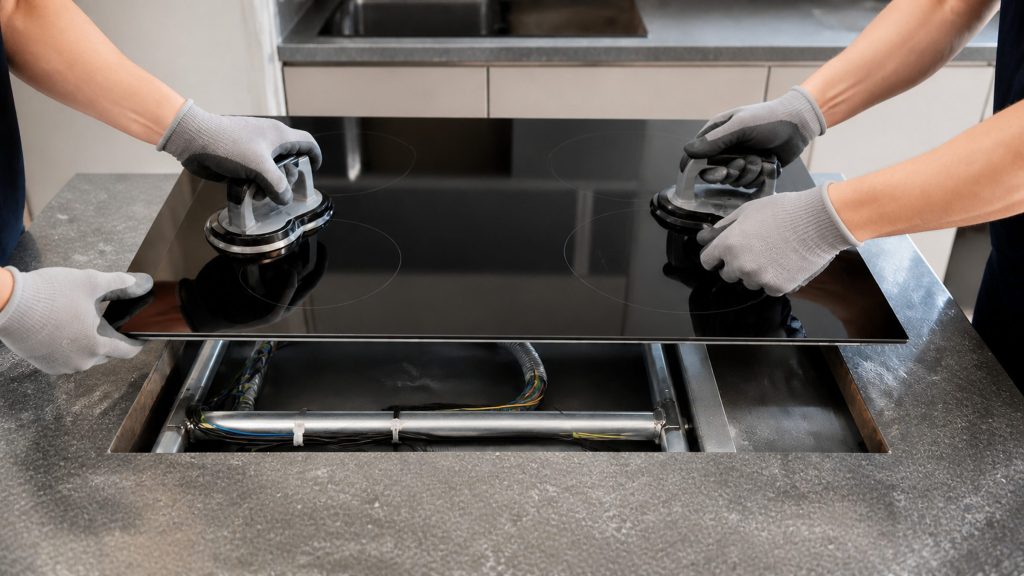
  • Two pairs of gloved hands lifting a ceramic glass cooktop out of its cut-out with suction cups
    from $275

    Cooktop glass replacement

    A cracked or chipped induction surface is a part, and a replaceable one — but it is among the more expensive single parts on the appliance, so it deserves an honest conversation rather than an automatic yes. We quote the glass against the value of the unit and tell you which way we would go. In the meantime a cracked top should not be used: the glass is structural and the electronics beneath it are not meant to meet anything spilled.

    • Replaceable, but one of the costlier parts on the appliance
    • Quoted against the value of the unit, with a recommendation
    • A cracked top should not be used in the meantime
    What this involves
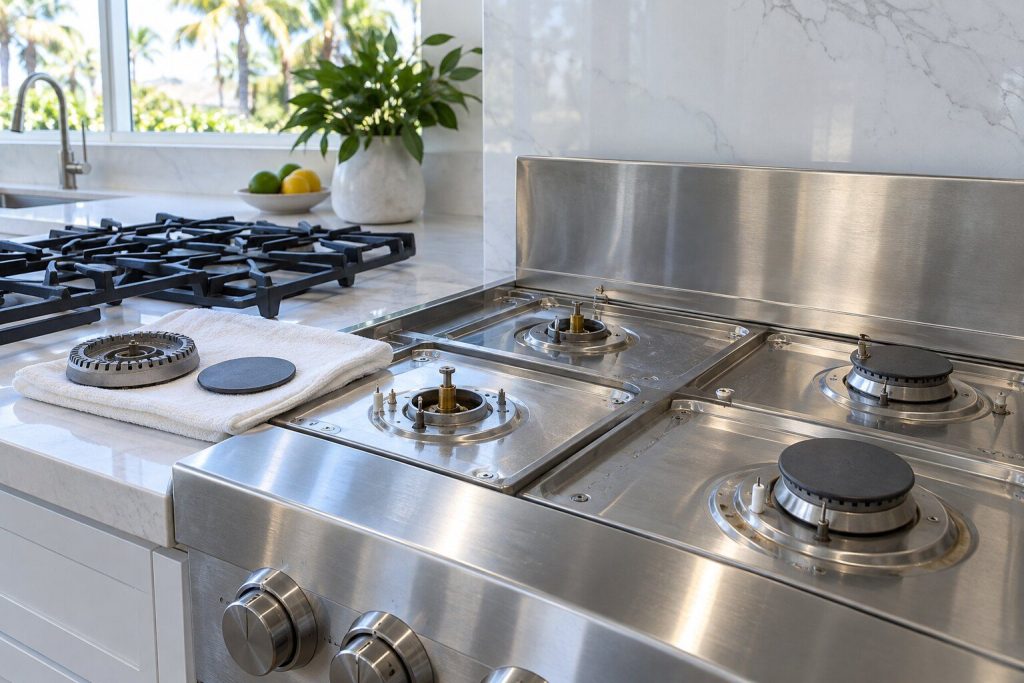
  • A stainless gas rangetop with a raised back panel, its cast grates lifted off and set aside, one burner head and cap apart on a folded cloth.
    from $185

    Rangetop service

    One of this maker's five cooking surfaces is a 36-inch gas rangetop, and it is not a cooktop with a different name. It is deeper, it has a raised back panel and its own controls, it sits in a counter run with the oven built in somewhere else, and its parts are its own. When somebody books a cooktop repair and we find a rangetop, the visit usually has to be repeated with the right parts — so we ask when the appointment is made, and this page exists so the distinction is findable.

    • A rangetop is a different appliance from a cooktop, with its own parts
    • 36 inches, raised back panel, its own controls, deeper than a drop-in
    • Telling us which you have avoids a repeated visit
    What this involves
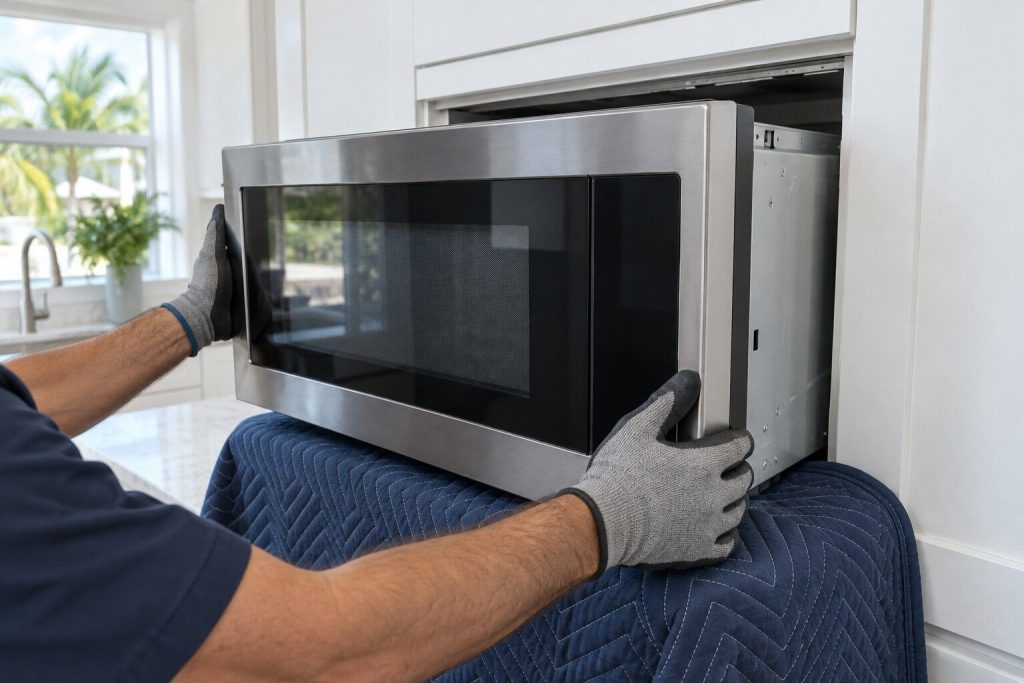
  • A built-in microwave eased partly forward out of its cabinet opening on a padded blanket, its outer case still on, gloved hands steadying it.
    from $185

    Built-in microwave repair

    This maker builds no countertop microwave — the three it sells are two built-in units and an over-the-range convection model — and that changes the whole economics. A countertop box is replaced for less than a service call; a built-in has to match an opening and a trim kit, and the current line has exactly three models. It is also the one appliance on this site we ask you not to open: the high-voltage capacitor holds a lethal charge long after the unit is unplugged.

    • No countertop model on this badge — every one of these is fitted in
    • Replacing a built-in can mean re-cutting cabinetry, so repair is usually right
    • Never open one: the capacitor holds a charge after unplugging
    What this involves
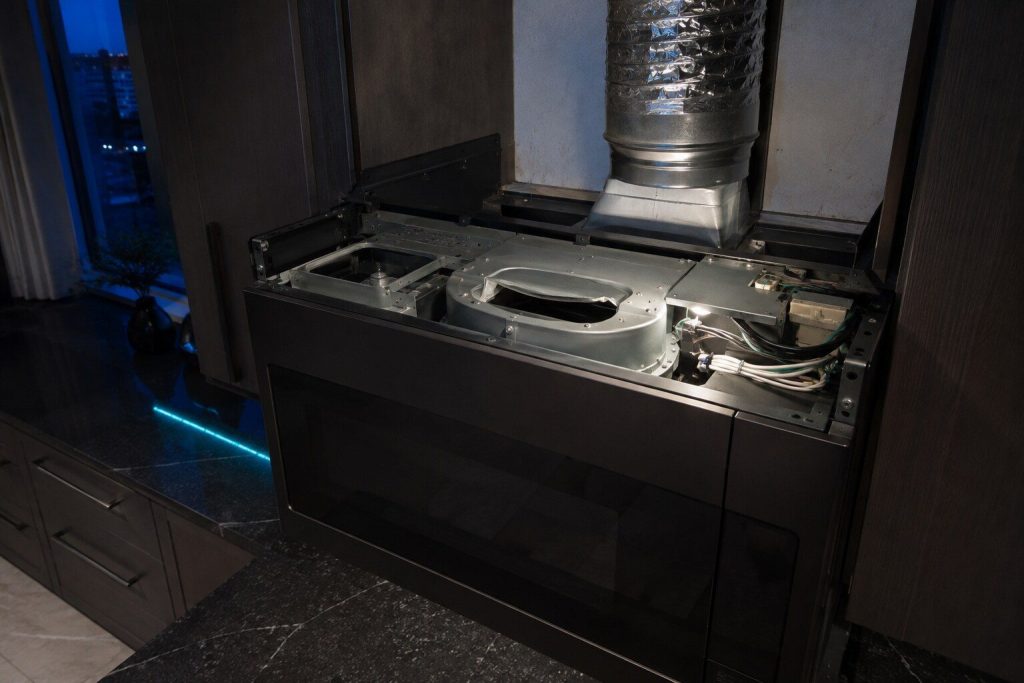
  • The blower housing inside the top of an over-the-range microwave with its vent flap turned
    from $159

    Over-the-range microwave and vent

    The over-the-range unit is doing two jobs and the second one gets forgotten. It is the kitchen's ventilation as well as a microwave, and most of the complaints we attend about it are about air rather than about cooking: grease filters that have never been washed, a damper stuck closed, or a unit set to recirculate when it is actually ducted to the outside. All three are checkable in minutes and none of them is a magnetron.

    • It is the kitchen ventilation as well as a microwave
    • Filters, damper and the recirculate-or-ducted setting first
    • Checkable in minutes, and none of it is an expensive part
    What this involves
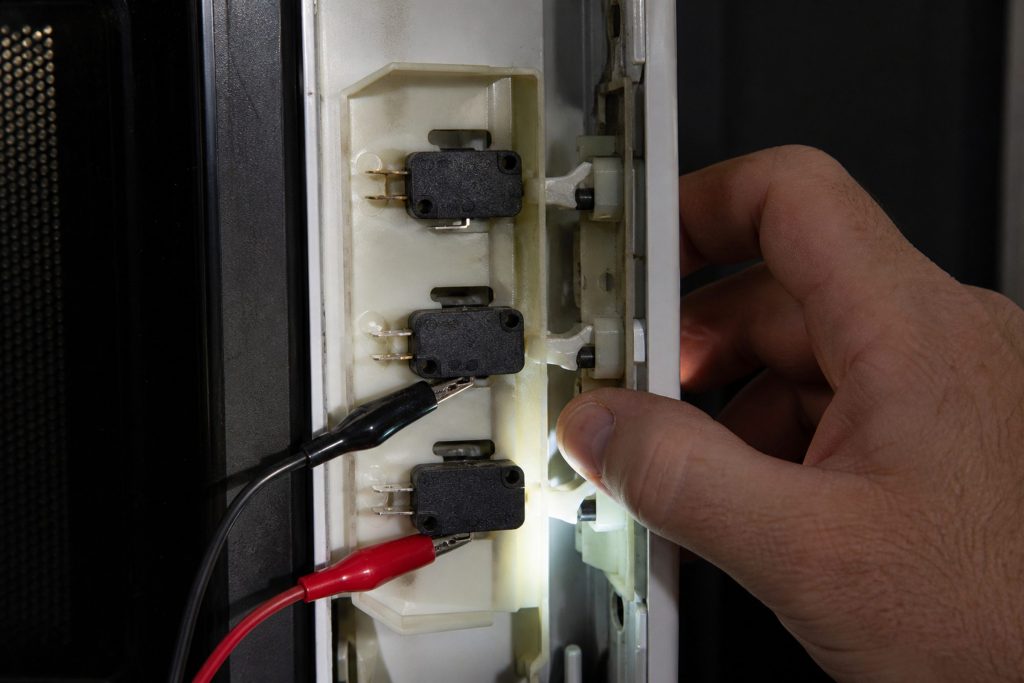
  • The latch board of an opened microwave door frame with its three interlock switches in a row
    from $165

    Microwave door and interlock repair

    A door that catches, drops, or no longer closes square is not a cosmetic problem on this appliance. The door carries the interlock switches that allow the unit to run at all, so a misaligned door is either a microwave that will not start or — the reason we ask people not to defer it — one that runs while not sealing as it was designed to. On a drop-down door the hinges take the full weight every single time it opens.

    • The door carries the interlocks that let the unit run at all
    • A drop-down door's hinges take the whole weight on every use
    • Not a cosmetic repair, and not one to postpone
    What this involves
  • A row of identical front-load machines along the wall of a shared laundry room, one standing open
    from $175

    Building laundry service

    We are not Electrolux Professional — that is a separate business with its own dealers. What we do is the domestic machines on this badge that are doing commercial work, which in this region means a great many of them: building laundry rooms, staff kitchens, small offices. A washer rated for six cycles a week doing forty is not defective; it is reaching in eighteen months the wear a household would reach in ten years, and what helps is knowing which part goes first in that room.

    • Domestic machines on commercial duty — not Electrolux Professional equipment
    • Duty cycle rather than age decides what fails in these rooms
    • Pumps, door locks and bearings go first, in that order
    What this involves
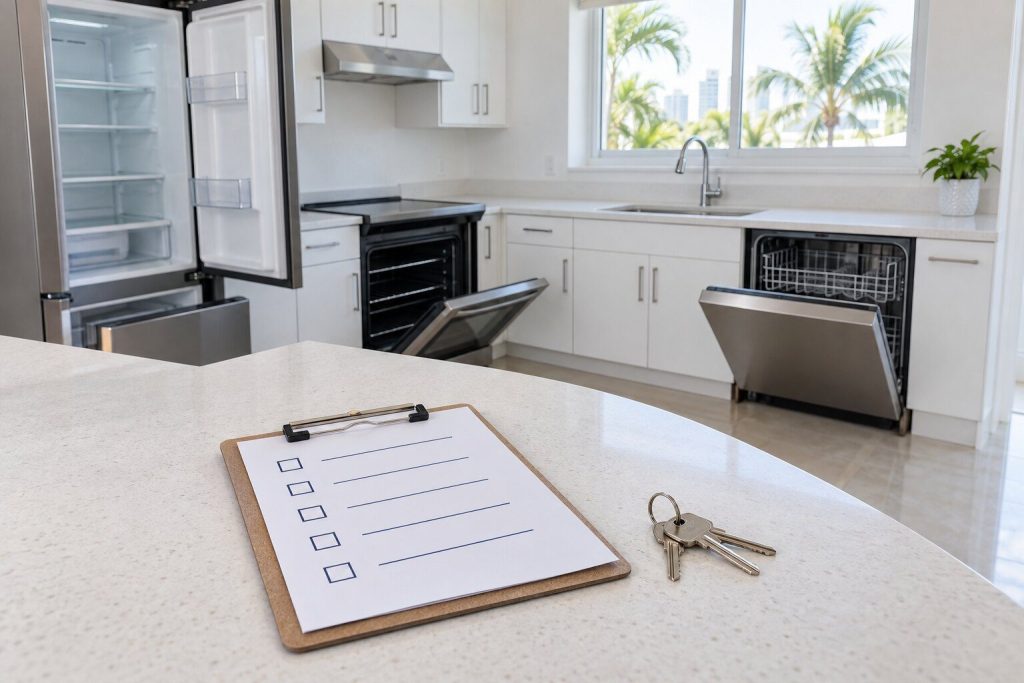
  • A clipboard with a plain checklist and a set of keys on a pale counter in an empty apartment kitchen, appliance doors standing open behind.
    from $165

    Short-term rental turnaround

    A different service from a repair, and worth booking as one. On a unit that changes guests on a Friday, a diagnosis on Wednesday with the part fitted on Thursday is worth more than a faster visit that ends in something being ordered. Tell us the turnover schedule when you book and we will plan around the calendar rather than against it. Managers with several units usually do better on an arrangement than on individual call-outs.

    • Planned around the turnover calendar rather than around our own
    • A diagnosis two days early beats a visit that ends in an order
    • Several units are usually better handled on an arrangement
    What this involves

Why the laundry list is the long one

This make sells more dryers than everything else combined

Eleven dryers, six front-load washers and four towers — 22 machines in all, against 6 refrigeration cabinets and two dishwashers. If you own one appliance from this badge, the odds are it is in the laundry room.

So the laundry jobs here are written in detail and stocked accordingly, and three of them exist only because this maker publishes a dryer code guide that its sister badge does not publish at all.

Dryer repair
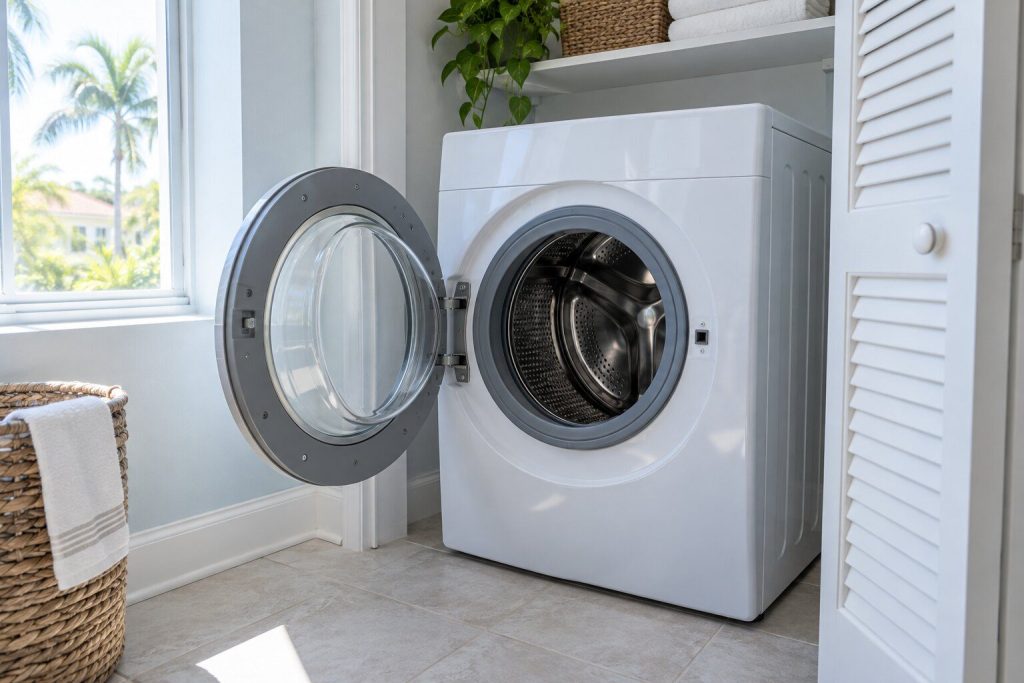
A laundry closet with louvered doors standing open, a front-load washer and dryer stacked inside, tiled floor.

And one job the sister site does not have

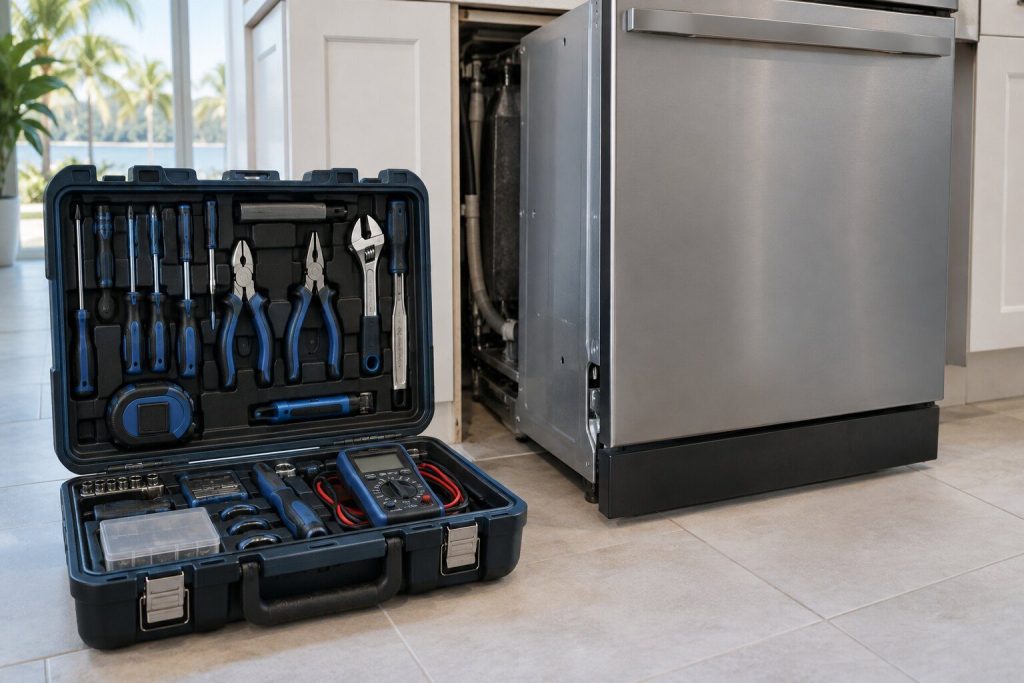
Getting the appliance out is the job

Every French-door refrigerator in this line is counter-depth. The largest cold cabinets are 33-inch columns sold behind flat or louvered trim kits. Wall ovens go into tall units and both built-in microwaves go into openings cut for them.

On equipment like that, access is the first cost of most repairs and sometimes most of the visit. We quote it as its own line so you can see it rather than find it folded into a part.

Built-in and column access
An open tool case standing on a pale tiled floor beside an appliance that has been eased forward from its opening.

Before you book

Four things that shorten the visit

Have these to hand

  • The model and serial off the rating plate. On this badge it also settles whether we are looking at the current line or at the built-in range that came before it.
  • A photograph of whatever the panel is showing, taken before anybody cuts the power — this maker keeps evidence that a reset destroys.
  • Whether the appliance is freestanding or fitted in. Almost everything this make sells is built into something, and that decides the length of the visit more than the part does.
  • Whether it is a rental or an association-managed unit, so the written findings reach whoever is paying for them.

Worth checking first

  • Whether the machine is locked rather than broken. A dash on a cooktop and LOC on a washer both look exactly like a dead panel.
  • Whether a new oven is in demo mode. It accepts every setting, counts down a preheat, and never heats — and it costs somebody a call-out every year.
  • The drawer under an induction cooktop. Packed to the top it blocks the cooling path and the zones cut out in August.
  • For laundry, the vent run and the drain hose before the machine itself. Five of this maker's own codes point outside the appliance.

Or start from the machine

By appliance instead

If you would rather begin from what it is than from what needs doing to it.

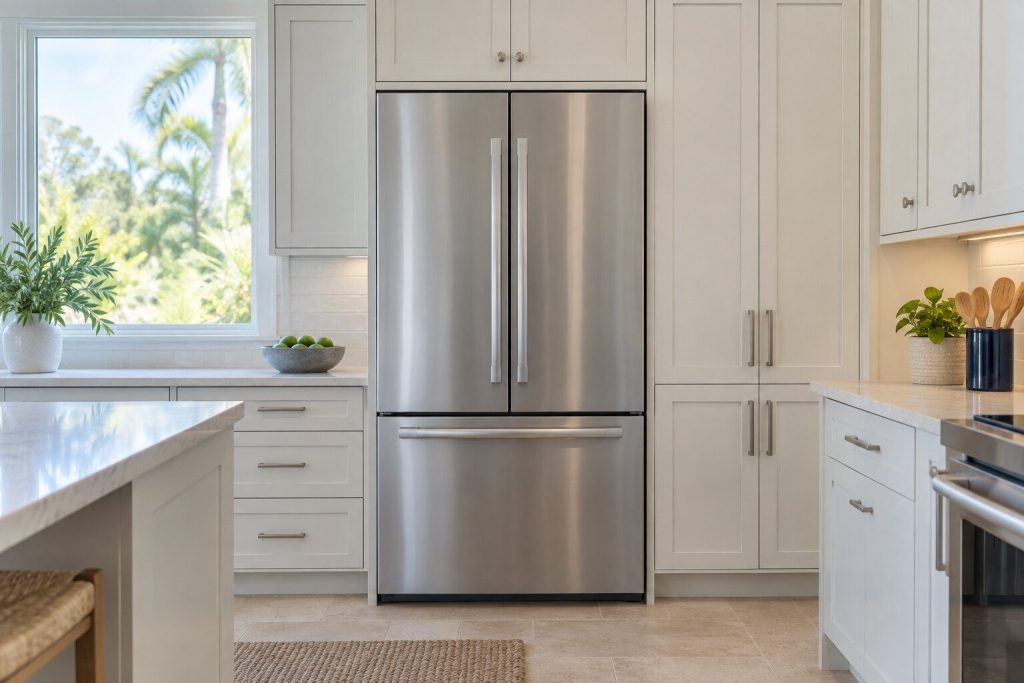
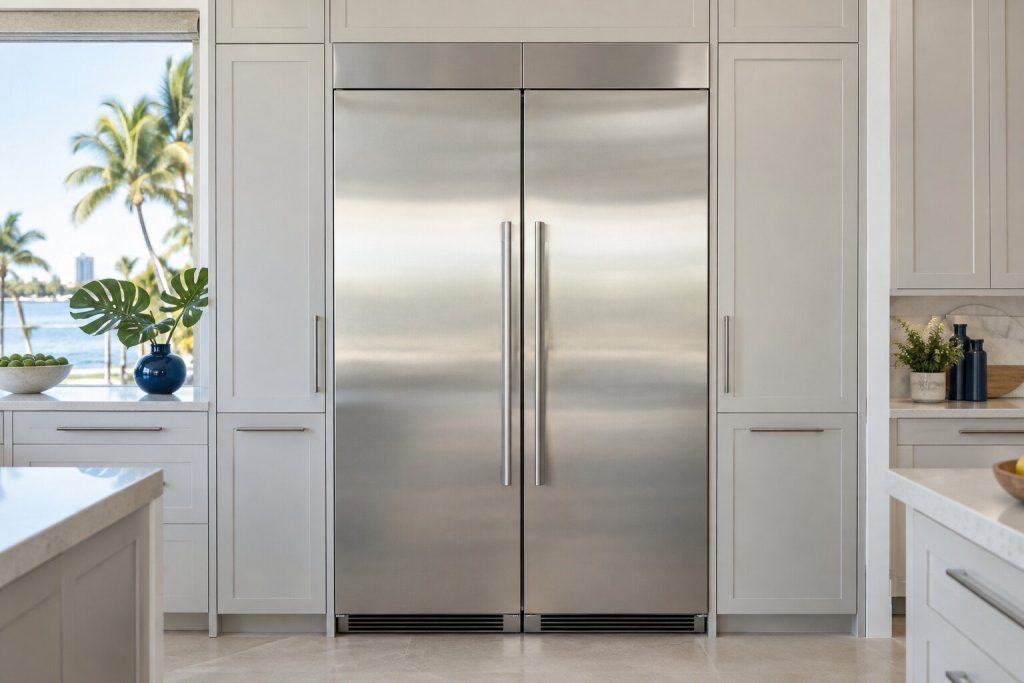
  • A stainless counter-depth French-door refrigerator set flush into a run of pale painted cabinets so its doors sit level with the fronts, seen square on from a few feet back, doors closed.
    Counter-depth French door · 33-inch columns

    Refrigerators

    Six cabinets in the whole current line, and every French door among them is counter-depth — three of them, at 21 and 23 cubic feet. There is no standard-depth box here, no side-by-side and no top-freezer; the deep end of this line is a pair of 33-inch columns, one refrigerator and one freezer, sold with trim kits so they read as cabinetry. That is a refrigerator somebody drew into a plan, and it changes the work: the cabinet is tight in its surround, the water line runs where the joiner left it, and getting the unit out is half the visit before anything is diagnosed.

    • Six cabinets total — three counter-depth French doors and a 33-inch column pair
    • Counter-depth means a tight surround: access is part of every job here
    • TasteLock Plus crispers and the TempAdapt drawer are the parts people call about
    Refrigerator repair
  • Two tall stainless columns of identical width standing side by side in a run of pale cabinetry, a single trim panel across the tops of both, doors closed, seen square on.
    33-inch all-freezer column

    Freezers

    Two freezers in the line, and both of them are the same thing: a 33-inch, 19 cubic foot all-freezer column, built to stand beside the refrigerator column of the same size and be trimmed to match. There is no chest freezer here, no upright for a garage and no convertible box. A freezer on this badge is half of a wall of cabinetry, usually in a kitchen or a butler's pantry, and it is treated as joinery by everybody except the person who has to open it up. Practically, that means everything the refrigerator column needs — clearance, a clean air path, access — matters here twice over.

    • Two models, and they are one design: a 19 cu. ft. 33-inch all-freezer column
    • No chest freezer and no garage upright — this line does not build them
    • Sold as a pair with the refrigerator column, behind matching trim
    Freezer repair
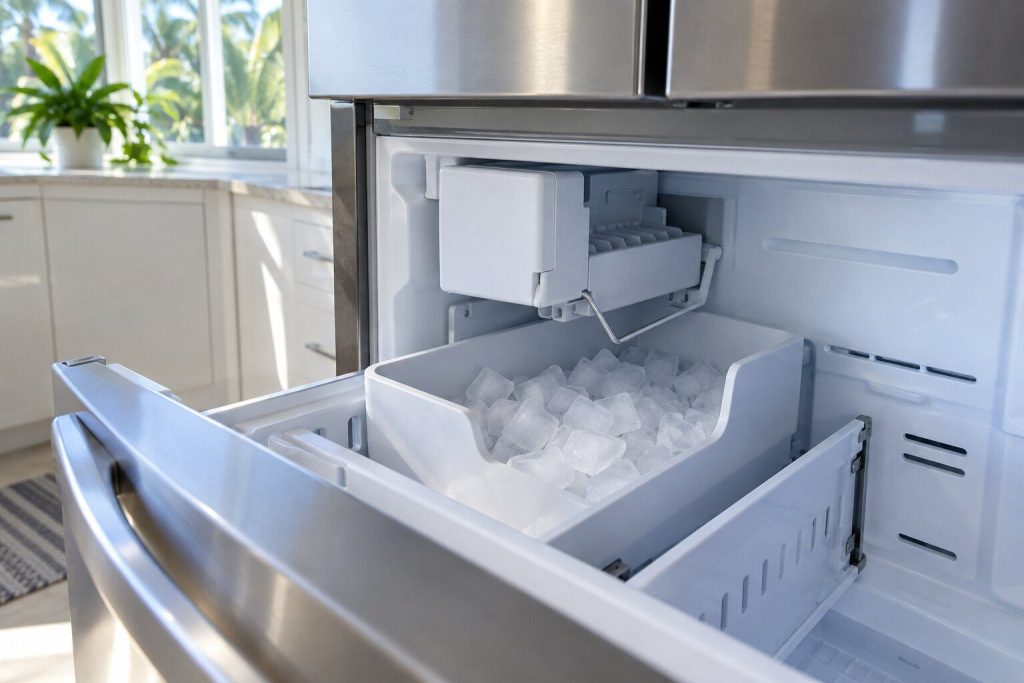
  • The ice-making module in the upper left of an open freezer drawer, its white plastic housing and bin-level arm visible, cubes in the bin below.
    In-cabinet ice · the 15-inch unit

    Ice makers

    This make currently sells no standalone ice maker at all — zero cabinets in the live catalog. So this page is about the two ice makers we actually attend on this badge: the module inside the French-door cabinets, and the 15-inch under-counter unit from the earlier built-in line, which is still in plenty of South Florida bars and butler's pantries. Both are worth writing about honestly rather than implying a product line that has been discontinued. Ice is also the one part of a refrigerator that this make gives its own error code — DI SP, for a jam in the chute — and that code is the start of most of these calls.

    • No standalone ice maker in the current line — this page is about what is installed
    • The in-cabinet module and the older 15-inch under-counter unit
    • DI SP is the maker's own code for a jam, and it is where most calls begin
    Ice maker repair
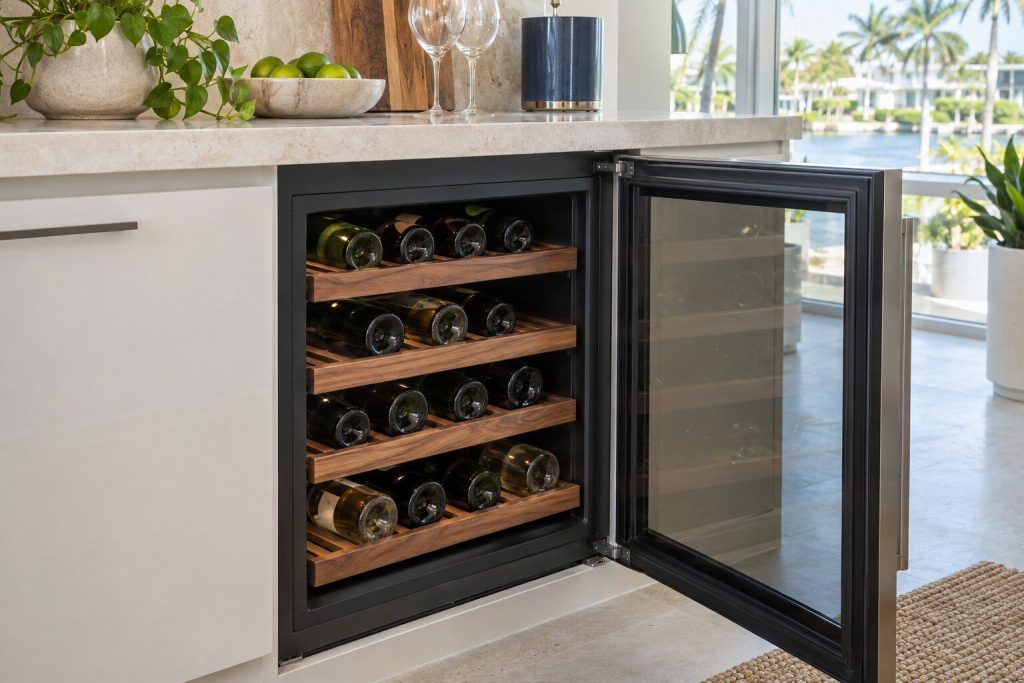
  • A 24-inch glass-fronted wine cabinet built in under a pale stone counter, its door open to show wide walnut-slat shelves with bottles lying on their sides.
    24-inch wine cooler · beverage center

    Wine and beverage coolers

    Two cabinets, both 24 inches and both under a counter: a wine cooler with wide walnut-slat shelving, and a 5.1 cubic foot beverage center. There is no full-height wine column on this badge and there never was in this generation — anybody selling you one has a different make in mind. These live in a bar run or an island, behind a glass door, in a house where the ambient never really drops, and the calls follow from that geometry rather than from any weakness in the machine: losing ground through a hot afternoon, misted glass, and a fan that has become audible from the next room.

    • Two cabinets — a 24-inch wine cooler and a 24-inch beverage center
    • No full-height wine column exists on this badge
    • Walnut-slat shelving takes bottles of different diameters without stacking
    Wine cooler repair
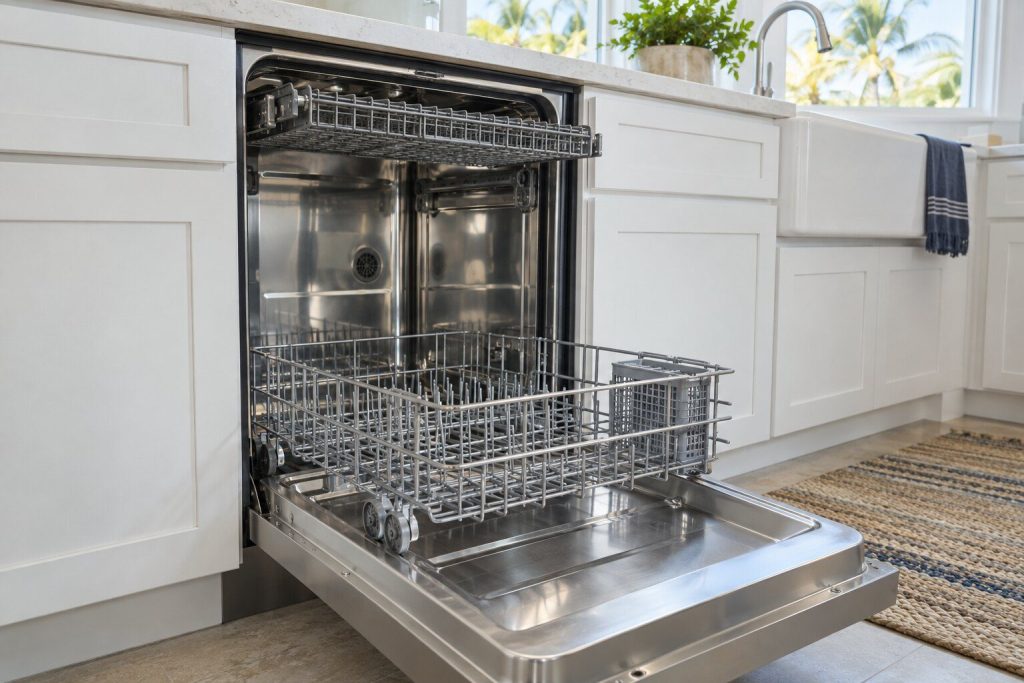
  • A built-in dishwasher with its door fully open showing a stainless steel tub, the lower rack drawn out and a narrow third rack across the top, clean and empty.
    24-inch stainless tub · SmartBoost

    Dishwashers

    Two machines in the entire current line, both 24 inches, both stainless tub, and both carrying SmartBoost — the feature that premixes water and detergent before it reaches the dishes. Two models is not a thin line so much as a single machine in two door treatments, which is unusually simple to work on: what we open is nearly always the same platform, and the spares behind it are the group's, which run deep. This make publishes three dishwasher codes and two of them are not failures at all — a delay counting down and a heat delay waiting for water. The third, i40, is a filter.

    • Two models, one platform — a 24-inch stainless tub with SmartBoost
    • Three published codes, and two of them are modes rather than failures
    • i40 is the filter and the sump, and it is maintenance rather than parts
    Dishwasher repair
  • A front-load washing machine in a laundry closet with its round door standing open, the gray rubber gasket around the opening plainly visible, tiled floor.
    Front load only · 300 to 700 Series

    Washers

    Six machines, and every one of them is a front loader — 300, 400, 500, 600 and 700 Series plus a 24-inch compact. This make builds no top-load washer at all, which is the clearest single difference between this badge and the mass-market half of the same group. Laundry is the deep end of this line rather than an afterthought: 22 machines across washers, dryers and towers against six refrigerators. The maker publishes eight washer codes with real procedures behind them, and — worth knowing before you are quoted — three of those eight are installation problems rather than failures.

    • Six washers, all front-load, 300 through 700 Series plus a 24-inch compact
    • No top loader is built on this badge at all
    • Three of the eight published codes are installation problems, not failures
    Washer repair
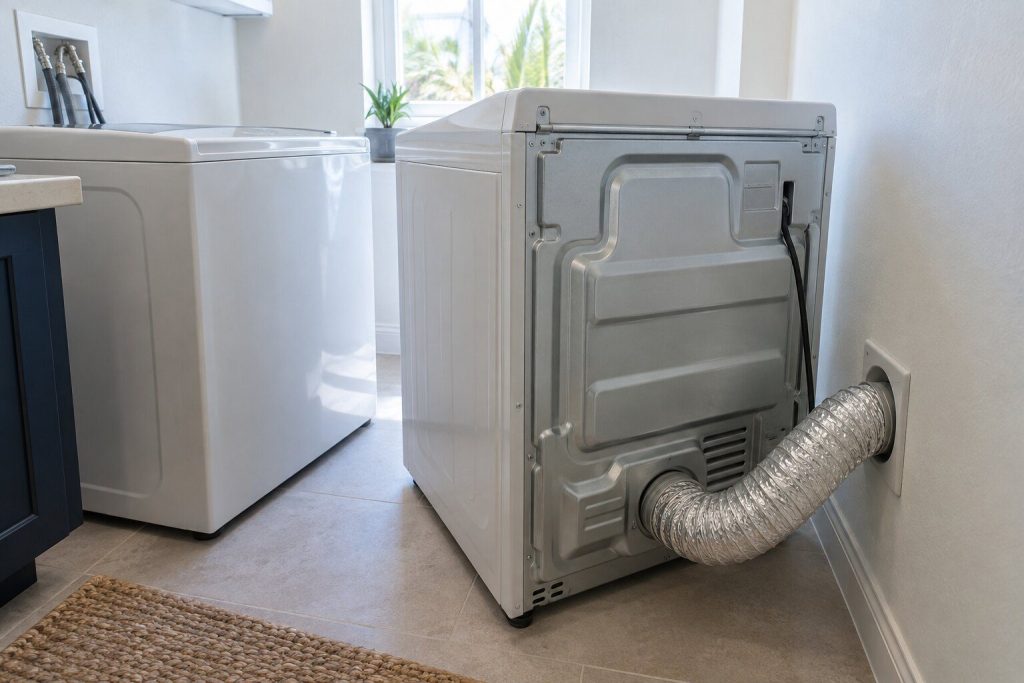
  • The back of a dryer pulled forward from a laundry closet wall, its flexible vent hose visible running to the wall outlet, the washer beside it.
    Eleven dryers · gas and electric

    Dryers

    Eleven dryers — the largest single family in this maker's whole US line, bigger than every refrigerator, range and dishwasher it sells put together. Electric and gas at each of the 300, 400, 500, 600 and 700 Series, all at 8.0 cubic feet, plus a 24-inch compact at 4.0. Four more machines are laundry towers, where the washer and dryer are one unit. This badge also publishes a dryer error code guide, which its mass-market sister does not publish at all — seven rows, and three of them send you back to the installer rather than to a repair company.

    • Eleven dryers plus four towers — the deepest family in the line
    • A published seven-row code guide, which the sister badge does not have
    • EF1 is airflow, and in a condominium that is the vent run rather than the machine
    Dryer repair
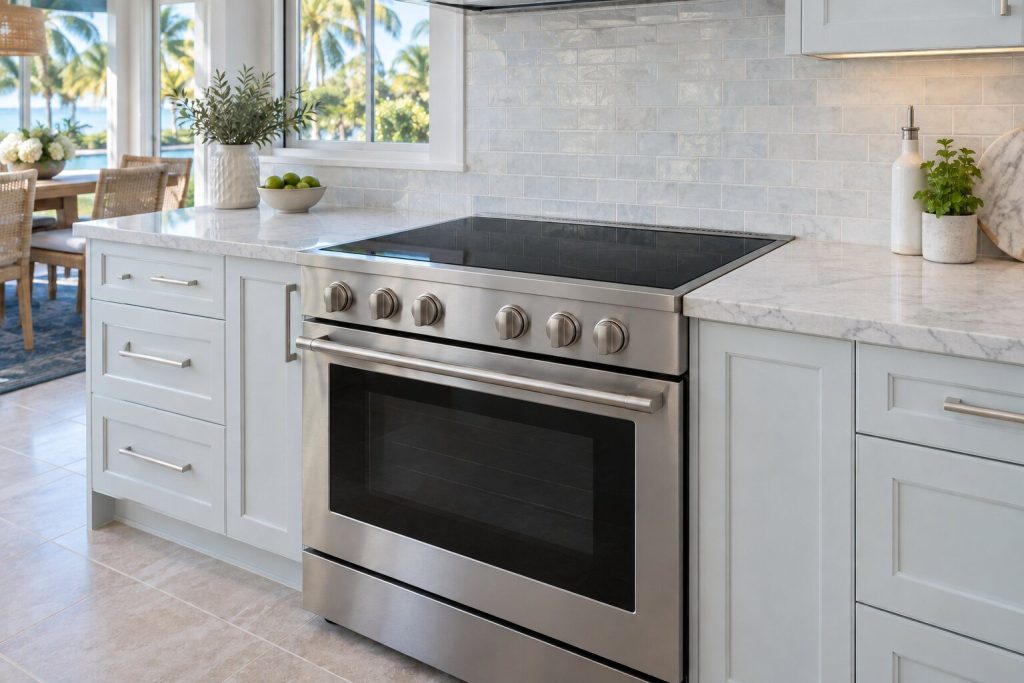
  • A 36-inch stainless freestanding induction range set between pale cabinets, its smooth black glass cooking surface clean and empty, front control knobs along the fascia.
    Induction · dual-fuel · gas, 30 and 36 inch

    Ranges

    Six ranges, at 30 and 36 inches, in three fuels: induction, dual-fuel and front-control gas. There is no electric coil range and no plain radiant range in this line at all — which is precisely the machine that fills the rental kitchens its sister badge sells into. A 36-inch range is a deliberate purchase and usually the center of the room, and that shows in how these calls come in: people describe what the range was doing when it stopped, not just that it stopped. Almost every published range code on this badge is a name plus a power cycle, so the honest page says that rather than inventing a checklist.

    • Six ranges — induction, dual-fuel and gas, at 30 and 36 inches
    • No electric coil and no plain radiant range is built on this badge
    • Most published range codes are a name and a thirty-second power cycle
    Range repair

Worth saying

Several of these end with us telling you not to book

A dishwasher counting down from a number between one and twenty-four has a delay start running. A dishwasher showing Hd is heating water and will begin on its own. A washer rinsing over and over is clearing foam and is working correctly. An oven that lights up and never warms may simply be in demo mode.

None of those is a repair, and all four are on this site because a visit to be told so is a visit nobody should pay for.

Before you book

The questions this page is asked

Do you work on the built-in range that came before the current line?

Yes, and a good deal of what we open is exactly that. The ICON-era built-in cabinets and the 15-inch under-counter units are still in kitchens across this region, and parts for them are still reachable. We will tell you honestly when a particular part is not.

Why is there no range-hood service here?

The owner's appliance list does not grant this site that type, even though the maker sells hoods. We would rather say that plainly than let the absence look like an oversight. The over-the-range microwave, which is also a vent, is covered.

Is the diagnostic really credited?

Yes. If you go ahead with the repair, the diagnostic comes off the bill. If the answer is that the machine is not worth repairing, you have paid for the answer rather than for a part, and we will say so plainly.

In more detail

How this list was decided, and what is not on it

Weighted like the catalog, not like a price list

55 jobs, and they lean the way this maker’s own range leans. 22 current laundry machines against 6 refrigeration cabinets is an unusual shape for an appliance brand, and it is the reverse of the volume badge in the same corporate group. So drains, pumps, door locks, vents and moisture sensors take more of this list than defrost and condensers do. An even spread would have been tidier and less true.

Two jobs that are here because the appliance is built in

Access to a column or a counter-depth cabinet is a service of its own on this site rather than an invisible line inside somebody else’s quote, and so is a laundry tower, where two machines share one cabinet and you cannot replace half of it. Both exist because of what this maker actually sells.

What a starting figure is

Every number on these pages is a from. The diagnostic is from $95, credited toward the repair, and no final price is published anywhere on this site — the cost is measured at your machine and agreed in writing before anything is opened.
Not sure which of these it is?

Describe what the machine is doing and we will tell you which page you are on — and whether it is a job at all. If a diagnostic is the right next step it is from $95, credited toward the repair.
This article is based on:

  • Official manufacturer documentation
  • Internal repair procedures
  • Technician repair history
  • Company quality standards
Call (305) 912-9018