Appliance
Electrolux ranges
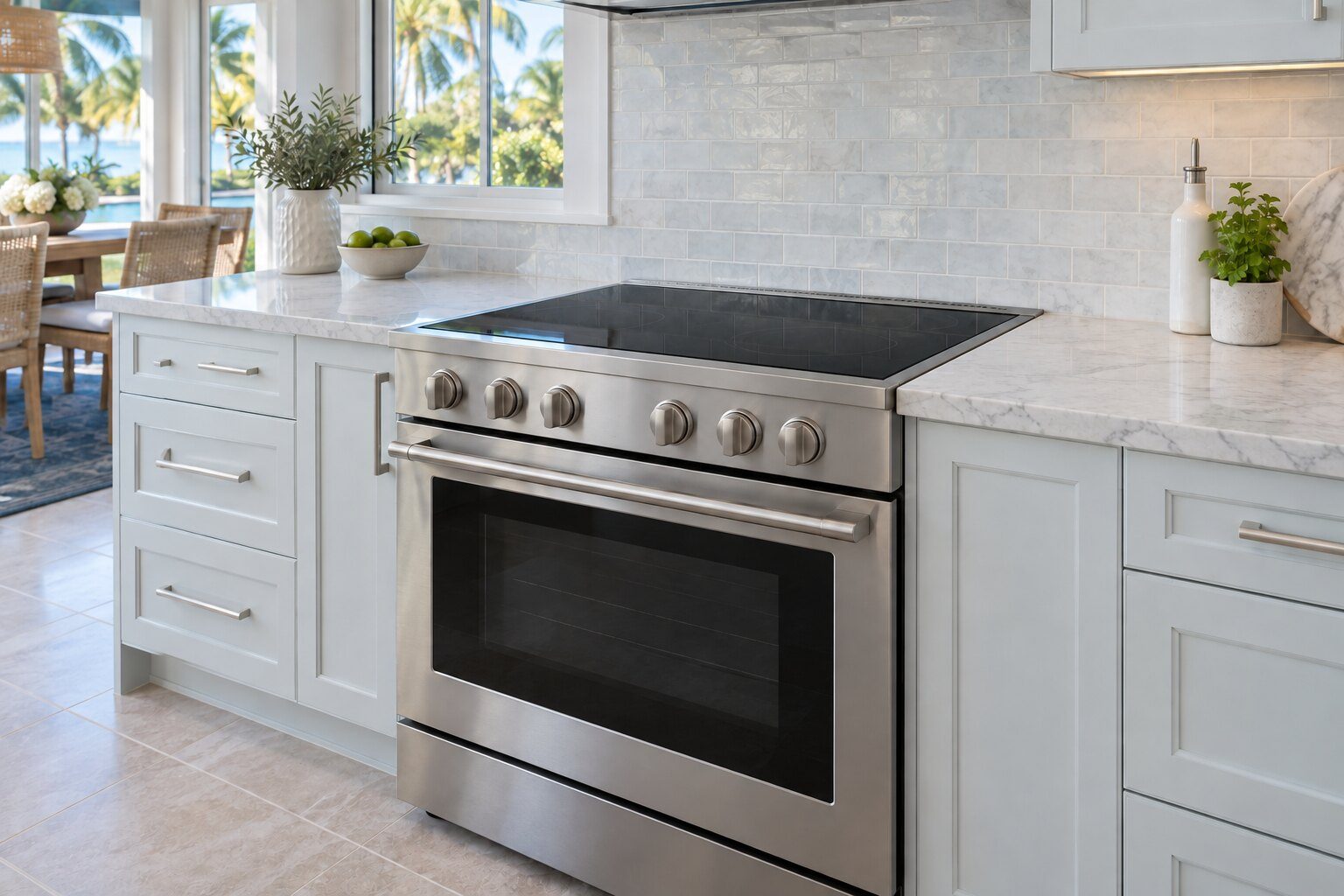
Six ranges, at 30 and 36 inches, in three fuels: induction, dual-fuel and front-control gas. There is no electric coil range and no plain radiant range in this line at all — which is precisely the machine that fills the rental kitchens its sister badge sells into. A 36-inch range is a deliberate purchase and usually the center of the room, and that shows in how these calls come in: people describe what the range was doing when it stopped, not just that it stopped. Almost every published range code on this badge is a name plus a power cycle, so the honest page says that rather than inventing a checklist.
- 4 symptoms we are called out to
- From $95 diagnostic, credited to the repair
- 59 cities and neighborhoods covered
- OEM parts available on order
The short version
What this equipment is, for a repair
Configurations
Induction · dual-fuel · gas, 30 and 36 inch
Access
Planned before the visit, not discovered on arrival
Parts
OEM, available on order
Diagnostic
From $95, credited to the repair
What goes wrong with it
Symptoms we are called out to on Electrolux ranges
Each one covers the likely causes in the order they are worth checking, and what to do in five minutes before booking anything.
-
It lights up, it counts down, and it stays cold Oven not heating
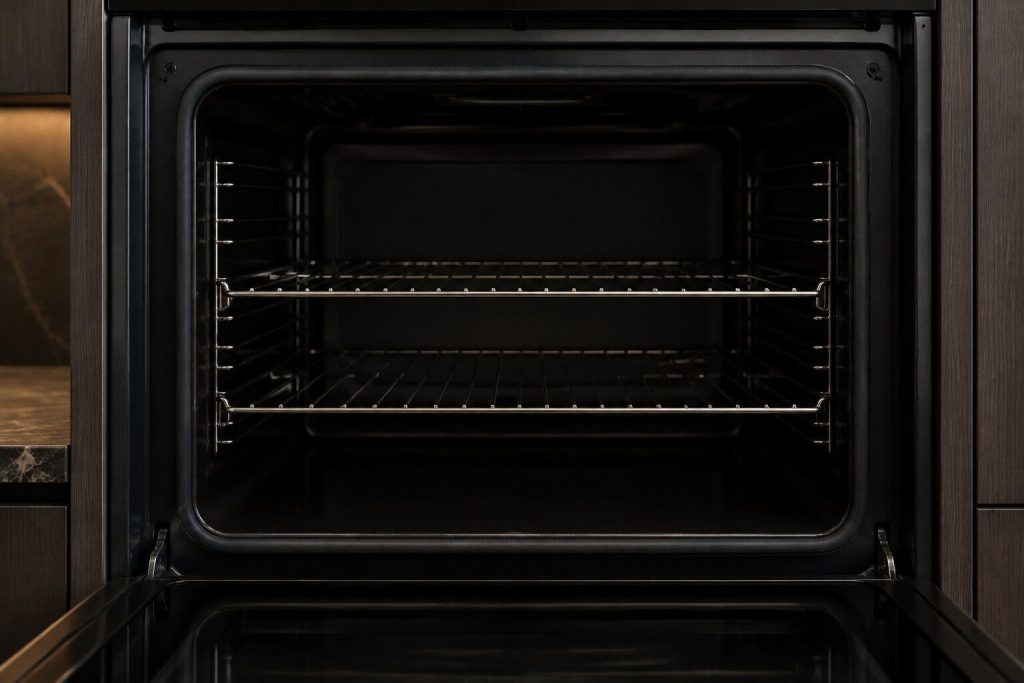
Two free answers come before any of the expensive ones on this badge. Demo mode accepts every setting and counts down a preheat without heating at all, and it reaches kitchens on floor models and by an accidental button combination during setup. And F10 on the stone-baked pizza ovens is frequently the Pizza Shield in the wrong rack rather than anything wrong. Both are published by the maker and both cost somebody a call-out every year.
- Demo mode is free to rule out and it is a genuine cause
- F10 on a pizza oven is often an accessory in the wrong rack
- On a new kitchen, a cold new oven is very often neither
-
After a clean cycle, and it will not open Oven door locked shut
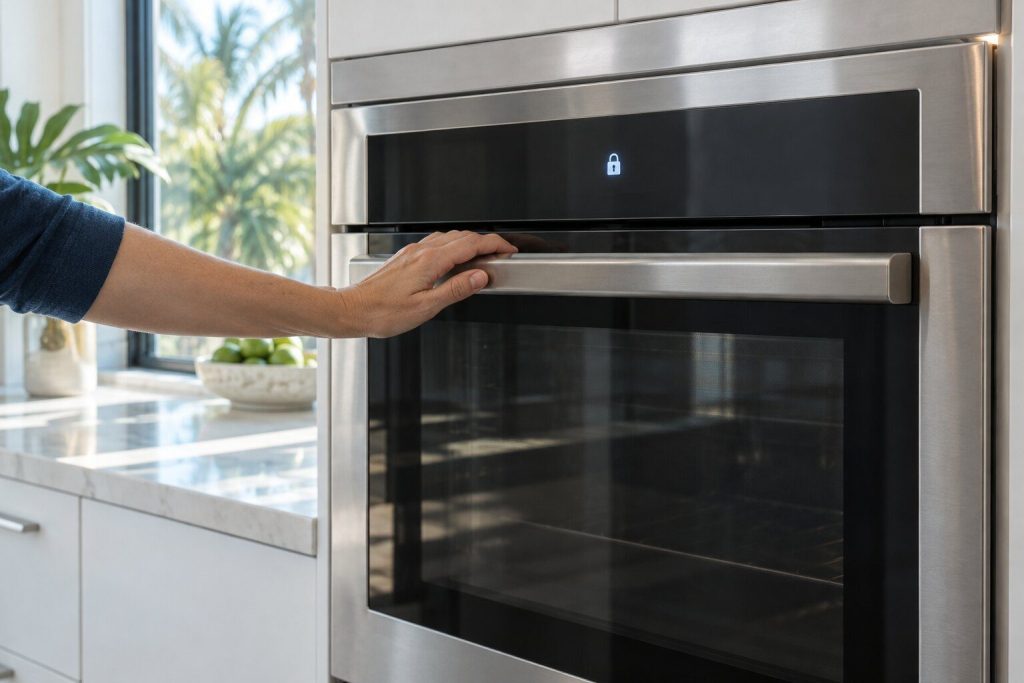
Five codes — F90 through F94 — describe one mechanism: the small motor and cam that bolt the oven shut for a clean cycle. Nearly every one of them arrives the morning after a self-clean, because that is the only occasion the latch is asked for everything it has. The maker's own route out is the UNLOCK key, and on these ovens the screen hands you a code to type back.
- F90 to F94 are five numbers for one latch
- They nearly all appear the morning after a self-clean
- Levering the door turns one part into a door, a hinge and a liner
-
It clicks and clicks and nothing happens Gas burner will not light
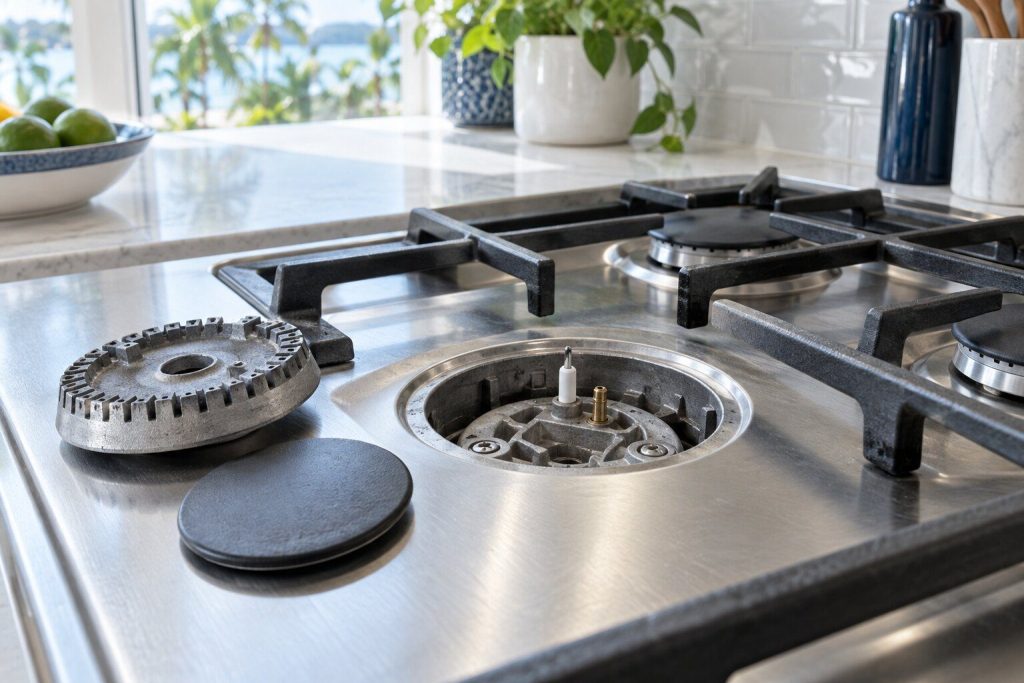
The igniter is working, so the problem is the gas or the port rather than the spark. On a sealed burner the usual pair is a clogged port or a cap that went back very slightly out of true after somebody cleaned the hob — and both are free to correct. If one burner lights and another does not, you have already done most of the diagnosis yourself.
- Clicking means the igniter is fine — look at the gas and the ports
- A burner cap seated slightly off after cleaning is very common
- All burners clicking when one is turned is normal on these
-
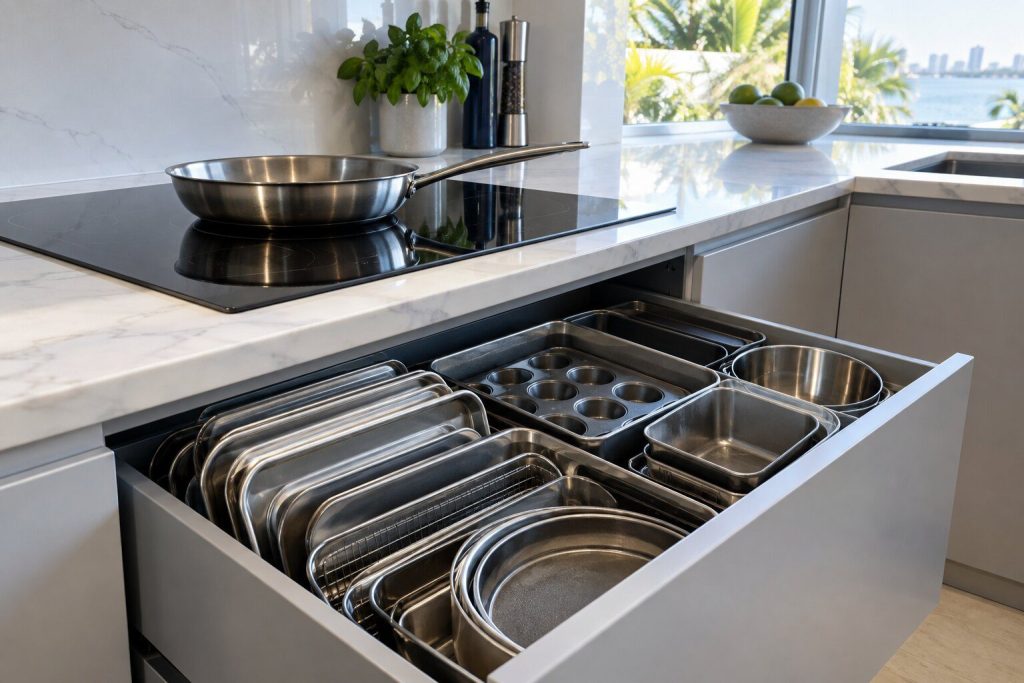
It heats for a moment and then stops Induction zone shuts off
Usually the cooktop protecting itself rather than failing, and two of the ordinary causes are free. Induction zones shut down on their own temperature, and the commonest reason they get hot is a blocked cooling path underneath — a drawer packed tight against the unit is enough. The other is a pan too warped to couple properly. Every glass cooking surface on this badge is induction; none of the general advice about radiant tops applies.
- No radiant cooktop exists on this badge — this is induction
- A drawer packed against the underside is a genuine cause of shutdowns
- One dead zone means one power stage, not the whole board
What we do on it
Repairs we carry out on Electrolux ranges
Starting figures for this equipment in South Florida. The exact cost is confirmed after an on-site diagnostic — and this is not the whole list of what can go wrong, so call if your problem is not here.
-
from $95 Diagnostic visit
Finding out what has actually gone wrong, before any part is named or priced. On this badge the opening question is usually about access rather than age: a counter-depth cabinet scribed into an opening, a column captured behind a trim kit, a wall oven sitting in a tall unit — each has to be brought far enough forward to be reached, and establishing that in advance is what separates one appointment from two. The charge is credited against the repair if you go ahead. Where our honest recommendation turns out to be that the machine is not worth mending, you still get that recommendation, and the charge does not change.
- Access comes first — built-in equipment is most of what this badge sells
- A written figure ahead of the work, credited against the repair
- If mending it is the wrong call we tell you, rather than selling a part
-
from $149 Appliance maintenance
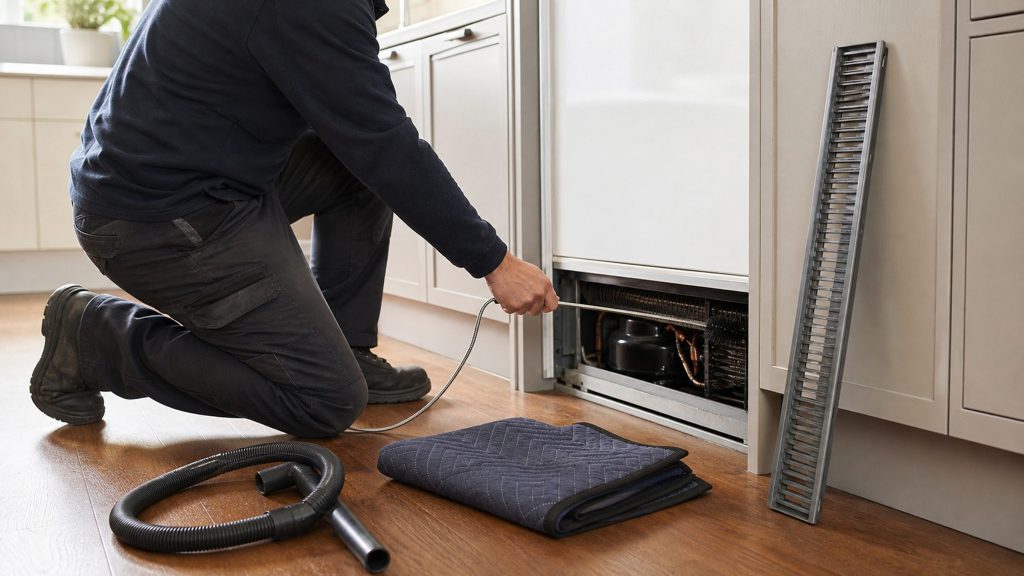
Scheduled work on the parts that fail from accumulation rather than from age: condenser coils in salt air, a dryer duct that has been narrowing for four years, a dishwasher sump, the fold in a washer door seal that never dries out in this climate. On a kitchen where the appliances were specified together it is worth doing them together — the visit costs less than the sum of its parts and it catches the one that was about to fail.
- Coils, ducts, sumps and seals — the parts that fail from accumulation
- Worth doing as a suite when the kitchen was specified as one
- Finds the failure that was three months away, which is the actual value
-
from $175 Appliance installation
Fitting an appliance properly, which on this badge usually means fitting it into something. Columns go behind trim kits, counter-depth cabinets go into openings that were drawn for them, wall ovens and built-in microwaves go into tall units, and every one of those has a clearance and an air path that the appliance depends on. This maker sends three of its own washer codes and two of its dryer codes back to whoever installed the machine — which is a fair measure of how much installation decides here.
- Built-in work: trim kits, openings, clearances and air paths
- Five of this maker's published codes are installation problems, not failures
- Supply, drain and vent checked and documented rather than assumed
-
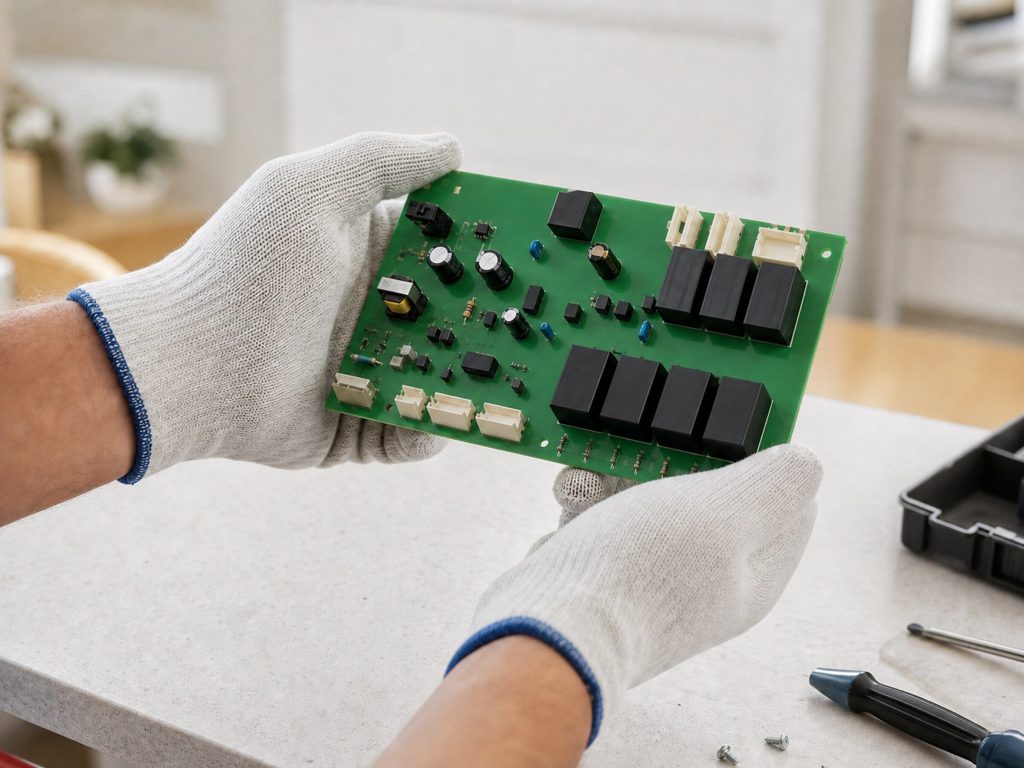
from $245 Control board repair
When the board is genuinely the answer — and it is worth saying that it often is not. A great many appliances condemned as "a board problem" have a sensor lying to a board that is working perfectly. This maker helps here more than most: F12, F13 and the F3/F20/F26 family are published as board-level conditions by name, so when one of them is on the display the diagnosis has a document behind it rather than an assumption.
- Named board conditions — F12, F13 and the communication family
- Most "board problems" are a sensor telling a healthy board something false
- Connectors and harnesses checked before anything is ordered
-
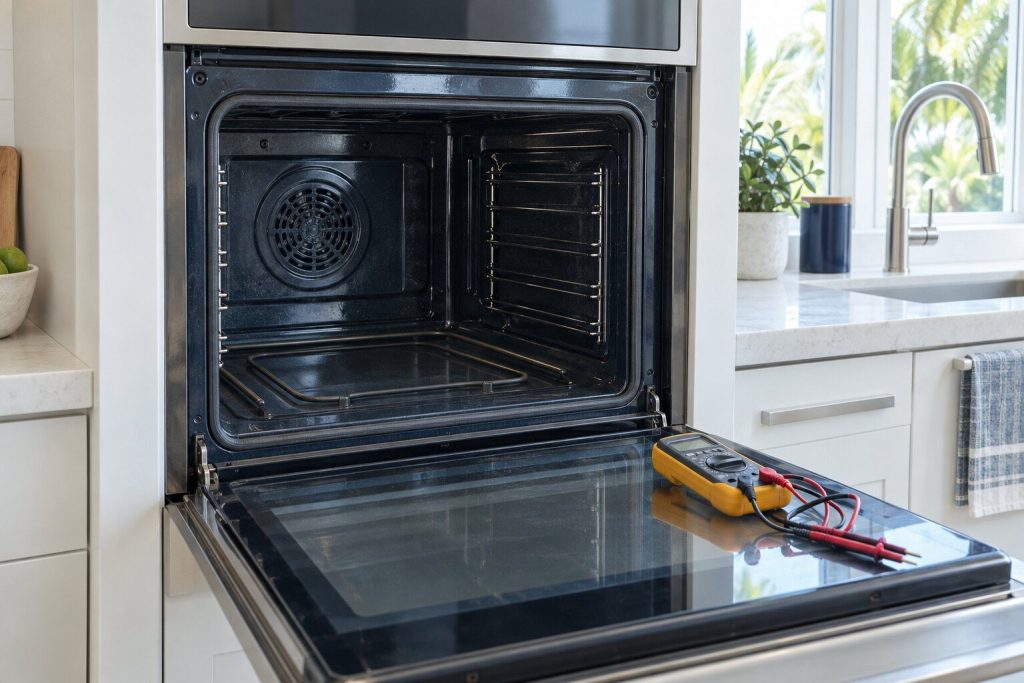
from $165 Oven not heating repair
An oven that stays cold, heats slowly, or heats and then quits part-way. Before any of the expensive answers there are two free ones on this badge worth ruling out: demo mode, which accepts every setting and counts down a preheat without heating at all, and F10, which on the stone-baked pizza ovens is frequently the Pizza Shield in the wrong rack. Both are published by the maker and both cost somebody a call-out every year.
- Demo mode and the Pizza Shield are free to rule out and often the answer
- Element, sensor, relay, control — in that order and not the other way
- A wall oven in a tall cabinet costs access before it costs parts
-
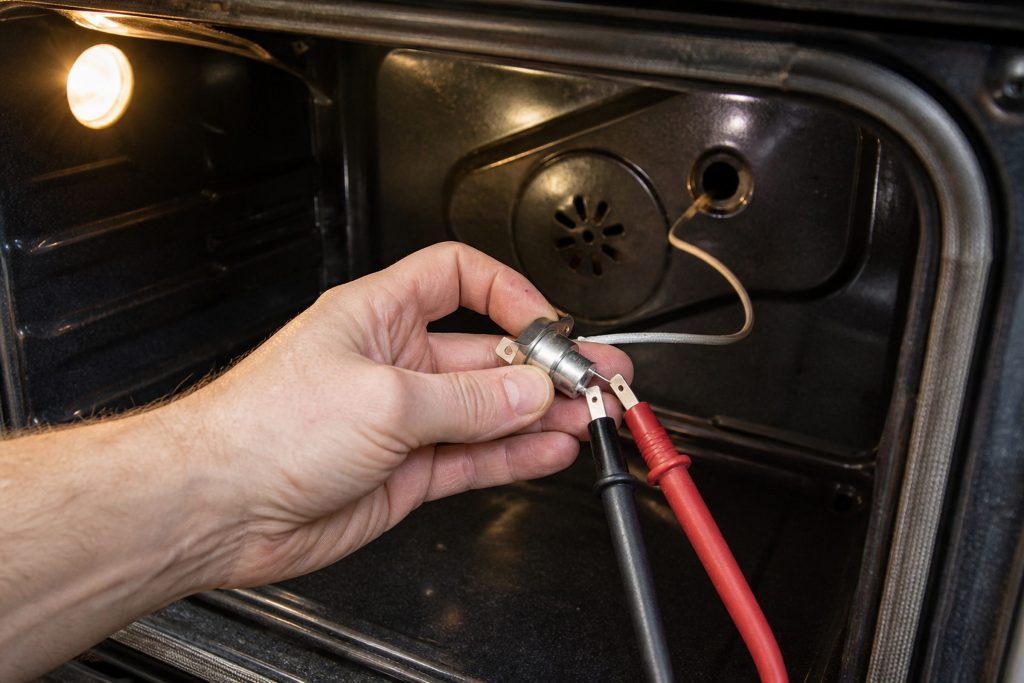
from $139 Oven temperature and calibration
Everything comes out consistently wrong by about the same amount, or a recipe that worked for years has stopped working. That is calibration, and it has two ordinary causes: the sensor drifting, or the control losing what it was calibrated to — which is precisely what F13 reports on this maker. Worth knowing on a double oven that the two cavities have separate sensors, so one being right tells you nothing about the other.
- Consistently wrong by a fixed amount is calibration, not a failure
- F13 is the maker's code for the control losing its calibration
- On a double oven the two cavities are measured separately
-
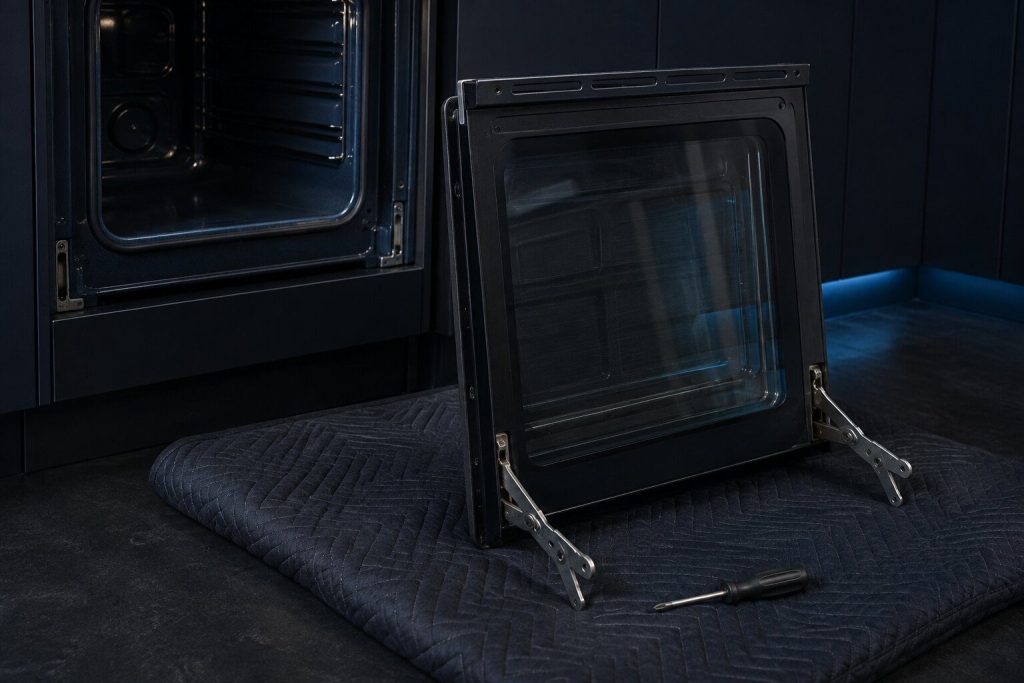
from $159 Oven door and hinge repair
A door that will not close flush, one that drops open, or a glass panel that has misted between its layers. All of it is heat management: a door that does not seal lets the cavity lose heat unevenly, which shows up as food browning on one side long before anybody thinks about the door. The hinges carry real weight on a 30-inch double oven, and they are replaced in pairs because one new hinge against one aged one puts the door out of true.
- Uneven browning is a door problem more often than an element problem
- Hinges are replaced in pairs, always
- Misting between the glass panels is a seal, and it is serviceable
-
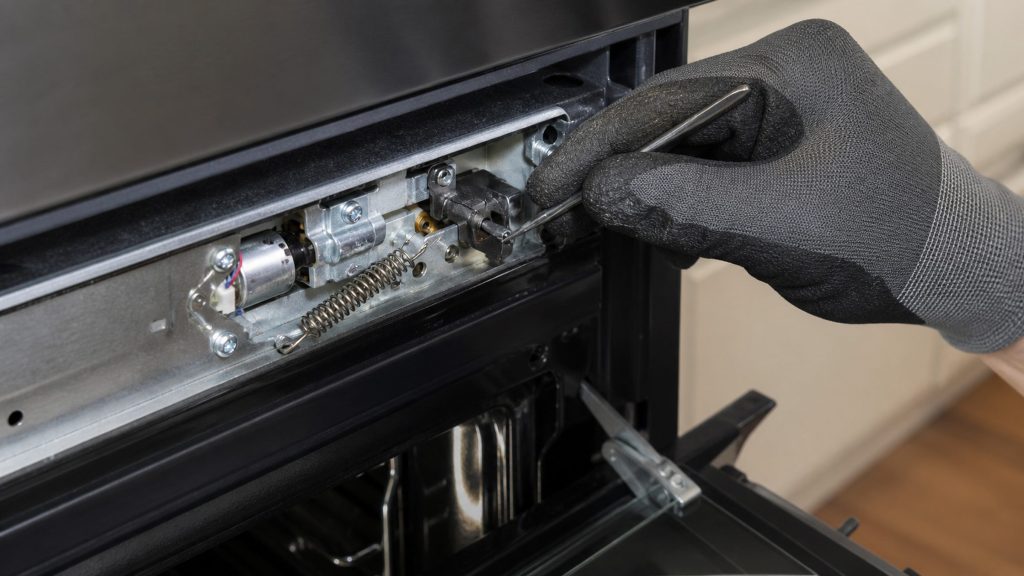
from $165 Self-clean and door lock repair
Five of this maker's codes — F90 through F94 — describe one mechanism: the motorized latch that bolts the oven shut for a clean cycle. Nearly every one of them arrives the morning after a self-clean, because that is the only occasion the latch is asked for everything it has. The maker's own route out is the UNLOCK key, and on these ovens the screen hands you a code to enter back. What it is not is a door to lever.
- F90 to F94 are five numbers for one latch mechanism
- They nearly all appear the day after a self-clean cycle
- Levering the door turns one part into a door, a hinge and a liner
-
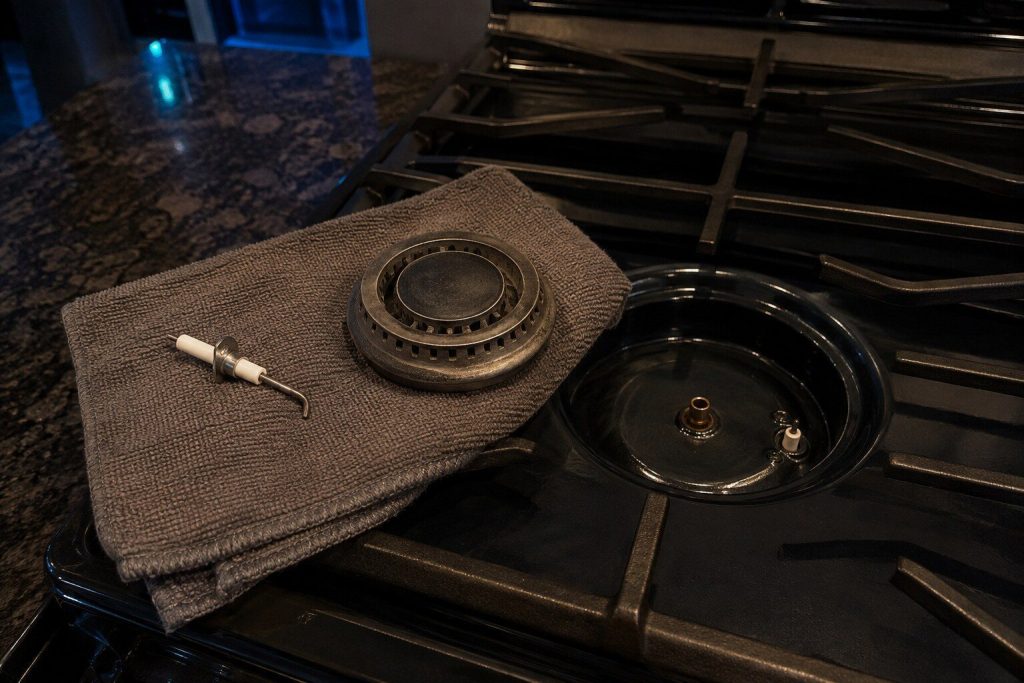
from $145 Gas burner and igniter repair
Clicking that never lights, a burner that lights and goes out, or a flame that is yellow and lazy where its neighbors are blue. On a sealed burner the ordinary pair is a clogged port or a cap that went back very slightly out of true after a clean, and both are ordinary work. The gas rangetop and the drop-in cooktops on this badge share burner design, so the diagnosis carries across — the access does not.
- A clicking burner and a silent one are different parts
- Cap seating after a clean is a real and frequent cause
- Yellow flame is air or ports, and it is worth attending to
-
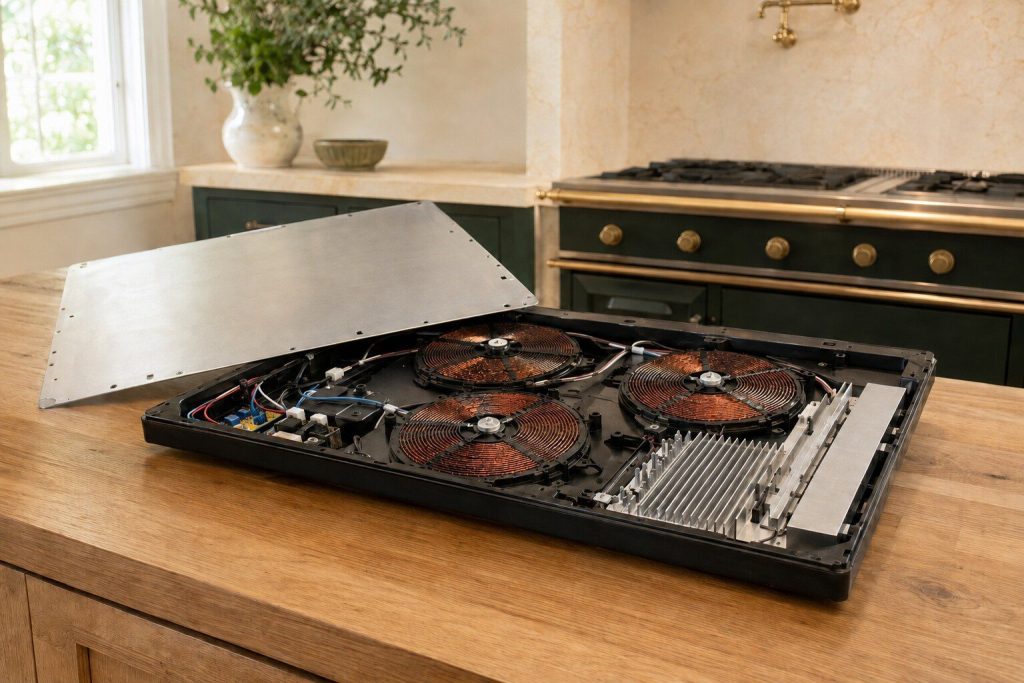
from $195 Induction cooktop repair
Every glass cooking surface on this badge is induction — there is no radiant element in the line at all — and it fails in ways a radiant top does not. Zones that heat for a moment and cut out are usually the unit protecting itself: a blocked vent underneath, often a drawer packed tight against it, or a pan too warped to couple properly. Both are free to rule out. Beyond that, zones are driven by their own power stages, so one dead zone is good news rather than bad.
- There is no radiant cooktop on this badge — general glass-top advice does not apply
- Cutting out is usually thermal protection, and often a packed drawer
- One dead zone means one power stage, not the whole board
-
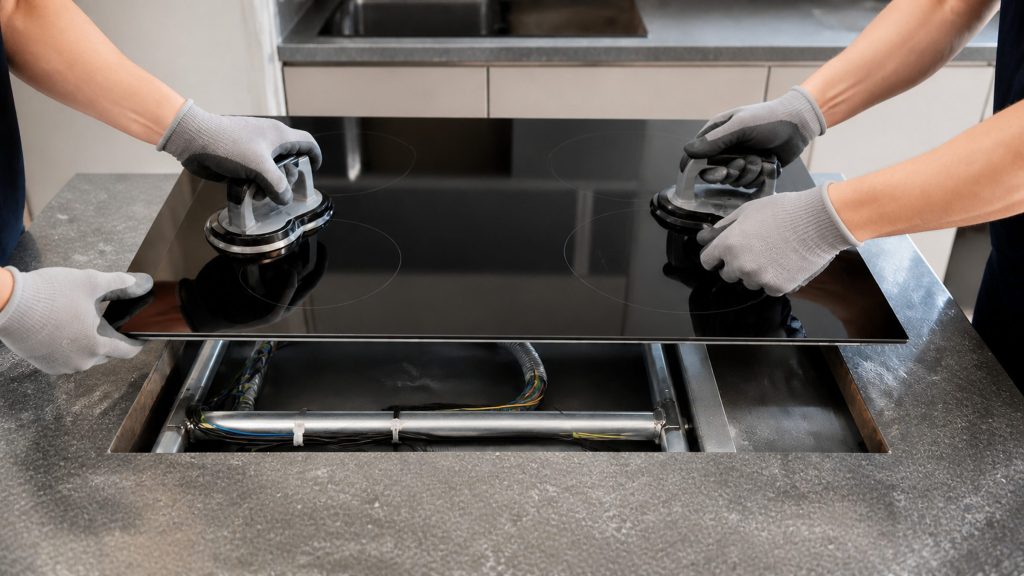
from $275 Cooktop glass replacement
A cracked or chipped induction surface is a part, and a replaceable one — but it is among the more expensive single parts on the appliance, so it deserves an honest conversation rather than an automatic yes. We quote the glass against the value of the unit and tell you which way we would go. In the meantime a cracked top should not be used: the glass is structural and the electronics beneath it are not meant to meet anything spilled.
- Replaceable, but one of the costlier parts on the appliance
- Quoted against the value of the unit, with a recommendation
- A cracked top should not be used in the meantime
-
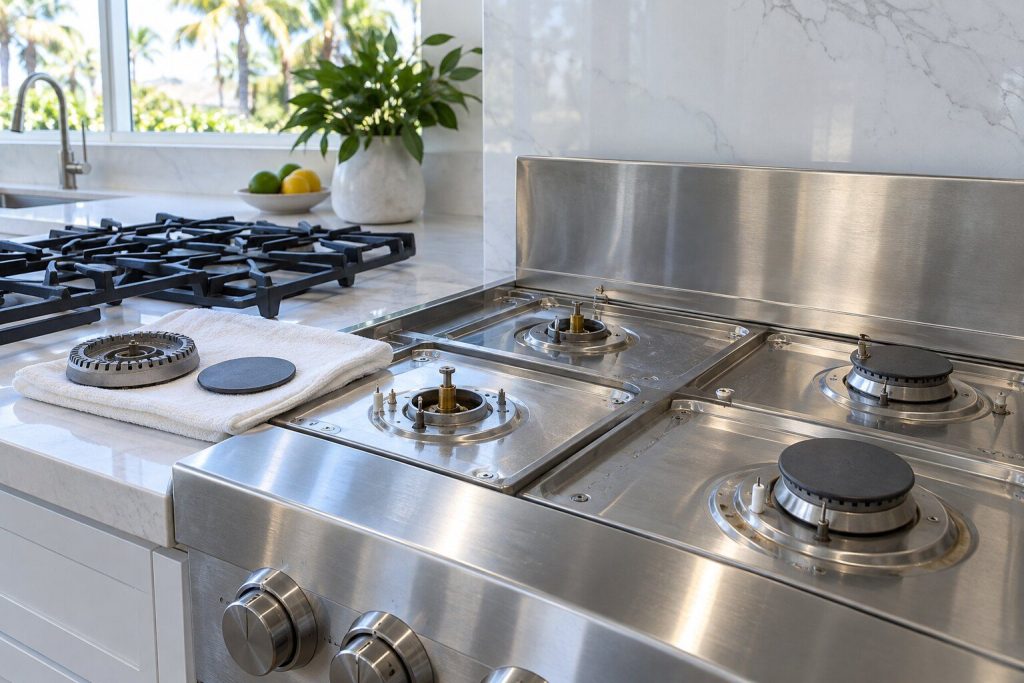
from $185 Rangetop service
One of this maker's five cooking surfaces is a 36-inch gas rangetop, and it is not a cooktop with a different name. It is deeper, it has a raised back panel and its own controls, it sits in a counter run with the oven built in somewhere else, and its parts are its own. When somebody books a cooktop repair and we find a rangetop, the visit usually has to be repeated with the right parts — so we ask when the appointment is made, and this page exists so the distinction is findable.
- A rangetop is a different appliance from a cooktop, with its own parts
- 36 inches, raised back panel, its own controls, deeper than a drop-in
- Telling us which you have avoids a repeated visit
In more detail
About Electrolux ranges
No coil range, and why that changes the site
The cheapest range this make builds is a front-control gas model at 30 inches. There is no coil-top range and no plain radiant one anywhere in the line. That means every range we attend on this badge is induction, dual-fuel or a sealed gas burner — three technologies with three different sets of failures, and none of them the ones general appliance advice is written about.
Why so many codes end in a power cycle
Read this maker's own range guide and most entries are a title and thirty seconds at the breaker: F1 shorted key pad, F12 micro identification, F13, F30, F31. That is what the manufacturer publishes and so it is what our pages say. Where a code genuinely has a procedure behind it — the door-lock family, F10 — we write the procedure. Where it does not, we do not invent one, and the archive of codes on this site is explicit about which is which.
This article is based on:
- Official manufacturer documentation
- Internal repair procedures
- Technician repair history
- Company quality standards
Before you book
Questions about Electrolux ranges
The panel shows a dash and nothing responds.
That is the lock, not a failure. Press and hold OFF for a full six seconds — most people let go at three, which does nothing and proves nothing. If a self-clean has just run, the door stays locked through the cool-down and that is correct. A locked range and a dead range look identical from across a kitchen.
Induction: one zone has stopped and the others are fine.
Good news, in diagnostic terms. Induction zones are driven in pairs or singly by their own power stages, so one dead zone points at that stage or its sensor rather than at the whole board. It also means the range is still usable while the part is coming, which matters when it is the only cooking in the house.
Dual-fuel: the oven is fine but a burner will not light.
On a dual-fuel range the top is gas and the oven is electric, so the two have almost nothing in common — one failing says nothing about the other. A single burner not lighting is usually the igniter or a blocked port, and both are ordinary work. Tell us whether it clicks, because a clicking burner that will not light and a silent one are different parts.
It shows F10 and I have a pizza mode.
Worth checking first, because this maker names it: on the stone-baked pizza ovens F10 is frequently the Pizza Shield sitting in the wrong rack rather than anything wrong. Confirm it is in position 7 before you assume the worst. On any other oven F10 means the cavity is reading hotter than it was asked for, and that is not one to keep resetting past.
Where we do it
Across Miami-Dade, Broward, and Palm Beach
Same terms everywhere we go: an on-site diagnostic first, the price agreed in writing, and the exact figure confirmed once we have seen the unit.
Neighborhoods people ask for by name