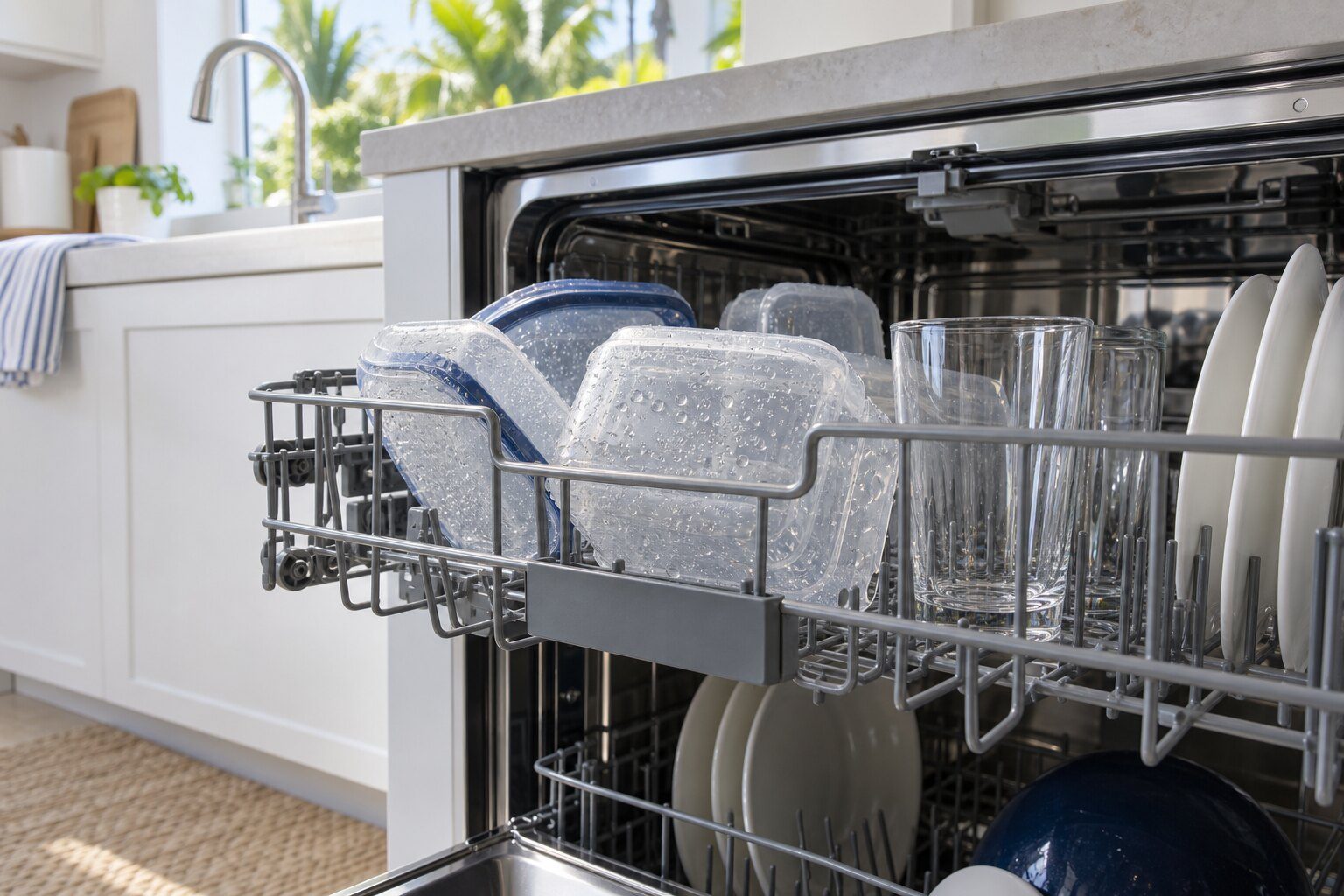
- “Wet plastics are the design, not a failure”
- “Everything wet, or a permanent Hd, is the heater or its control”
- “Rinse aid is doing more work here than people realize”
Symptom
Electrolux dishes coming out wet
Plastics coming out wet is how these machines work and it is worth saying plainly rather than treating as a failure. They dry with residual heat rather than a blast of hot air, so glass and china give up their water and plastic does not. What is not normal is everything wet, or a machine that sits on Hd for half an hour and then washes cold.
- From $95 diagnostic, credited to the repair
- 59 cities and neighborhoods covered
- OEM parts available on order
- In writing the price, before anything is opened
Three ordinary causes
What this usually turns out to be
Cheapest and commonest first, which is also the order we check them in. They sit hundreds of dollars apart, and only the unit settles which one is yours.
-
It is only the plastics
Residual-heat drying cannot get plastic hot enough to evaporate what is on it. Nothing is wrong and nothing needs fixing.
Dishwasher drying and heat repair from $145 -
The rinse aid is empty
It changes how water sheets off a surface, and on these machines it is a genuine part of the drying rather than an optional extra.
Dishwasher wash performance from $129 -
The heater is not working
Everything wet, plus a wash that never gets hot, plus an Hd that never clears. That is the repair.
Dishwasher drying and heat repair from $145
In five minutes
Before you call anybody
None of it needs tools, and all of it makes the visit shorter.
-
01
Sort the load by material
If china and glass are dry and plastic is not, the machine is behaving correctly.
-
02
Check the rinse aid
It is the single most effective free change on this symptom.
-
03
Time the Hd delay against the inlet temperature
One to two minutes per degree is the maker's figure, and it makes a long wait explainable.
How it shows up
What people describe when they call
A shortcut
Narrow it down before anybody arrives
A description of the behaviour leaves a few possible causes. A code names the subsystem before anybody opens anything, which is why it is worth photographing before it clears.
If there is no code at all
On a dishwasher, the data plate is on the edge of the door — open it and look along the top or the side. All models
In more detail
About Electrolux dishes coming out wet
What to do in the next ten minutes
Establish what is actually wet — plastics only, or everything. Check the rinse aid reservoir is not empty. Run the kitchen tap hot before the next cycle and see whether the Hd delay shortens.
Residual heat, and what it cannot do
These dishwashers heat the final rinse and then let the load's own warmth evaporate the water. Ceramic and glass hold a lot of heat and dry themselves. Plastic holds almost none, cools immediately, and keeps every drop. No setting changes the physics — a rinse aid that helps water sheet off is the only real lever, and opening the door at the end of the cycle does more than anything a technician can fit.
This article is based on:
- Official manufacturer documentation
- Internal repair procedures
- Technician repair history
- Company quality standards
Before you book
Questions about Electrolux dishes coming out wet
My old dishwasher dried plastics fine.
It probably had a heated drying element running a fan, which used considerably more energy. Condensation drying is the trade, and it is why these machines use what they use.
Is there a setting for extra drying?
Most models have a boost or extended dry option. It lengthens the cycle and raises the final rinse temperature — it helps, and it does not change the plastics much.
Where we do it
Across Miami-Dade, Broward, and Palm Beach
Same terms everywhere we go: an on-site diagnostic first, the price agreed in writing, and the exact figure confirmed once we have seen the unit.
Neighborhoods people ask for by name