Cost Expectations
How Long an Electrolux Washer Lasts, Measured in Loads
How long Electrolux washers last is a question that gives a useless answer in years and a good one in loads. Ten to thirteen years is the range a household machine typically reaches, and that assumes something like six to eight cycles a week. The same machine in a small building laundry doing forty cycles a week reaches the same total wear in roughly eighteen months, and nothing about that is a defect. What fails first is predictable and it is the order that matters: the drain pump, then the door lock, then the bearings. A building that knows that keeps a pump on a shelf and turns a three-day outage into an afternoon. What ends one of these machines is bearings, because that job is the tub, the drum and the seal together.
The full guide
How long do Electrolux washers last is a question where the number everybody wants is the least useful thing anybody can give them.
Years is the wrong unit
Ten to thirteen years is the honest range for a household machine, and it is nearly meaningless on its own, because it hides the assumption that does all the work: something like six to eight cycles a week.
Change that number and everything moves. A family of five doing fourteen loads a week is running the machine at twice the rate the estimate assumed. A couple doing four is running it at half.
So the first question to ask about any lifespan figure — including ours — is how many washes a week it was calculated on.
What that means in a building
This is where the arithmetic becomes startling.
A front-load washer in a small building laundry runs perhaps forty cycles a week. That is five or six times a household rate, which means it reaches in roughly eighteen months the total wear a family kitchen reaches in ten years.
Nothing is wrong with the machine. It is not a defect, it is not misuse, and replacing it with an identical one changes nothing except the date of the next conversation. Domestic machines on commercial duty wear at a commercial rate, and that is arithmetic rather than quality.
The order things fail in
Predictable, and useful precisely because it is predictable.
The drain pump goes first. It is the hardest-working single component and the one most exposed to what comes off the laundry — in a coastal household, sand as much as lint.
Then the door lock. It engages and releases on every cycle, and forty cycles a week is forty thousand operations in a few years.
Then the bearings, and that is the one that ends the machine, because the job is the tub, the drum and the seal together.
A building that knows this order stocks a pump. One on a shelf turns a three-day outage — diagnose, order, return — into an afternoon.
What genuinely shortens a machine
Four things, all free to fix, all cumulative.
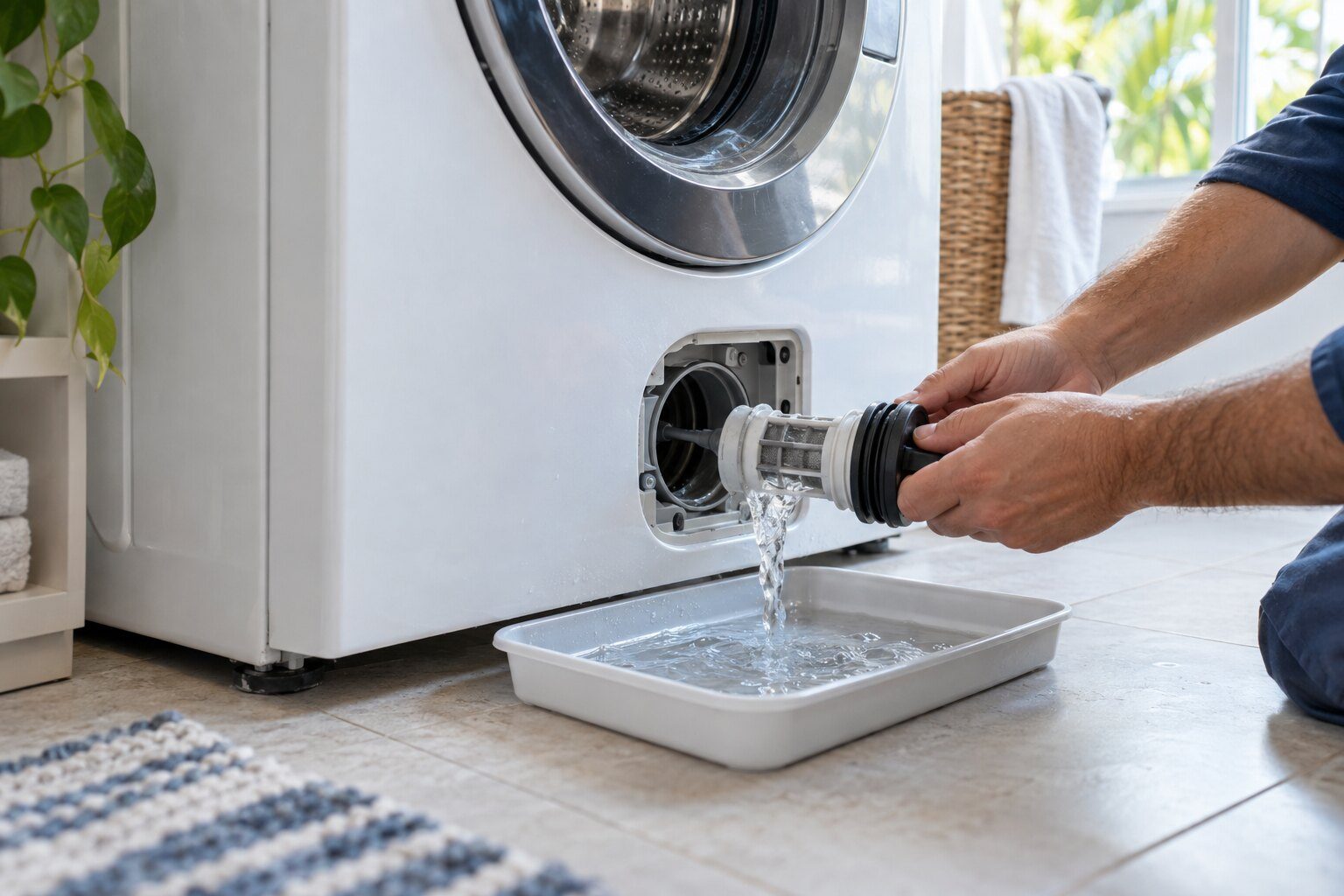
Overloading. Non-HE detergent, which cannot work in a drum that uses this little water at any dose. A machine that is not level under load, on a floor that flexes. And a pump filter that has never been opened — behind the panel at the bottom front, designed to be opened by the owner, opened by almost nobody.
The number we would actually give you
Not a year. Ask us how many loads a week the machine does, and we will tell you roughly where it is in its life and which part is due next.
That is a more useful answer than any figure on any manufacturer's page, and it is the only one that survives contact with a building.
If it turns out to be a repair
What this leads to, and what it costs
Every job on this site is priced the same way: an on-site diagnostic first, the figure agreed in writing before anybody starts.
-
from $175 Building laundry service
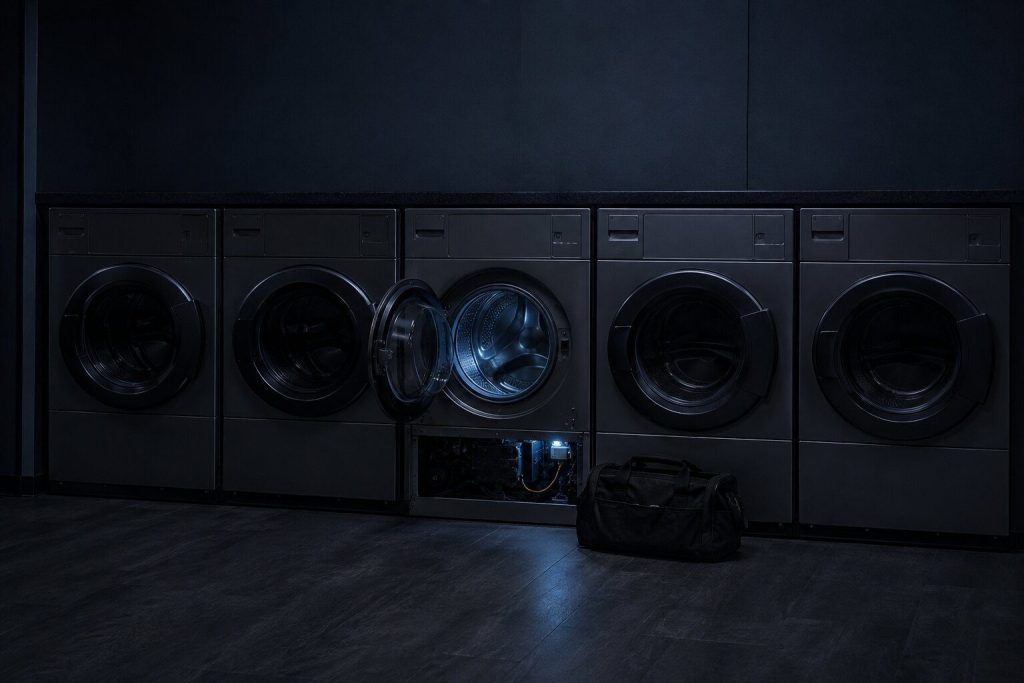
We are not Electrolux Professional — that is a separate business with its own dealers. What we do is the domestic machines on this badge that are doing commercial work, which in this region means a great many of them: building laundry rooms, staff kitchens, small offices. A washer rated for six cycles a week doing forty is not defective; it is reaching in eighteen months the wear a household would reach in ten years, and what helps is knowing which part goes first in that room.
- Domestic machines on commercial duty — not Electrolux Professional equipment
- Duty cycle rather than age decides what fails in these rooms
- Pumps, door locks and bearings go first, in that order
-
The same repair every few months in the same room Building laundry machine keeps failing
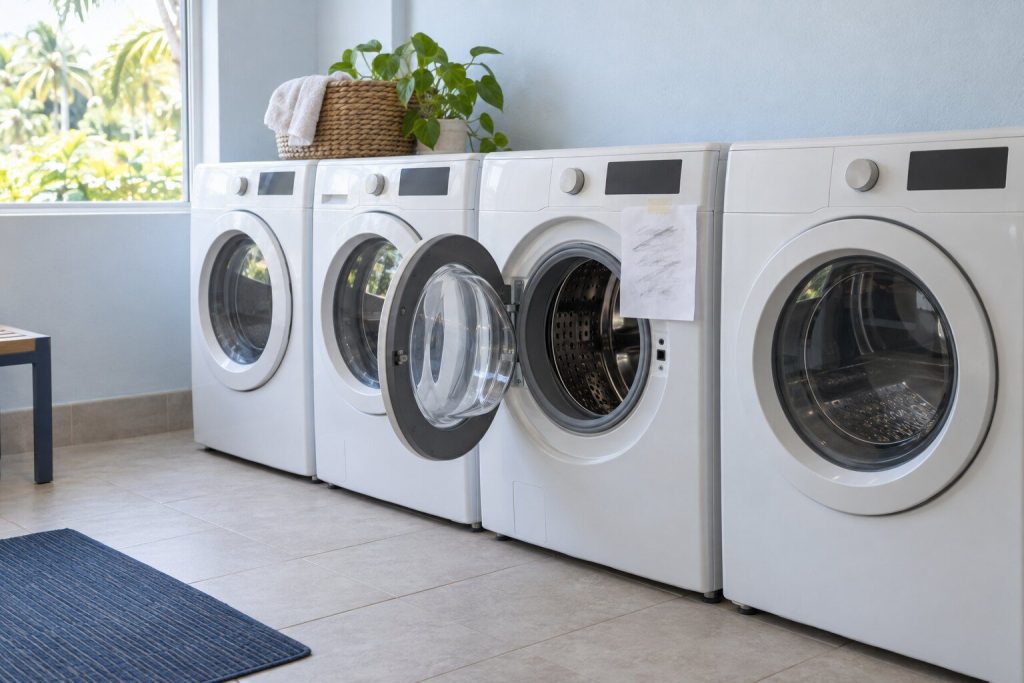
Not a defect, and saying so is the useful part. A front-load washer rated for six or eight cycles a week doing forty wears its pump, its door lock and its bearings at a proportional rate, so a machine that needs attention every few months in a building laundry is doing exactly what the arithmetic predicts. What changes the outcome is not a better machine — it is knowing which part goes first in that particular room and keeping one on a shelf.
- Duty cycle rather than age decides what wears in these rooms
- Pumps go first, then door locks, then bearings
- A part on a shelf turns a three-day outage into an afternoon
Questions people ask about this
Does a more expensive series last longer?
In a household, marginally. Under commercial duty, hardly at all — the cycle count dominates everything else. A 700 Series machine doing forty loads a week is a 700 Series machine doing forty loads a week.
What actually shortens it?
Overloading, non-HE detergent, an unleveled machine on a flexing floor, and a pump filter nobody has ever opened. All four are free to fix and all four are cumulative.
Is it worth replacing the pump twice?
In a building laundry, yes, several times. The pump is a fraction of the machine and the machine is a fraction of the room. That is why stocking one changes the economics of the whole laundry.
Cost Expectations
More guides like this one
-

A Cracked Induction Top: What It Costs and What Decides It
The glass is a part and it is replaceable. It is also among the costliest single parts on any appliance here, which is why the quote is published at its real level.
Read more -
What an Electrolux Service Call Costs in South Florida
The diagnostic here sits at the built-in band rather than the figure the volume badges of the same group carry, and the reason is countable: almost everything this maker sells has to be brought out of the kitchen first.
Read more -
The 24-Inch Pair in a Closet: Why Replacing Is Not One Number
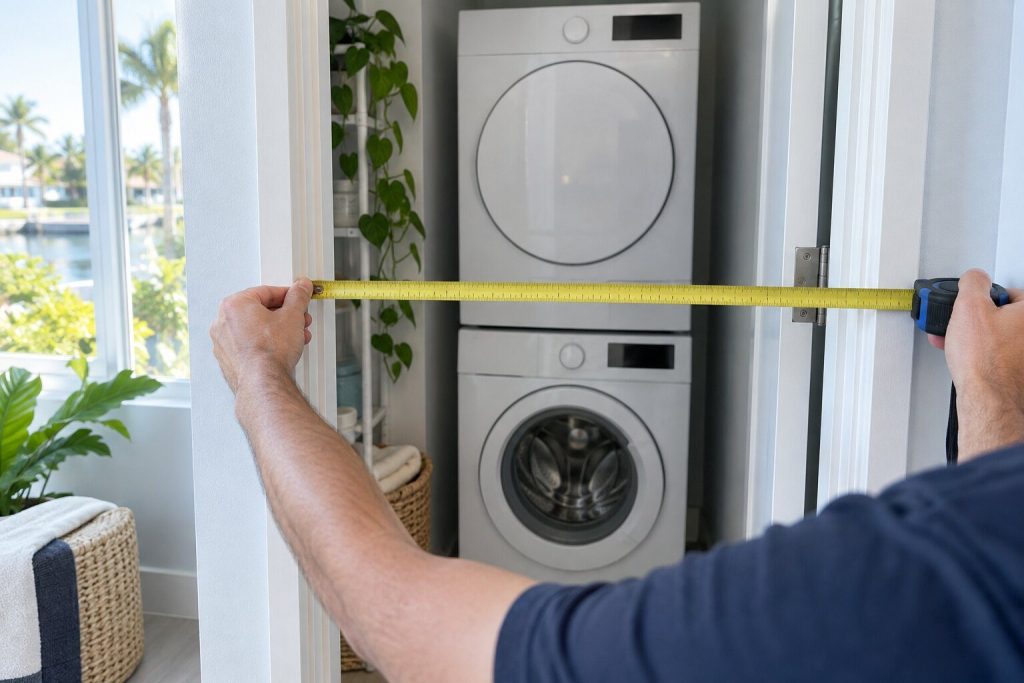
The compact pair is its own design and shares no parts with the full-size machines. In a closet built around it, replacement means the appliances, the stacking kit, the vent and sometimes the doorway.
Read more
Tell us the model number and what it is doing.
This article is based on:
- Official manufacturer documentation
- Internal repair procedures
- Technician repair history
- Company quality standards